
The Director Who Killed His Own Movie: Lawrence Turman and the Most Honest Press Tour of 1983
There's a reason you've never heard of the Lucie Arnaz comedy, Second Thoughts.


Hollywood runs on illusion.
Directors sell confidence. Producers sell certainty. Even bad movies are promoted like misunderstood masterpieces waiting for their audience to catch up.
Which is why Lawrence Turman — a man who helped bring The Graduate into existence — may be the most self-sabotaging director of the 1980s.
In an era before media coaching and publicists whispering “don’t say that” from the back of the room, Turman did the unthinkable while promoting his 1983 romantic comedy Second Thoughts.
He told the truth.
Not the curated version. Not the hopeful spin. The blunt, career-limiting truth — that his own movie didn’t quite work, that he could see its flaws clearly, and that he understood exactly where he’d gone wrong.
It was honesty so disarming, so casually destructive, that it effectively buried the film before audiences ever had a chance to discover it.
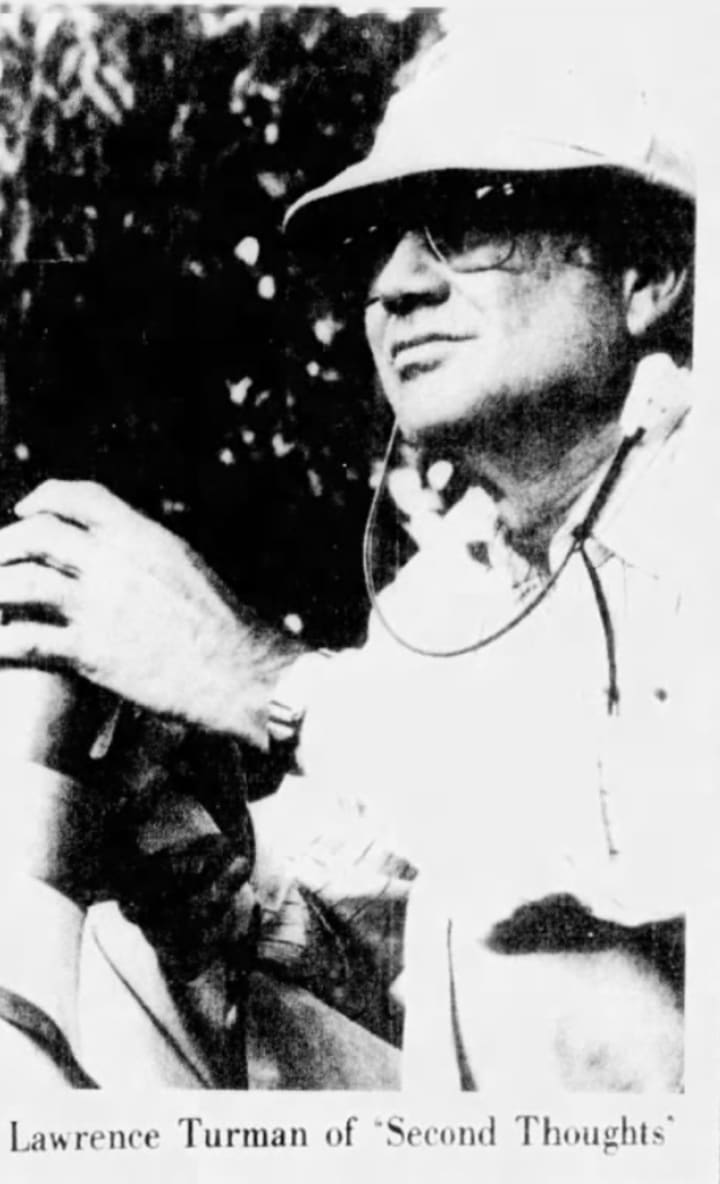
Who Was Lawrence Turman?
You may not recognize the name Lawrence Turman. But you know his fingerprints.
He was the producer who optioned The Graduate, hired Mike Nichols, and helped cast Dustin Hoffman in the role that launched one of the most important acting careers in American cinema. Turman later helped assemble John Carpenter’s The Thing, now regarded as a genre landmark, and even the crowd-pleasing robot comedy Short Circuit.
Turman had taste.
Turman had instincts.
Turman had credibility.
What he didn’t have, at least in 1983, was a filter.
Turman had a long, respected career — as a producer.
As a director, his story ends in 1983.
A Producer Tries to Direct
Turman’s final directorial effort was Second Thoughts (1983), a romantic comedy shot in Santa Fe, New Mexico and starring Lucie Arnaz and Craig Wasson as an unlikely couple — a successful lawyer and her lazy, musician client.
It was intended to be modest, charming counterprogramming.
Instead, it became a footnote.
While promoting the film, Turman met with reporters from across New Mexico, including Albuquerque Journal reporter Tom Jacobs. The resulting interview, published March 6, 1983, reads today like something from another planet — or perhaps a cautionary social media thread written forty years too early.
Turman did something unheard of then and nearly impossible now.
He asked critics what they thought of his movie.
“If I Had Done a Good Job…”
The critics were polite but honest. The film, they said, felt contrived.
And then Turman did the unthinkable.
He agreed.
“If I had done a good job, you wouldn’t have noticed that.”
In one sentence, Turman undercut his own movie more effectively than any bad review ever could.
He continued, openly acknowledging the film’s flaws:
“I’m committed to the movie. But that doesn’t mean I don’t see some warts.”
And then, with a self-awareness bordering on self-sabotage:
“I look at it and think, ‘Gee, why wasn’t I Stanley Kubrick and François Truffaut rolled into one?’”
Turman wasn’t posturing. He wasn’t joking. He was simply being honest — painfully so.
“You’re very aware of what you perceive are errors you’ve made. But we do the best we can at the time.”
Even The Graduate wasn’t spared:
“I look at The Graduate and see things that are wrong with it.”

Honesty Meets the Box Office
When asked how Second Thoughts might perform financially, Turman hedged again — and again told the truth.
“I want it to do business. I’m a normal apple-pie American guy who likes to make a profit.”
Then he corrected himself.
“That’s the goal. Excuse me — that’s a goal.”
Jacobs noted that Turman finally seemed uneasy when asked about the film’s budget. At first reluctant, he eventually labeled it “modest” by Hollywood standards before clarifying:
“In mainstream Hollywood, the average film costs $10 million to make. This film cost a lot more than half of that.”
Not cheap. Not disposable. And now, publicly doubted by its own director.
Turman closed the interview with a line that, in hindsight, reads like an epitaph:
“It doesn’t matter what goes in. What matters is what comes out.”
“Is the picture entertaining? Is it provocative? Will it satisfy a certain segment of the audience? I hope so.”
What Came Out Didn’t Matter
Second Thoughts quietly disappeared.
There are no official box office numbers, which tells you everything you need to know. The film made no cultural dent, no financial ripple, and no lasting impression. Its absence from memory is its legacy.
For Lawrence Turman, it marked the end of his directing career.
But not his career.
He returned to producing, where his instincts and taste continued to serve him well. His final credit came in 2011 as a producer on the The Thing remake — long after he had stepped away from Hollywood.
Lawrence Turman passed away in 1983.
The Cost of Saying the Quiet Part Out Loud
In today’s carefully curated media environment, Turman’s interview would go viral in minutes. Headlines would scream. Clips would circulate. PR teams would panic.
In 1983, it simply doomed a movie before it ever had a chance.
Lawrence Turman didn’t fail because he lacked talent. He failed because he forgot — or refused to learn — the oldest rule of Hollywood promotion:
Never be more honest than the audience needs you to be.
And that may be the most 1980s lesson of all.

About the Creator
Movies of the 80s
We love the 1980s. Everything on this page is all about movies of the 1980s. Starting in 1980 and working our way the decade, we are preserving the stories and movies of the greatest decade, the 80s. https://www.youtube.com/@Moviesofthe80s
Keep reading
More stories from Movies of the 80s and writers in Geeks and other communities.
John Travolta’s Lost Decade: Fame, Flops, and Survival in the 1980s
Few people will ever know what it feels like to become famous overnight. Not internet famous. Not viral-for-a-week famous. Real, unavoidable, nationwide celebrity. The kind where your face is suddenly everywhere and you don’t get a say in the matter.
By Movies of the 80s23 days ago in Geeks
Marvel Zombie
The last entry into our 2025 superhero projects catalogue is Marvel Zombies. This was a show that was anticipated by absolutely no one and it disappeared from the public consciousness as quickly as it was released. There was nothing special about the project that made it a must see, or a must remember. In fact if anything it's a must forget.
By Alexandrea Callaghan16 days ago in Geeks
How to Watch RTE in UK?
Picture the scene: you’re traveling outside of Ireland and sit down to watch your favorite RTE Player shows. But when you hit play, you’re met with the following error: “This program cannot be streamed due to rights restrictions.” Luckily, there’s an easy way to continue streaming RTE Player in UK, you just have to use a Virtual Private Network (VPN).
By David Cook5 days ago in Geeks


Comments
There are no comments for this story
Be the first to respond and start the conversation.