
The critique of artistic production amidst the zombie apocalypse
Or variations of Robert Neville's last stand

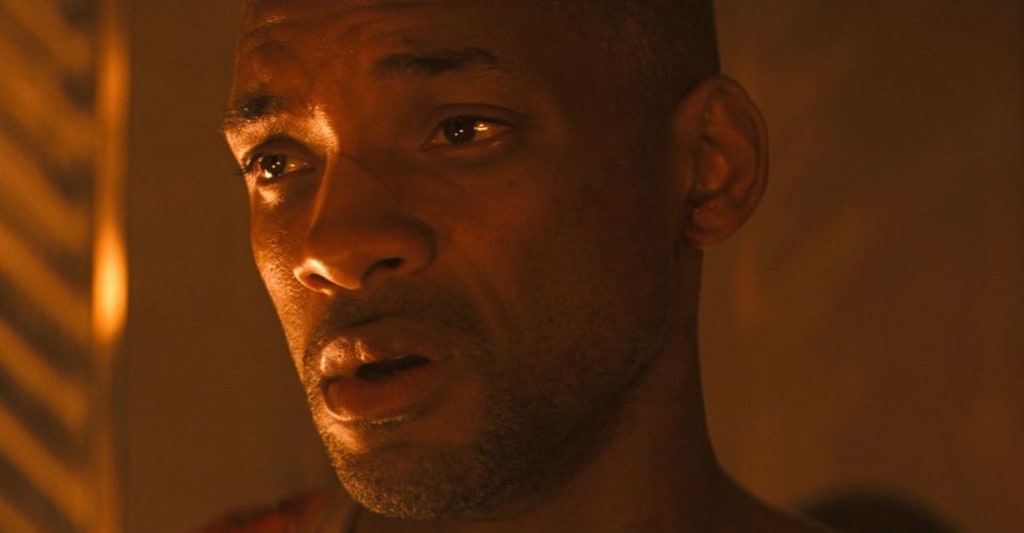
I think there is no better scene in cinema which explicates the predicament of an artist, or indeed a scientist when faced by the philistinic denial and ignorance of a mob than the dramatic end of Robert Neville’s life in I am Legend, the 2007 post-apocalyptic zombie horror movie. The zombies having identified the house where Neville and his friends are holed up in , assault it en-masse. Isolating the group of survivors in the basement where the experiment to make a vaccine is underway. Neville, played by Will Smith, in a last desperate attempt to show the assaulting mob that he has a cure, displays one of their own, whom the vaccine has been administered to and who is indeed, beginning to appear human again i.e., her vital signs are stabilizing, her breathing is becoming normal etc. But of course, the mob still don’t get it. Resigning himself to the situation, the lead protagonist asks Anna and Ethan, the two survivors who were with him, to escape from the back - through the underground tunnel and drive till they find the place of safe haven advertised on the radio.
The sheet of glass that separates Neville and the mob, cracking under the assault of the them mindlessly smashing their heads against it is the primal scene as it were. An artist, or scientist, a politician with a new deal attempting to confront an assembly who want nothing more than to destroy the edifice of such an operation. Indeed, to those who may be students and practitioners of psychoanalysis, an analogy of a child confronting a parent regarding a promise. Yet, if you notice - we never actually see what happens after the glass breaks.
Why is this? In a sense this is the situation which contemporary capitalism places every innovator in at some point. To this machine that is capitalism, the only thing that matters is for the product to be sold. We never see what actually happens after the glass breaks because that is the tension which sustains the tragic narrative of the film, what allows it to present itself as art. It is the very tension, the gap that allows a tragic zombie movie about a cure being manufactured in a basement laboratory to be made - to witness the events spoken of in the voiceover at the end about the vaccine being administered through planes, etc. would mean that it would not be a movie about an apocalypse but one about redemption, of a cure.
Can we not see, within such a scenario, how capitalism requires, in its very infantile assemblages, its organization of differences, the threat of violence to sustain a situation where the mass production of simply inane things, and the ritualization of their consumption can continue?
To make the same point in the level of stupid millennial acronyms - YOLO, this predisposition to try anything simply because of an idiotic recognition of one’s mortality, is of course an idiotic sentiment promoted by mass digital culture to get you to pay money for services and goods your life would do very well without. Yet, at another level, do we not see here, in this scene the fate of what Nietzsche describes as the ‘last man’ in his magnum opus Thus Spoke Zarathustra? ‘The last man says we have discovered happiness, and blinks’ - is this not, at its core the very definition of what a zombie is? A mindless automaton, whose only drives are the basic animal need to feed? Which perhaps can be ‘sublimated’ into the sugar fueled rush to try anything new?
In this sense, when Nietzsche was describing the loss of faith in Christian Europe, and allegorizing the characters that it produced, he was, from within the circumstances of his historical moment, confronting a zombie apocalypse. Indeed, in a prophetic moment, was addressing all the apocalypses to come. Here, I maintain that Nietzsche was a progressive, even in the dilettante’s sensibilities and we should, or rather our job as philosophers, is to recover his example, his breach into metaphysics.
He confronts, in the sheer brutality of the encounter, what becomes of a society without an organizing principle, be it in faith, government or vocation - and provides, before any party is remotely cognizant of the scene, an ideological critique of culture and individuals who are produced and reproduce it. This, I believe - is an example that the left has to learn from, if it can look beyond its own limitations in representative parties competing for seats.
In confronting what is depicted as apathy and chaos in society, the role of art has been, in the absence of religion, to provide allegories which allow us to revision how we see our present situation. Yet this medium can and does often fall into hands which use it as an instrument of propaganda. Here, it is the task of philosophy to provide critiques, not merely of representations and their uses, often political, but of the situations which permit these representations to perpetuate themselves. In other words, there can be no critique of art which does not take into account the circumstances of its production.
About the Creator
Silver Screen Magic with Mae West
American actress and singer Mae West became a popular film actress during the Great Depression. She started entertaining in vaudeville, then performed on Broadway, and finally went to Hollywood. She signed up with Paramount Pictures and made her debut in the 1932 film “Night After Night.” She also starred in musicals, comedies, and crime dramas. The American Film Institute named her one of the best classic Hollywood actresses.
By Rasma Raisters6 days ago in Geeks



Comments
There are no comments for this story
Be the first to respond and start the conversation.