
The Cheshire Cat: A Reflection of Alice’s Unconscious Mind
A deep dive into McGee’s spin on an iconic character

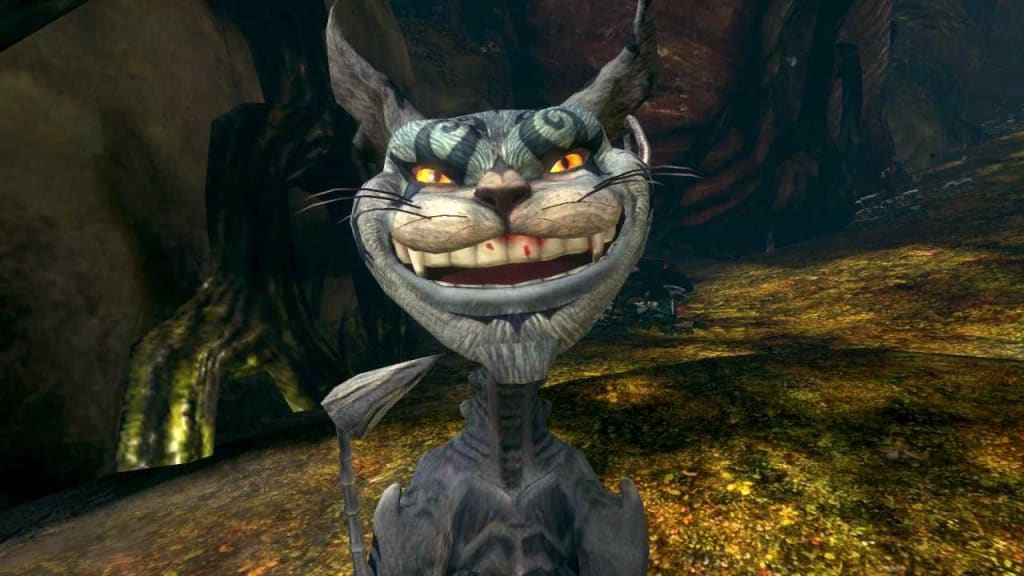
The Cheshire Cat has always been an enigmatic and curious character, but his role in American McGee's Alice and Alice: Madness Returns takes on a deeper psychological meaning. In these games, he isn’t merely a quirky, grinning guide but a manifestation of Alice's unconscious mind—her fears, doubts, and instincts given voice.
The Cat as Alice's Ally
In both games, the Cheshire Cat serves as a guide, leading Alice through her shattered Wonderland. He appears when she most needs him, offering riddles that seem nonsensical but are actually loaded with insight. This reflects how the unconscious mind often communicates—through dreams, symbols, and elusive patterns rather than direct, linear thoughts.
When the Cat speaks to Alice, he speaks to her instincts, embodying the part of her psyche that understands what her conscious mind denies. This can be seen most clearly in Alice: Madness Returns, where the Cat reminds her of the destruction she’s caused in Wonderland, as the real-world destruction of her own mind has lead to the Infernal Train’s rampage through Wonderland.
Similarly, when Alice faces the Red Queen near the end of the game, the Queen’s line “What you claim not to know is merely what you’ve denied” mirrors the Cat’s warnings that the destruction of Wonderland is directly related to Alice’s real-world suffering and ignorance. The directness of these statements force Alice to confront the parts of herself she has repressed—the trauma, guilt, and memories of the fire that destroyed her family, as well as the ignorance she has exhibited towards the suffering of other orphans at Houndsditch Home for Wayward Youth.
The Weight of His Words
Though he sometimes speaks in riddles, the weight of his words cannot be ignored. The Cat’s dialogue in this universe is full of cryptic wisdom, making him a mirror to the darker recesses of Alice’s psyche. His riddles, like the unconscious mind, require Alice to work through her confusion, just as one would with buried emotions or unresolved trauma. His tendency to shroud himself in mystery adds to this parallel—much like the unconscious itself, he is ever-present yet difficult to pin down or fully understand.
Same Character, Different Approach
In the first game, the Cat is whimsical and elusive, embodying the chaotic nature of Wonderland. He offers riddles, plays tricks, and acts as a detached observer of Alice's journey. But in Madness Returns, he has evolved into a more cynical, philosophical, and blunt figure. This shift reflects the change in Alice’s mental state; though deemed “socially sane” after ten years in Rutledge, her madness has deepened due to her current circumstances—mainly via the influence of Dr. Bumby—and the Cat, as her unconscious voice, has become more direct. He no longer dances around the truth but instead confronts her with it: the destruction of Wonderland is her doing. He is no longer content to let her deny reality.
His shift from whimsical to blunt also mirrors Alice’s progression from avoiding her trauma to facing it head-on. The Cat’s role is pivotal here, pushing Alice to confront the darkness she’s buried. His cynicism and wisdom act as the harsh truths we often suppress in our waking lives—truths that only come out when we’re ready to deal with them.
The Cat as Alice's Alter Ego
Interestingly, in the extra content of Madness Returns, Alice refers to the Cat as her “alter ego,” suggesting that he is more than just a guide. He represents her id—the inaccessible part of the psyche that contains our most basic instincts and desires. For Alice, this means the Cat embodies her desire to escape insanity, to claw her way back to normalcy even when it feels like everything is falling apart.
At the game’s end, when Wonderland has merged with London, the Cat’s claim to “our Wonderland” underscores this connection. He doesn’t just guide Alice through Wonderland; he claims ownership of it alongside her. This hints that he and Alice are one and the same, that her unconscious mind—the part of her that understands the madness and the trauma—holds as much power in Wonderland as her conscious self does.
Fear and Paralysis: The Final Lesson
One of the most profound lines the Cat delivers is, “If fear paralyzes you, we are lost.” This isn’t just a piece of advice for navigating Wonderland; it’s a reflection of Alice’s internal battle. Fear is paralyzing Alice, keeping her from fully confronting the trauma of her past. The Cat, as her unconscious mind, recognizes this paralysis and warns her that unless she faces her fear, she will be trapped in her madness forever—or worse, become a shell of what she once was.
In many ways, the Cheshire Cat is Alice’s internal compass, guiding her toward self-awareness and urging her to face the darkest parts of herself. He’s the voice in her head that can’t be ignored—the one that nudges her toward healing, even if it means facing the pain she’s tried so hard to bury.
~*~
About the Creator
Eva A. Schellinger
Content Creator, Writer, and host of Elaborations with SchellingtonGrin. Come on in, make yourself at home.
Keep reading
More stories from Eva A. Schellinger and writers in Geeks and other communities.
Mean Girls 2024: The Musical Movie That Had More Potential
Hey there, friends! I’m back with another film review. After taking a hiatus due to some life changes, I decided “What better way to come back to Vocal Media?” Buckle up, because this review is about to get fetch!
By Eva A. Schellinger2 years ago in Geeks
Silver Screen Magic with Mae West
American actress and singer Mae West became a popular film actress during the Great Depression. She started entertaining in vaudeville, then performed on Broadway, and finally went to Hollywood. She signed up with Paramount Pictures and made her debut in the 1932 film “Night After Night.” She also starred in musicals, comedies, and crime dramas. The American Film Institute named her one of the best classic Hollywood actresses.
By Rasma Raisters3 days ago in Geeks
When Sweetness Turns Sour: A Review of Saccharine
Some films announce their intentions loudly. Others whisper, smile politely, and then leave a strange aftertaste long after the credits roll. Saccharine belongs firmly in the second category. With a title that suggests artificial sweetness, the film uses that expectation as a quiet trap, drawing the viewer into a story that is far more unsettling, reflective, and emotionally ambiguous than its name implies.
By David Cookabout 6 hours ago in Geeks
Wild Card Weekend Recap: What Happens Now?
I think I figured out why I love Wild Card Weekend so much. It's because it's the first playoff anything of the calendar year. The NFL season starts in the fall, and once upon a time, the champion was crowned either on or slightly before New Year's. The evolution of the NFL schedule has resulted in the playoffs starting just into the New Year, and currently, the final week of the season falls on the first weekend of the New Year, with Wild Card Weekend coming a week after that. So yes, chronologically, the NFL's Wild Card Weekend serves as the first playoff anything of the calendar year.
By Clyde E. Dawkins4 days ago in Unbalanced



Comments
There are no comments for this story
Be the first to respond and start the conversation.