
The changes that time brought to american cinema
The movies as mirrors of reality
One thing you need to know about me is that I love to watch movies. To me, a perfect day has to involve watching a good film. However, I do not mean that I like all cinematographic genres equally.
Lately, I have been choosing to see films that, in a “sublime” way, address racism. In fact, the reason that led me to focus on the movies that talk about this subject was because I noticed, more deeply, the speeches that the black characters have. Because of this, I have decided to make a comparison between the oldest pictures, made during the 20th century, and the films of the present century.
By this I mean that, after analyzing several pictures both old and recent, I have noticed that there is a big difference in the way that the black actors act including their character’s lines, that their characters, have in comparison with the white characters.
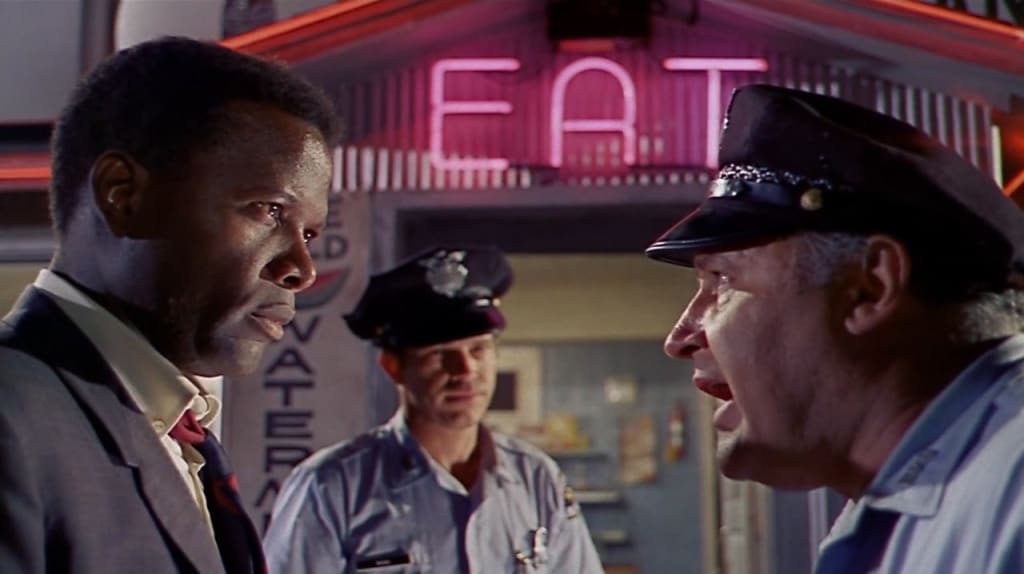
Ever since cinema exists, it has become a mechanism of information and projection of the reality that is lived at that moment (except if it is about science fiction or historical films that address past moments). For this reason, it can be seen that there was structural racism in older movies, such as the film In the heat of the night.
To clarify the concept, structural racism is understood to mean:
“The normalization and legitimization of an array of dynamics - historical, cultural, institutional and interpersonal - that routinely advantage whites while producing cumulative and chronic adverse outcomes for people of color.”
https://www.intergroupresources.com/rc/Definitions%20of%20Racism.pdf
The film that, at the time of its release, in 1967, won many awards due to the theme that portrayed which is a mixture of racism related to the character Virgil Tibbs, represented by the actor Sidney Poitier, and a murder unsolved. As I analyzed Poitier's performance more closely, I noticed that his behavior did not seem natural, either in the face of accusations of racism that were made against him or when he was a victim of verbal violence by other characters. Both his attitudes and his speech have always revealed a tranquility and control that is not observed in real life.
In the film, Guess who is coming for dinner, also from that year, we see the same lack of naturalness in the main character, also represented by the actor Sidney Poitier.
Making a parallel with the historical context that was lived at the time, and that demonstrates the existing structural racism, it is not surprising that it was portrayed in the films in such a subtle way, since it was not intended to provoke more discord and revolt between the population. The audience, who received the messages that the films transmitted and that were affected by the way the stories were told, was huge. For this reason, they transmitted an image of apparent equality between races that, in reality, didn’t exist.
Despite the fact that, over time, the filmmakers began to change the plot of their stories and stop to show the black person as the slave or the house manage, as we can witness in the films The Color Purple, Gone with the Wind or Amistad, since historically black people have been gaining more direct. This was reflected in the naturalness of their roles, which little by little began to show less limitation in the speech.
Subsequently, this change began to shape the way of thinking of the audience who saw the film, which, in turn, was fundamental for the mentality to begin to change. However, as you can see, with a closer look, the black characters, despite playing different roles, with more important positions, continued to be limited.
It is necessary to take into account that many of the directors were white, which could influence their narrative due to their biased perspective of reality. Although, as time went and goes by, it is possible to notice more and more that there is a gradual evolution in the speeches and behavior of the actors. An example of this is the film Driving Miss Daisy, released in 1989, in which Hoke, played by Morgan Freeman, has already a much bigger freedom of speech, exemple of it is a scene where the character revolts against a situation of demotion. This “revolt” attitude would not have happened in older films due to not being considered “acceptable” or “allowed”.
Only in more recent films, after the turn of the century, such as The Help or Men of Honor, can we see a huge difference in the role that black people began to play. Their speeches became more natural as well as their reactions to racist comments or attitudes.
It is important to mention that there are movies that are based on literary works and of course that in these films, the speeches of all the characters, regardless the color, are limited to what was written in the book. Since what is intended to pass to the screen is the author's faithful thought at the time, even if it’s problematic as is the case with the film How to kill a Monkingbird.
In conclusion, of course that there is always a social and temporal context behind the films and that’ why the black characters were not so prominent and had more limited lines, unlike the characters played by white actors. For this reason it is important when analyzing a movie to know the historical context in which it was filmed. Because, as I said before, the film reflects the mentality of the time. That’s why I decided to address this issue to highlight the changes that have occurred in american cinema over the years regarding to the role of black actors.
How much time until a future without the vision of black and white?
About the Creator
Keep reading
More stories from writers in Geeks and other communities.
Silver Screen Magic with Mae West
American actress and singer Mae West became a popular film actress during the Great Depression. She started entertaining in vaudeville, then performed on Broadway, and finally went to Hollywood. She signed up with Paramount Pictures and made her debut in the 1932 film “Night After Night.” She also starred in musicals, comedies, and crime dramas. The American Film Institute named her one of the best classic Hollywood actresses.
By Rasma Raisters3 days ago in Geeks
Premier League in Italy: How to Watch
The 2025–26 Premier League season is underway, marking the 34th edition of the competition and the 127th year of top-flight English football. Liverpool start their title defense with confidence after lifting their second Premier League trophy last season, but the return of Leeds United, Burnley, and Sunderland ensures fresh rivalries – including the long-awaited Tyne–Wear derby, back for the first time since 2015–16.
By David Cook5 days ago in Geeks




Comments
There are no comments for this story
Be the first to respond and start the conversation.