
The Brilliance of ‘Unbreakable’ Remains Intact, 20 Years On
Shyamalan's second film may very well be his best

READ THE REST OF THIS ARTICLE ON OUR WEBSITE: https://moviebabble.com/2020/11/22/the-brilliance-of-unbreakable-remains-intact-20-years-on/
...
The year 1999 has long been considered one of the greatest years in cinema history. I see no issue with that position. It’s a shame that so many were left out when it came Oscar time, though; films like The Cider House Rules, The Green Mile, The Insider, and yes, American Beauty were awarded Best Picture nominations instead of All About My Mother, The Matrix, or Eyes Wide Shut. However, the Academy did get one nom right: The Sixth Sense. M. Night Shyamalan took the world by storm with his debut, to the point that he was dubbed ‘The Next Spielberg’ right out of the gate. Over the following two decades, the statement did unfortunately prove to be somewhat hyperbolic. But nevertheless, Shyamalan still stands today as one of cinema’s most distinct voices, and nowhere are his unique talents better exemplified than in his second and best film Unbreakable, which turns twenty years old today.
Unbreakable – Summary
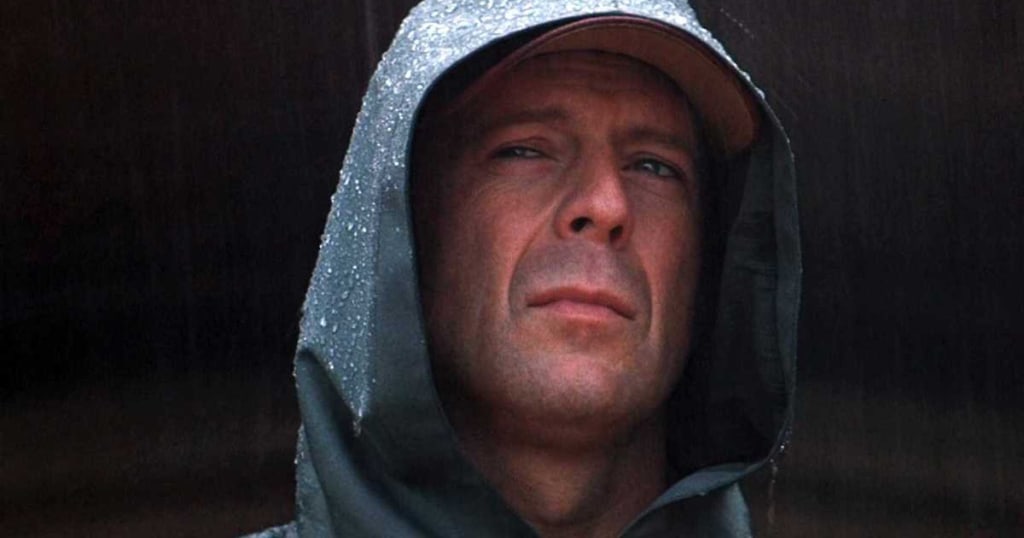
Unbreakable is a 2000 narrative feature film written and directed by M. Night Shyamalan. It stars Bruce Willis as David Dunn, a Philadelphia security guard who gains the attention of Elijah Price after becoming the only survivor of a train crash. Price, played by the iconic Samuel L. Jackson, lives with Osteoporosis, a deadly condition that causes his bones to break extremely easily. Obsessed with comic books since childhood, Price believes that Dunn may be his antithesis: a man with extreme resilience and strength. Initially, Dunn dismisses Price, but as events unfold, he realizes there could be some truth to Price’s wild idea.
Some Context
It would be five years after the release of Unbreakable that Christopher Nolan revolutionized blockbuster filmmaking by ripping off The Mark of Zorro with Batman Begins. Since then, most casual film fans have pointed to that as the template by which all contemporary cinematic superhero origin stories are made. However, while Batman Begins‘ storytelling was definitely influential, it was also definitely not the first of its kind, even in the modern era. You see, I should point out that what the above summary did not mention is the very reason Unbreakable holds a special place in pop culture history: it is a superhero story. And not only that, it is a superhero origin story.
That fact might seem unimpressive now, but superhero films were not common when Unbreakable came out, let alone the dominant box office attraction. This is evident in the film’s marketing; like my summary, previews did their best to hide what the film was actually about so as not to turn off audiences. Throughout the film itself, Elijah Price gives monologues which serve the purpose of educating other characters, as well as the audience, of the most basic elements of comic book storytelling. And there’s even text at the beginning of the film essentially introducing the idea of comic book collectors! This is all to say that Unbreakable was exploring something very niche when it came out.
Power in Simplicity
But what about the film itself? Well, to put it simply, Unbreakable is a masterclass in minimalist filmmaking. Let’s begin with the performances. Willis, who was once a very energetic screen presence (see: Death Becomes Her), is now mostly known as a tired, emotionless performer. This film managed to capture him in middle of that transition, and it’s perfect. Dunn is a meek character, defeated by life. Willis, as is appropriate, gives him a quiet but still heartfelt presence. Playing opposite Dunn is Price, a man who wishes he could fly, but is always in danger of literally breaking. So Jackson, who is normally asked to crank himself to eleven, turns in the subtlest performance of his career. The result of these choices is a film that is for the most part quite somber.
Shyamalan backs up that somberness with his imagery. First off, the color theory in Unbreakable is absolutely elegant; Dunn is green, Price is purple, and *redacted* is orange. The color accompanies the whole story, practically telling it for you (from the background, though; Shyamalan keeps it pretty muted).
Moving from color to framing, here’s a fun fact: the average shot length in Unbreakable is 23 seconds. That is absurd (at the time, the average shot length for American films was around 5 seconds, and today it’s less than 3). Throughout the runtime, Shyamalan lets entire scenes play out in single takes, whether they feature conversations or fights. But they’re barely ever static shots, mind you; push-ins, panning back and forth and handheld movements keep a rhythm that upholds the slow-but-steady pace of the film. Shyamalan also takes advantage of reflections, particularly with Price, which makes for a lot of beautiful double and triple-framing.
As a result of all these choices, Unbreakable seems to be a very uneventful film. That is, until it hits you. This is what less is more means. Because all the performances are reserved, when people shout, you feel something. Because the film’s color palette is muted, when vibrant colors appear, you notice. And because the film plays out in long takes, when quick edits happen, you become unsettled.
Oh, and of course, when James Newton Howard’s score (which is amazing) goes full Superman, you freaking pump your fists!
About the Creator
MovieBabble
The Casual Way to Discuss Movies! Head over to moviebabble.com to see all our content!
Keep reading
More stories from MovieBabble and writers in Geeks and other communities.
Silver Screen Magic with Mae West
American actress and singer Mae West became a popular film actress during the Great Depression. She started entertaining in vaudeville, then performed on Broadway, and finally went to Hollywood. She signed up with Paramount Pictures and made her debut in the 1932 film “Night After Night.” She also starred in musicals, comedies, and crime dramas. The American Film Institute named her one of the best classic Hollywood actresses.
By Rasma Raisters4 days ago in Geeks
Trump’s Attacks on Iran
Tensions between the United States and Iran have once again drawn global attention, fueled by renewed political rhetoric from former U.S. President Donald Trump and an increasingly fragile Middle East landscape. While Trump is no longer in office, his influence on American foreign policy discourse remains strong, especially regarding Iran. His recent statements and past actions continue to shape how the situation is discussed, both domestically and internationally. The ongoing Iran situation cannot be understood without revisiting Trump’s long-standing approach to Tehran—one defined by pressure, confrontation, and a belief that economic and political force could reshape Iran’s behavior. As events unfold in the region, Trump’s attacks on Iran, primarily through rhetoric and policy advocacy, have reentered the conversation at a time when stability is already uncertain. A History of Confrontation During his presidency, Donald Trump positioned Iran as one of the primary adversaries of U.S. foreign policy. His decision to withdraw from the Joint Comprehensive Plan of Action (JCPOA), commonly known as the Iran nuclear deal, marked a turning point. Trump argued that the agreement was flawed, claiming it failed to permanently prevent Iran from developing nuclear weapons and did not address Iran’s regional influence or missile program. Following the withdrawal, the U.S. imposed sweeping economic sanctions under what the administration called a “maximum pressure” campaign. These measures significantly affected Iran’s economy, targeting oil exports, banking systems, and international trade relationships. Trump consistently framed these actions as necessary to protect U.S. interests and global security. That confrontational posture remains central to Trump’s public messaging today. Rhetoric That Resonates Trump’s attacks on Iran in recent speeches and interviews have focused less on diplomacy and more on strength. He often portrays Iran as a destabilizing force in the Middle East, accusing its leadership of funding proxy conflicts, threatening U.S. allies, and undermining regional peace. This language resonates with segments of the American public who favor a hardline approach to foreign policy. At the same time, critics argue that such rhetoric escalates tensions rather than easing them. Words from influential political figures carry weight, especially when they echo previous policies that brought the two nations close to direct confrontation. Even without immediate military action, strong language can affect markets, diplomatic relations, and public perception across the region. The Current Iran Situation Iran today faces a complex set of challenges. Economic pressure from sanctions continues to strain daily life for many citizens, while internal political dynamics remain tense. Regionally, Iran is involved in multiple theaters through alliances and influence, making it a central player in broader Middle Eastern conflicts. Against this backdrop, Trump’s renewed focus on Iran adds another layer of uncertainty. While the current U.S. administration may pursue different strategies, Trump’s voice amplifies debates about whether negotiation or force is the more effective path forward. Supporters of Trump argue that his tough stance kept Iran in check, claiming that pressure limited its resources and influence. Opponents counter that the approach isolated the U.S. from allies and reduced opportunities for diplomatic solutions, leaving the region more volatile. Global Reactions and Diplomatic Concerns International responses to Trump’s attacks on Iran have been mixed. Some U.S. allies in the Middle East view his rhetoric favorably, seeing Iran as a shared threat. Others, particularly in Europe, remain cautious, emphasizing the importance of dialogue and multilateral agreements. Diplomats warn that escalating language can undermine ongoing efforts to stabilize the region. Even symbolic threats or aggressive statements may provoke responses that spiral beyond control. In a region already marked by conflict, restraint is often seen as a necessary component of effective diplomacy. Political Strategy at Home Trump’s focus on Iran is also tied to domestic politics. Foreign policy strength has long been a cornerstone of his political identity. By highlighting Iran as an adversary, Trump reinforces his image as a leader unwilling to compromise with perceived threats. This strategy plays well among voters who believe the U.S. should project power globally. However, it also raises questions about long-term consequences. Critics argue that consistent confrontation without clear diplomatic off-ramps risks entrenching hostility rather than resolving underlying issues. What Comes Next? The future of U.S.-Iran relations remains uncertain. While Trump’s attacks on Iran currently take the form of rhetoric and policy advocacy rather than direct action, their impact should not be underestimated. Political language can shape expectations, influence decision-makers, and affect the behavior of nations. For Iran, continued pressure may harden positions within its leadership, reducing incentives for compromise. For the United States, balancing strength with diplomacy remains a delicate challenge—one that will define its role in the Middle East for years to come. Conclusion Trump’s attacks on Iran reflect a broader debate about how powerful nations should handle long-standing adversaries. Is pressure the path to peace, or does it deepen divisions? As the Iran situation continues to evolve, the consequences of words spoken today may shape realities tomorrow. In a world already facing uncertainty, the need for measured dialogue, strategic thinking, and global cooperation has never been greater. Whether confrontation or communication ultimately prevails will depend not just on leaders, but on the choices they make in moments of tension.
By Saboor Brohi 6 days ago in Geeks


Comments
There are no comments for this story
Be the first to respond and start the conversation.