
The Book Report: Atlas Shrugged
Analyzing one of America's most polarizing novels

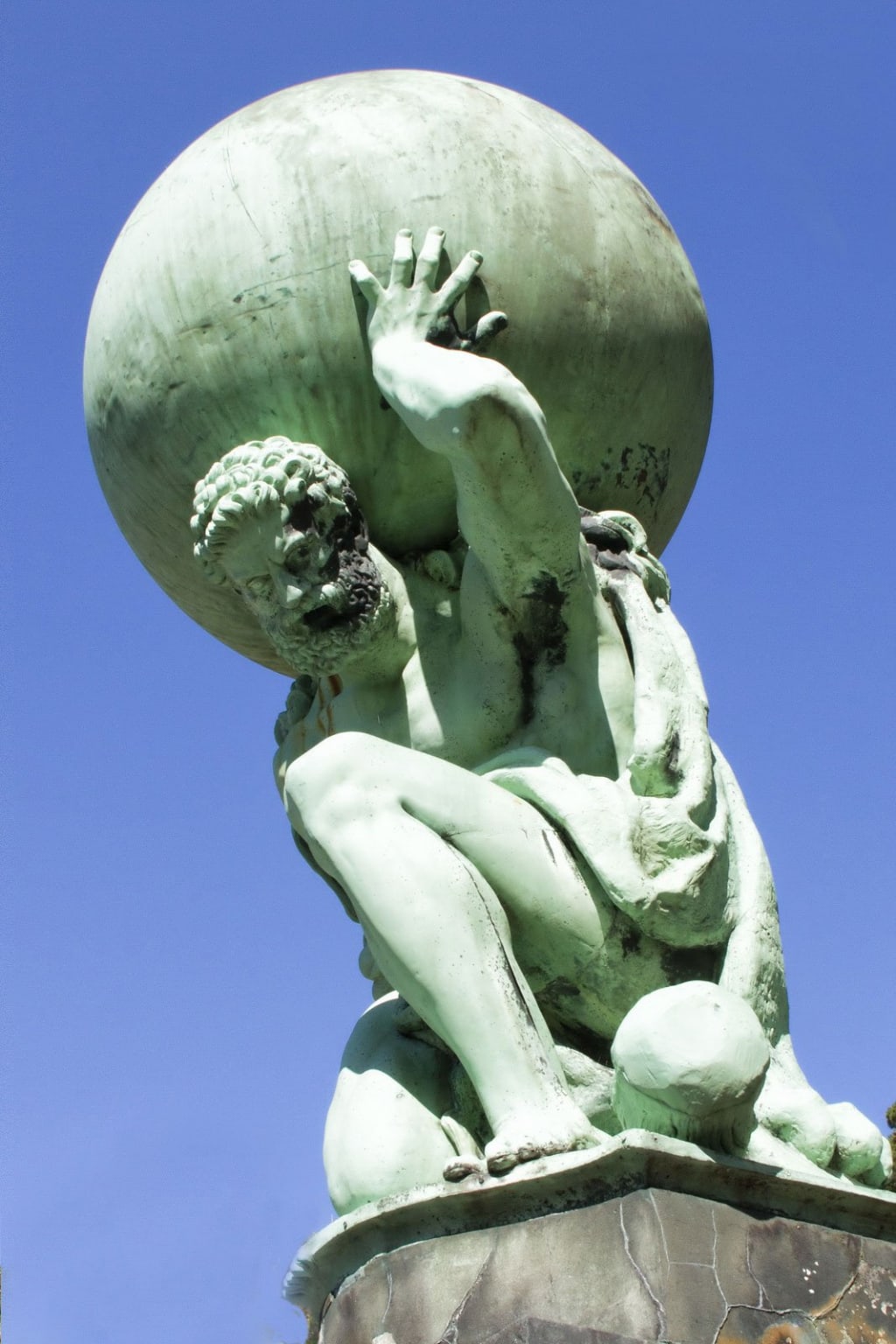
In 1957, Russian-American author Ayn Rand published her most ambitious work, now regarded as the work she is most known for: “Atlas Shrugged”, a monolith of 1,100 pages of paper and 645,000 words. To put that count into perspective, “It” by Stephen King (another beast of lumbering length) is only 441,156 words. A novel is considered any piece of writing between 90,000 to 120,000 words; anything beyond that is an “epic”.
In the years and decades following its release, “Atlas Shrugged” has garnered a reputation of infamy, brought on by the unbending and controversial philosophical stance taken by Rand, and the content of the book itself. A quote, attributed to Dorothy Parker though perhaps not actually said by her, is often brought up when talking about this book: “This is not a novel to be tossed aside lightly. It should be thrown with great force.”
Rand’s work has found praise among the conservative leadership of the US, as well as different parties who themselves wrote expansive projects (James Clavell, and the books of his Asian Saga, being one). The central figure and ideology of “John Galt” became a rallying figure during Tea Party political rallies. The book alternates between being praised or loathed by whoever might be discussing it.
To understand what volatile spark dwelled within it, and with a wish to understand American ideologies I don’t interact with from the 1950s and modern times, I set out to read “Atlas Shrugged” by way of a copy that came home with me from helping a family friend move. Having already read her novella “Anthem” from 1937, and finding it both unintentionally funny and miserably full of itself, I thought I knew what I was getting into.
I am going to state upfront: I did not much like this book, nor do I agree with its message. I am not going to relate it to politics any more than saying “these folks did enjoy it, and I wanted to understand them a little better.” It is my intention only to analyze the novel by itself and within the context of the author’s life. I am going to give it credit where I found things to enjoy. These are all only my opinions.
To summarize (FULL SPOILERS AHEAD):

ATLAS SHRUGGED
The novel is split into three sections, each of ten chapters. The titles of the three sections--“Non-Contradiction”, “Either-Or”, and “A is A”--are taken from the philosophies of Aristotle, whom Rand studied in college. The novel opens with a man named Eddie Willers being approached by a bum in New York, who introduces us to the phrase “Who is John Galt?” as a vocal indicator for “Ah heck it’s all hopeless.” Through Eddie, we move briskly to the main character; his boss, whom he adores: Dagny Taggart, a no-holds-barred woman working as the vice president of Taggart Transcontinental, the biggest railroad in the United States. She’s barred from the presidency because her brother, a whining amoeba named James Taggart, holds that position, and is also male. Everyone defers to her, including James through frequent bouts of shrieking that everything’s falling to bits and he knows it better than her anyway. A charming introduction!
It was about this point that I wondered when the plot would begin, and Mr. Taggart would be swept aside so that his unpleasantness would be all but a distant memory, forgotten by the expanse of the 1,080 pages left. Ha ha… ah, what a youthful fool I was.
Through these first chapters, we learn that the railroad is under fire from James’s mismanaging, and that Colorado needs their efforts badly as a place of rising INDUSTRY! Creating a better world! Ellis Wyatt, an oil baron, unimpressed with Mr. Taggart’s lack of a spine or chin, is won over slightly seeing Dagny’s resolve to help the situation there. But James instead prefers to divert attention out of the country, down to the San Sebastián Mines, where a family friend--Francisco Domingo Carlos Andres Sebastián d’Anconia, who is from Spain if you’d believe it, the heir of the best copper mines and fortune in the world--needed help getting transport to and from his new venture. Except the mining project is turning into a disaster!
There’s an entire chapter devoted to Mr. d’Anconia and his history with the Taggarts: good ol’ Jim was a bleeding heart as a kid who whimpered and was excluded from Francisco and Dagny’s adventures running off to work on their own for money! And they dreamed about the future; walked down the rails together; Francisco met her at her job when they were adults and they got incredibly intimate and--
Woah, woah, WOAH it’s one of these books. Well okay, I mean-- I mean, okay then. The chapter being called “The Climax of the d’Anconias” is in reference to how he’s the last one of his lineage, I swear.
Well, they were indeed a couple, and they felt such a drive of passion for one another and their work, until all at once Francisco went away by himself, and came back as a playboy spending as much as he could on lavish parties, mewling with the high-society crowd who drew Dagny and any respectable worker’s ire because I mean look at them, enjoying life and not working! How empty they are, and--
Anyway, the novel’s male lead is a fellow named Henry “Hank” Rearden. Hank is, if I remember from the one time he’s described, a blond and blue-eyed ideal man. Yeesh. (I could be remembering wrong, too.) Hank is introduced as the owner of a series of coal and iron mines and a sizable Steel Mill that’s absolutely demolishing the competition. At home, Hank supports his mother--screeching fingernails on a chalkboard in human form--his brother Philip--a pouting man constantly in support of nice organizations that care about the poor and stuff and who’s never worked a day in his life--and his wife Lillian who’s initially much calmer--a gold-digger who loves the prestige of being married to a big rich Industrialist! Most importantly, Rearden has spent 10 years developing a new alloy that’s like, so much better than steel, and it’s super durable and much lighter and pretty blue-green and it’s just that COOL!
This is a good 100 pages, maybe even 150, already read and ruffled through.
Basically, the first section alternates Dagny to Rearden, with emphasis being put on Dagny. She needs to get her railroad working through Colorado for industry; Jim Taggart squawks no; Dagny contacts Rearden and asks him for his alloy to use in the rail because it’ll be better; Hank says yeah you can use my Rearden Metal (because he made it, so it’s called--) at X price; Jim squawks some more so Dagny says you know what, screw this, and starts her own train line called the John Galt line after everyone giving up before they start. Jim makes her promise she’ll give the John Galt line to him after she’s done with building it--she just needed to not be under their board room anymore to get stuff done. Through complications, they build the train line, everyone screams oh my God though Rearden Metal isn’t tested, but her and Hank go on the train themselves which goes at like, CRAZY fast speeds of a couple hundred miles an hour, and in the view of their accomplishments and how awesome they both are as industrialists who did the thing! they start making out once alone at the reception in Ellis Wyatt’s house and oh-- oh my God WOAH!
Woof, I guess it is that kind of book. Holy moley.
Anyway everything’s okay for a couple pages during which Dagny upstages Lillian Rearden by exchanging a diamond bracelet for Lillian’s Rearden Metal bracelet--making things, perhaps, rather obvious--because Rearden Metal was a symbol of ACCOMPLISHMENT not just empty jewels! And it all goes bad because Wesley Mouch, a whimpering con-artist who went to Washington to support Rearden but took over as one of the evil bureaucrats, starts introducing directives to sabotage Wyatt’s oil and Colorado and make them “for the people”, causing Wyatt to literally go scorched-earth and set the oil fields ablaze for decades to come. Dagny sees it and screams--Wyatt himself vanished into thin air along with a couple other industrialists off-screen.
Thus ends part one.

Part two is a miserable slog of events that barely felt like they tied together, and is harder to recall. In the wake of Colorado’s burgeoning industries collapsing, the country has moved into unease. Dagny and Hank enjoy their affair (which is totally okay because they’re people who’ve accomplished stuff so they deserve to take to bed this pinnacle of industry; it’s about the accomplishment of “I’ve slept with them!” vs gross lust), and go on a vacation together. They wind up in Starnesville, a small town in Wisconsin utterly decimated into poverty, and go up to an abandoned factory to find an incredible--though broken--motor. They take it with, in the process learning from residents that the factory had been bustling as the main place to work in town, until the owner died and his three kids took over and did a Communism which wrecked it all to bits.

Dagny chases the trail of Ellis Wyatt to no success--except to find Hugh Akston, a professor of philosophy, running a small diner who’s amazing to talk to but vanishes too. Lillian Rearden realizes eventually Hank has a mistress and hounds him over it. Jim Taggart finds a shop-girl named Cherryl who’s unironically my favorite character because she and Eddie are good people, and woos her over by taking credit for the John Galt line. They get married--and at the wedding, Francisco the playboy crashes the party to say “watch this” privately to Dagny and tells Jim OH MY GOD MY STOCK IS CRASHING sending Jim and all the other “parasitic businessmen” scrambling away. Hank watches Francisco with admiration at what a man he is and-- oh, oh my, I mean if it’s this kind of book maybe I’ve been too harsh. Move over, MXTX; Francisco Wuxian’s here and hot.
There’s a scene at the mills where molten slag bursts through a container, and Francisco--there on business--helps Hank patch it up; Hank even catches him and (I swear to God I’m not making this part up) holds him close way too long to steady him and make SURE he’s steady so that he doesn’t fall into the slag and get burned up. History will just call them sworn brothers but AO3 and I know better.
The OTP of Reard’Anconia is put in jeopardy though: Hank needed a big shipment of copper from Francisco’s mines! Even though he was told not to deal with the d’Anconias in earlier scenes! And we find out why: the shipment goes plunging to the depths of the ocean floor by way of Ragnar Danneskjöld, pirate extraordinaire, who’s targeted all these supply ships. Hank, realizing Francisco knew and is sabotaging BUSINESS! gets the double-whammy after realizing too that Francisco slept with Dagny first, and slaps him, telling him to leave or die. RIP Reard’Anconia stans.

Hank is honestly ridiculously possessive of Dagny during their affair, in a way that reminded me uncomfortably of Edward Cullen.
Lillian eventually finds out that it’s Dagny her husband’s seeing, and uses her connection with Jim Taggart and Jim’s connection to Mouch and the government to blackmail Hank into signing over Rearden Metal to the government’s State Science Institute--an action which he’d already refused to do twice in earlier scenes. The government slams down Directive 10-289 which caps a lengthy list of scenes of the government screwing everyone over; this one introduces Communism to the US by way of “everyone has to work the exact same as they did last year, nobody can quit or move jobs, and all money will be distributed based on who ‘needs’ it most”.
Dagny’s main plot in this second part is to try and stop the spread of industrialists just up and quitting out of nowhere. But is it really out of nowhere? One of the last ones to go, goes after being in a long conference--and who was that, sneaking out of the office?! It’s a Destroyer! A Destroyer of these best "Men of the Mind"!!! Raahhhh anyway she goes after him to no avail. Dagny then tries to go after a scientist named Quentin Daniels, who was working on the impossibly cool motor she and Hank found, but Quentin was also being talked to by the Destroyer! They’re getting on a plane!! AFTER HIM!
Her plane, not fueled for the trip to Quentin in the Western states and back again, splutters and dies high above the Rockies in Colorado. She’s going down, spiraling helplessly into oblivion, and utters that immortal phrase: “Oh hell, who is John Galt?”
If and when I’m ever staring down the end, I am not entirely sure those would be my last words, but to each their own.
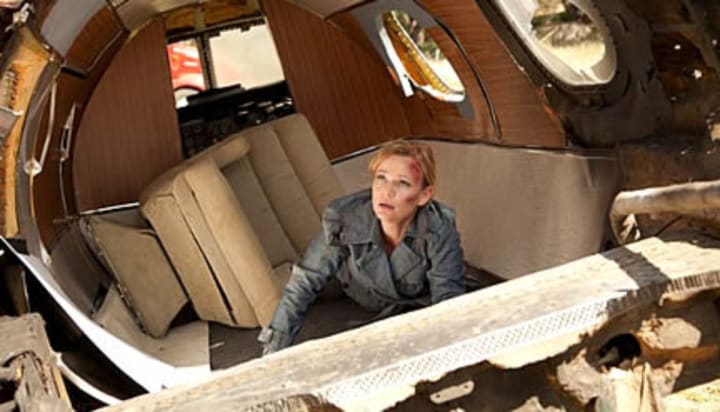
Part three is the longest, and opens with Dagny somehow being alive even though--and I had to re-read this, but they very clearly just state it--nobody helped her in the freefall. Like, we’re about to see this mythic sci-fi utopia of Rand’s ideas, but Dagny survives freefalling seven or eight hundred feet with only a broken leg through sheer dumb luck, not anyone there’s help or inventions. Or maybe because she’s just that awesome, as an industrialist, that she’s clinging to life! We’re off to the races.
Turns out, she’s landed in Atlantis! Not-- not the city under the sea; the hard-working, downtrodden Industrialists’ city is named Atlantis because it’s The Lost Empire. It was established by a banker named Midas Mulligan who was the first to start it and own the land after being persuaded to leave by John Galt--the man, not the phrase. But, to quote Dagny’s almost-final words, who is John Galt? Well, let’s introduce him, ⅔ through the book:
John Galt is Superman.
John Galt is the most hard-working man, who knows no fear or pain or guilt, who’s super smart and invented that motor that is so much better than anything else; he’s an electrical and chemical genius, a tall man with a chest that could crack walnuts, austere and blond and green-eyed and tall and handsome and super strong and he’s so handsome like, oh my God Dagny look at how he’s so confident and smooth and--
She’s immediately smitten because she just has hero worship for this kind of confidence in a man and also he’s really hot.
Galt takes her home with him because everyone visiting the valley they’re in in the Rockies stays in his guest bed to rehabilitate and get through the sad night when they come to terms with leaving everything behind. Dagny refuses to be coddled and works as his maid--which impresses and amuses him; she’s just that strong-willed a woman! What an industrialist--and experiences Ayn Rand’s utopic vision: a world of slim houses and few possessions where everyone WORKS HARD and the work IS the reward because it’s that you earned being tired and you produced something that you can sell and only you have it if you want because it’s yours! And everyone lives like that and the few artists there create triumphant masterpieces every single week based on their fervorous work ethic and Rand Hitchcock’s it by having a throwaway line about a writer who’s there who’s now a fisherwoman in her downtime because her novels were too advanced for society.
Everything’s profound and capitalistic and there’s only one “word forbidden in the valley: the word ‘give.’ ” Earn it yourself, pull yourself up by your own bootstraps, obviously that’s possible to everyone if they just tried and there’s still 400 pages left aaaaAAAUUUUUUUUUGH.
Dagny, at the end of the requisite indoctrination month, still has ties to the outside world by way of loving her ancestral train system, so she’s let go of back to New York. Galt reciprocates that he’s loved her from first sight, but don’t ever try and find him even though he’ll be watching her always. Watching. Always. Mmm: true love.

The outside world has absolutely fallen to pieces, barely holding on by way of Hank Rearden’s productivity with Rearden Metal and Taggart Transcontinental continuing to transport things.
A character I haven’t touched upon yet is Dr. Robert Stadler, who’s an example of “what if the Industrialists did try to work peacefully in the world?” He’s a scientist who’s brilliant and who is walked all over by his crony underlings until he’s a puppet of theirs and the evil government, leeching off of his name and reputation, and he himself closes off his mind and tries to just convince himself of his greatness. He’s John Galt’s other teacher; the first was that Hugh Akston guy Dagny found in the diner (and in Atlantis) who also taught the pirate Ragnar Danneskjöld and Francisco d’Anconia at the same time.
Dr. Stadler’s final caving in comes at the first scene back from Atlantis, which introduces what the government was so desperate for Rearden Metal for: PROJECT X. (I could’ve sworn I saw that on one of those Sinister Cinema double-features…) The inventive and unique name relates to a mushroom building that houses a device that nobody has expounded upon, which is definitely for the public good! Dr. Stadler invented it after all! (He signed the papers put in front of him whilst musing over how smart he was earlier in the book.) Here, we have a cute mama goat and her kid to demonstrate:
Project X uses soundwaves to HOLY LORD THE GOATS GOT FLATTENED INTO A CUBE OF MEAT! Who do I root for now in this dystopian America, now that my favorite goat characters are gone?! Oh hell, who is John Galt?
Dagny returns to New York to be crushed by waves of government lackeys asking her to be on their press conferences to reassure the nation she wasn’t another deserter and that they can trust her trains and Big Brothe-- oop, wrong book-- to help them through this ongoing crisis. Hank calls her and she realizes he spent the whole month she was gone up in a plane over the Rockies. She’s blackmailed onto the nationwide radio program the same way Hank was with turning over his product; want to tell the world about your affair?
Actually, uh, that’s-- that’s what she does.
Going totally off-script, she says “yeah I slept with him, I wanted to, I’m glad I did, I achieved it, what are you going to do about it? Also the government blackmailed him to giving in.”
Her broadcast is then cut off, and she waltzes out while the headless chickens Rand writes as antagonists rush about hither and yon. Hank’s totally fine with it too; he’s like “yeah, I love you but you never said you loved me in all the broadcast, so you must love another since you were away a full month. It’s all good baby!”
We get a full chapter devoted to Cherryl, whom we haven’t seen since the wedding, and it’s honestly heartbreaking. This sweet girl, trying to work her way up in life from poverty, marrying Jim because she thought he was a good person from the railroad working for the people, has been working night and day to fit with high society. Eventually, she realizes that that’s the opposite of what her husband wants: Jim Taggart “married her because she was worthless” and paraded her around to show how awkward she was and make himself feel better about look how good I am for helping. And after sleeping with Lillian Rearden basically in front of her, Jim hits her because I guess Rand just wants to drive the knife deeper into the readers? and Cherryl runs off into the night. She’s found by a social worker who berates her instead of offering help--social workers are eeeeevil!--and Cherryl drowns herself.
I’m gonna go stand in the sun for a bit. Just-- hold on.
Okay, so a bunch of stuff happens that ends this whole mess. Hank Rearden leaves his miserable “looter” (Rand calls everyone who disagrees with her praise of selfishness “looters” because they “loot” good selfish men of their property for nothing in return, and like--did they actually use that phrase in the '50's that much?) family for dead. He goes to Washington for a hopeless conference that’s almost the exact same one as we just saw with Dagny before the radio. He goes back to his mills to find that the workers planted by Washington have unionized and revolted--unions are eeeeevil!--and finds a minor character dying. Tony aka the Wet Nurse is a kid in earlier scenes who was just out of college and tried to help the government first but got more and more influenced by Rearden’s greatness to be more like him; he’s shot and left for dead in a slag heap down a hillside. He’s got a wonderfully poignant death scene that lasts way too long where he and Rearden put aside past differences. It’s undercut by how Rearden’s anger when Tony dies doesn’t go towards the people who killed him, but towards those darn college professors and coddling mothers who made him believe all this anti-industrial stuff and let the world get this bad in the first place; they’re eeeeevil!!!!
Rearden survives the eeeeevil mob by Francisco d’Anconia showing up guns blazing and murdering those people out to kill his man: Rearden, knocked out, wakes up with d’Anconia over him, nursing him, bodyguarding him, recruiting him to Galt’s mission and Atlantis as “my greatest achievement” and if this was on Netflix I swear to God-- imagine the fan videos of their scenes edited to “Delicate” by Taylor Swift, a soft velvety layer added with Adobe After-Effects, softening their gazes further. Oh, some glory’s come from this book!

Dagny realizes that Galt was stalking (keeping an eye; say it’s “keeping an eye!” he’s the hero not a creep!) her by working a menial track job in the station under her office, and that Eddie her assistant was also just telling him everything as someone anonymous to vent to. Dagny, upon seeing Galt in the tunnels (herself being there to fix a problem), goes off into the dark and he follows and they woawahaaaaAAAAAA MA’AM PLEASE IT’S SO GRIMY DOWN THERE!
Anyway he’s like “my penance for allowing this contact is never to let you see me now but I’ll still be watching you baby,” and off they go back to life, definitely healthy people.
The nation is told out of nowhere that this big government guy will do a full radio broadcast, but it’s interrupted by Galt with his super-secret-special-super-science-special-super technology, who freaking monologues for three hours in-universe--65 pages in reading--a full essay of Rand’s “Objectivism” philosophy. It boils down to ⅔ of SCREW YOU! to the entire world for being spineless and cowardly and following the government--Europe and South America having long succumbed to “People’s States” and Asia being--well, this is from the '50's and it’s rather racist--and ⅓ of that patented “well, I did it so obviously you can too” mentality. It took 3 days to read it all because I wanted to go soak my head in a storm.

Galt becomes the number one fugitive, and Dr. Stadler says “hey, guys, stop running about like headless chickens for the sixtieth time this book; just tail Dagny because obviously Galt’s going to go for her since she’s an industrialist.” It doesn’t work throughout a montage of mayhem erupting from people getting sick of the government and each other, including a lady “going to the New York hospital with a broken jaw after being slapped by a passerby for telling her child of five to give his favorite toy to his neighbor.” You know, a realistic and subtle thing to have suggested. Parts of the nation are seceding back into barbarian Mad Max tribes.
Dagny caves in finally because she’s just not sure if John’s still alive through all the mess the world’s become, and he’s right there at the address listed on the payroll of Taggart Transcontinental. They smooch and she was followed--but Galt’s way too smart! He already knew! He can do anything; oh, Jacob Marley be prai-- wrong book, apologies.
Because seeing Dagny hurt is the only thing that would make Galt cave in to the government’s eeeeevil demands that he lead them out of the crisis while they ride his back like the looters they are and beat out the last of his life like that one scene from Cat Soup, she acts on his orders to denounce him and hate him and waltzes away free from the secret police who arrive. Galt is captured and taken to the government HQ in New York’s formerly nicest hotel, where every one of the antagonists interviews him and goes shrieking that he’s unable to be talked to, he’s an egoist, he’s--
He asks for Dr. Stadler and Stadler monologues that screw you I just played by their rules and tried to do what I could and you’re the eeeeevil one! and, realizing he wanted his favorite student dead, panics and runs off to Project X where a faction struggling for power blows this pointless plotline and device to smithereens, having accomplished nothing narratively.

Galt is paraded to the nation at hidden gunpoint to give a speech with the hopes that he’ll concede; he stands up to show the gun and says “get the hell out of my way!” so they decide to torture him with electroshock currents to force him to become a dictator over them while they survive. It’s very silly. Jim Taggart tries to up the voltage to kill him and screams with sudden insanity realizing that he himself is eeeeevil and wants Galt and “the freedom of life Galt represents” dead.
Dagny, recruited by Francisco, busts into a military facility with Rearden and his new husband and they take over by easily killing trained guards. They bust John out and head back to Atlantis, reveling that they’ve won as New York’s electrical grid finally dies and the remaining thousands, hundreds of thousands, millions? of people below swarm only to eventually perish or become nomads with no resources or technology.
A brief final bolt of pain shows Eddie--sweet Eddie, who has spent the entire book helping out, who has gone through the most amount of degradation for his job, who couldn’t go with Dagny because he wanted to hold onto the railroad he served with her--on the last of the Taggart trains as it breaks down, refusing the offer of a nomad caravan to get the train working, finally being left to die in the locomotive’s spotlight alone in the Arizona desert.
In Atlantis, everything’s wonderful and they’re rewriting the constitution to include letting industrialists get away with anything. Everyone there’s happy and ready to go back to reshape the world in their image. The end.

“Atlas Shrugged” is not a masterpiece for three critical reasons, all of which relate to the writing. One is that the book is overwritten. Two is that the book is devoid of subtlety. Third and most pressing is that the book’s ideology is dangerous.
The first is easiest to argue. For context: I have worked personally and professionally as an editor for writing, moreso for film scripts, but also for novels. This book is 645,000 words: it could be ¼ the length, and you would not have to cut a single scene. It is that badly overwritten. This is an unedited first draft. The same arguments play out again and again and again, with sentences that run on and on and on, with examples and anecdotes and descriptions and inner musings that relate the same thing over and over. If it were ¼ the length it is, it would still be a slog, but it would be manageable.
The second point is supported a lot by the first. People do not speak like people: they speak like two puppets whose strings relate the viewpoints of Rand, and the entire rest of the world that Rand wants to make look like morons for not agreeing. Case and point, from Hank Rearden’s final talk with his family:
“ ‘If you still want me to explain it, Mother,’ he said very quietly, ‘if you’re still hoping that I won’t be cruel enough to name what you’re pretending not to know, then here’s what’s wrong with your idea of forgiveness: You regret that you’ve hurt me and, as your atonement for it, you ask that I offer myself to total immolation.’
“ ‘Logic!’ she screamed. ‘There you go again with your damn logic! It’s pity that we need, pity, not logic!’ ”
That’s all said after six or seven pages of arguing and screeching, the third or fourth scene of that family dynamic and by far the shortest of them in the book.
Later the same chapter, after Tony the Wet Nurse dies in his arms, having just achieved that happiness of being an industrialist and being capable:
“He walked, as if this were his form of last tribute and funeral procession for the young life that had ended in his arms. He felt an anger too intense to identify except as a pressure within him: it was a desire to kill.
“The desire was not directed at the unknown thug who had sent a bullet through the boy’s body, or at the looting bureaucrats who had hired the thug to do it, but at the boy’s teachers who had delivered him, disarmed, to the thug’s gun--at the soft, safe assassins of college classrooms who, incompetent to answer the queries of a quest for reason, took pleasure in crippling the young minds entrusted to their care.”
That inner “tell, don’t show” which caps off and destroys one of the best scenes of the book goes on for a full page of metaphors and examples.
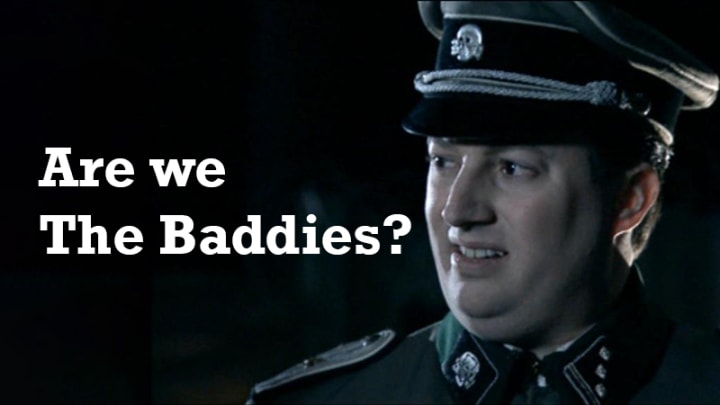
Which brings us to point three:
This book is dangerous.
It is not dangerous because it is “right” or “wrong” but dangerous because it presents a contrived, extreme, unrealistic world of characters, then acts with complete sincerity and conviction to convince you that the author’s binary rhetoric of the way to see the world is how you too should view things, and shame on you otherwise. The people are not real: they are caricatures. Nobody is going to torture someone while yelling “We demand that you dictate!” Nobody is going to go off the deep end after 1064 pages of wailing about everything because they realized they were evil. Nobody is that perfect John Galt, and if they were, would you actually want to live in that back-breaking society? Rand’s idea of Atlantis also points out: all these people, working their butts off every single day, the best of the best at what they do, are willing to whole-heartedly concede if a competitor surpasses them. Feel free to correct me if you’re in business, but I highly doubt a single person would agree with that “well shucks, you’re better, you've put me out of business; I can roll over and immediately work for you!” mentality.
The closest we get to non-caricatures are Cherryl Taggart and Eddie Willers. One is driven to drown herself; the other presumably dies a broken man in the Arizona desert. Neither is the steel-jawed selfish industrialist: they are people trying to help and do the right thing, and they suffer the worst punishments in the book.
In Galt’s radio speech--Rand’s essay on her ideals--one of the key things Galt says is “There are two sides to every issue: one side is right and the other side is wrong, but the middle is always evil.” This opinion is refuted by Dr. Stadler, who says “You permit no moments of weakness, you don’t allow for human frailties or human feelings!” and since he’s evil, that’s considered wrong and followed up with "AND YOU SHOULD BE UNALIVED!" People are selfish or they’re so bleeding-heart they want to emotionally devour everyone around them, in this world. There is no place for random acts of kindness or compassion: those are considered evil. There are no compromises, no generosities, and no acts done without some selfish trade intended. The world is painted black and white for “Atlas Shrugged” and takes into account none of the necessary shades of gray.
There are factors in this real human world that make it impossible for some people to get ahead. There are factors that make it sheer luck that some people do get ahead. I am where I am due to a college I could get into because of my own hard work--and my dad working there. Dagny Taggart is where she is because of her determination--and that she inherited a transcontinental railroad company doing booming business. Cherryl Taggart worked hard in a supermarket--and couldn’t escape poverty until a rich person whisked her up; not her "pulling herself up by her own bootstraps" despite years of effort. There are shades of gray.
The end result of this mentality of Rand’s is “us vs. them.” That is dangerous, as exemplified in the novel’s ending itself. Dagny, upon trying to break out John from his torture, holds a guard at gunpoint telling him to unlock the door or try and shoot her first. The guard is caught between following his orders and dying or disobeying and being killed by the government:
“Calmly and impersonally, she, who would have hesitated to fire at an animal, pulled the trigger and fired straight at the heart of a man who had wanted to exist without the responsibility of consciousness.”
The first step towards harming someone else, or groups of someone elses, is developing impersonal feelings and dehumanization. This is the end of Rand’s ideals. This is her heroine.

For the sake of being fair, there are things I did like about this book. The key thing I enjoyed was the sense of scale it had: it is told on an epic scale, with a huge cast and an intricate layering of characters and relationships that I enjoyed once I got past the prose. There are dynamic scenes that are visually stunning: Dagny seeing Wyatt’s Torch of burning oil, Dagny and Hank watching Francisco smile as he causes chaos by destroying his stock at James Taggart’s wedding, Hank carrying Tony up from the slag as the steel mills erupt in flames. There are actually things in Rand’s essay that I agreed with; things like you can’t cheat yourself out of reality, and you have to accept a mistake has happened. If someone’s view is right and you find yours isn’t, listen and accept it with grace as a new thing learned. Never start a fight if you can help it but defend yourself because you’re worth defending. And, Ms. Rand definitely did her research into making this world’s locations and processes believable; the descriptions of the inner workings of a train company (Taggart Transcontinental being modeled off of the New York system), of a steel mill, of a copper mine, of opulence in high society and of poverty-stricken towns, makes you believe you could feel the world’s settings and find yourself working there as another person on the tracks.

“Atlas Shrugged” is a conundrum, but I sort of knew that going in. The inside blurb, after all, says “This is the story of a man who said that he would stop the motor of the world--and did. Is he a destroyer or a liberator? Why does he have to fight his battle not against his enemies but against those who need him most? Why does he fight his hardest battle against the woman he loves?”
Why are we asking these at the start, learning that the mystery man eventually known as John Galt is there, when over half the book is a mystery trying to learn where all the industrialists went?
An editor was needed.
“Atlas Shrugged” as a title refers to this idea: overthrowing the burden of the world because you’re carrying it. I do like that kind of poignancy.
It is, currently, my second most disliked book I’ve read, and certainly the longest of that list. John Fowles’ “The Magus” was second place before (my review, for my father’s blog, which covers the book and the movie can be found here) but honestly, I think I'd rather reread that than this. J. K. Huysman’s “Là-bas” remains in number one. If there’s any interest, I could talk about that someday.
To give Ms. Rand some amount of credit, she did not have an easy life. Born Alisa Zinovyevna Rosenbaum, she lived through the October Revolution and Lenin’s rule in Russia as a young child, fleeing her first home as civil war descended on the country. She did not have an easy life, seeing first-hand her family get close to starvation and being thrown out of university along with numerous other middle-class students. She learned English after coming to the US and lived through two world wars and McCarthyism--working in Hollywood as a screenwriter throughout much of it and fighting off the effects of prescription drugs that wrecked her system early on. I do not agree with a lot of her material: she was also human, and her viewpoints had roots in a hard life. That she chose the things she did is a combination of her own free will and the conditions around her, just as it is for all of us. Could I have chosen better, if I were her?
I hope I could’ve. Only the Gods know.

The best that I can offer, when it comes to “Atlas Shrugged”, is that I can understand why it is as important a book as it is, and why it is so talked-about. When I was reading it, a process that took from February to July, I was asked constantly “why haven’t you put that down yet?” and my answer was always “historical context.” I wanted to know what drew people to the book, and why it gathered such volatile emotions. I know now, and have drawn my own opinions of it above. A friend from work, when trying to wrap his head around it as I described it to him, nodded and said “It’s like if George Orwell wrote ‘1984’ about communism instead of fascism, and just wrote way too much.” That’s the best summary of the writing I could’ve given.
I think that material you may disagree with is important to read, but, bluntly, this book is too long to recommend for someone who might disagree with it. Read “Anthem” if you want to read any Rand. It’s truly the exact same, besides the specific events. It’s just as disagreeable.
Hopefully my next review can be something much more pleasant! I knew I wanted to review this book, and knew that I did not ever want to reread it to write that review sometime in the future. I hope this read has been enjoyable!
Reard’Anconia forever <3

About the Creator
Keep reading
More stories from Justin von Bosau and writers in Geeks and other communities.
Apron's Folly. Runner-Up in Campfire Ghost Story Challenge.
The cabin in the woods had been abandoned for years, but one night, a candle burned in the window. It was an early summer night, rich with the smells of wild honeysuckle and apples fallen off their trees. The cicadas whirled their music through Grover's Field, and under the starlight, the six of us had wandered into nature to get drunk and sweaty and carefree. But then, after the first libations were poured, Mac looked over towards the shell of Apron's Folly, and exclaimed, waking us up from our revels.
By Justin von Bosau4 years ago in Horror



Comments
There are no comments for this story
Be the first to respond and start the conversation.