
The American Film
"The Best Years of Our Lives" and Paul Thomas Anderson

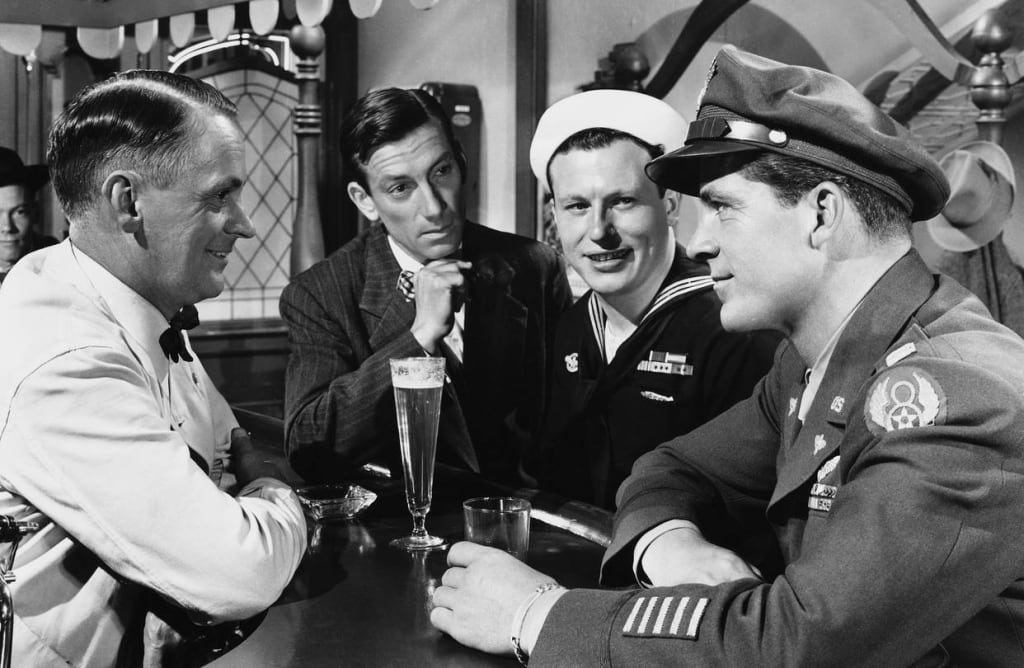
There is a dialogue exchange in The Best Years of Our Lives (Wyler, 1946) in which Fred (Dana Andrews) reminisces about his pre-war career as a soda jerk. He brags that he can throw a scoop of ice cream into the air and have it land perfectly into the cone every time, he jokes that this is the training that allowed him to successfully drop bombs on all of his intended targets. There is a real melancholy to Wyler’s film. In reality, it’s a film about trauma bubbling under the surface of a picturesque America. We as viewers are confronted about how we approach war, and if it is worth it. In another scene, Homer Parrish (Harold Russell) is told by a Nazi sympathizer that he lost his hands for nothing, his sacrifice had no meaning, thus leading to the powerful image of an American flag lapel pin juxtaposed against Russell’s prosthetic hooks. Wyler is directly contrasting the American dream against the harsh realities of what it takes to protect it. By the end of the film, it seems that the thesis reached, as per Wyler’s vision, is that military service is a patriotic sacrifice you make for the sake of your friends, family, and neighbors. This is not necessarily incorrect, but it showcases a sometimes problematic trend in American pop culture. We as Americans like to think we are immune to criticism, and that we somehow have a moral high ground on the rest of the world. This hypocrisy has affected American media for decades, and only recently have we started to examine that. There Will Be Blood (Anderson, 2007) is a film that picks at the two biggest paragons of American culture. That being capitalism and religion, represented by Daniel Plainview (Daniel Day-Lewis) and Eli Sunday (Paul Dano) respectively. The film is ultimately a farce, in that it shows that these two main building blocks of American culture cannot coexist. One cannot be a true capitalist while being truly religious and vice versa. So, we are faced with the fact that our foundational governing principles are based on a contradictory lie. The tragedy of the film comes when greed beats virtue to death, and ultimately our darkest angels triumph more often than our better ones. Accompanied by Jonny Greenwood's score, the prospectors arrive and steal the lifeblood from America’s natural beauty and Californian landscape, dooming generations of Americans to live off of their blood money and malicious industry for the next century. There is something transcendental in the way Anderson shoots tornadoes of fire and raining black oil. Visually it is a representation of the rape of the natural world. The color of the natural landscape is drowned in deep black muck. The greed of the characters is represented within the landscape as their morals grow as black as the oil. Honest religion is defeated by capitalism as Eli is tricked into admitting he is a false, atheistic, prophet and is murdered by Daniel for it. The American dream is dead and we are doomed. Anderson explores similar themes in The Master (Anderson, 2012) as good religion and conspiracy theory blur together beyond recognition. Set against the busting, up-tempo world of 1950s America, we watch as traumatized Americans crawl to fearful deities. We are scared of the world we live in, and the jazzy swing of the 50s is a facade. Our lives are destroyed by our societal evils. There is hope to be found in the works of Anderson and in The Best Years of Our Lives, however. We can escape through our virtues and the virtues of others. We can find relief lying in bed after being cared for by a loved one. The shot of the tear trickling down Homer Parrish's face, maybe that’s the American dream.
About the Creator
Rowan Harper
Rowan Harper is a Colorado-based filmmaker, film critic/historian, and lifelong lover of the arts. Rowan's career includes extensive experience as an actor, director, producer, stagehand, and awarded musician in both film and live theater.
Keep reading
More stories from Rowan Harper and writers in Geeks and other communities.
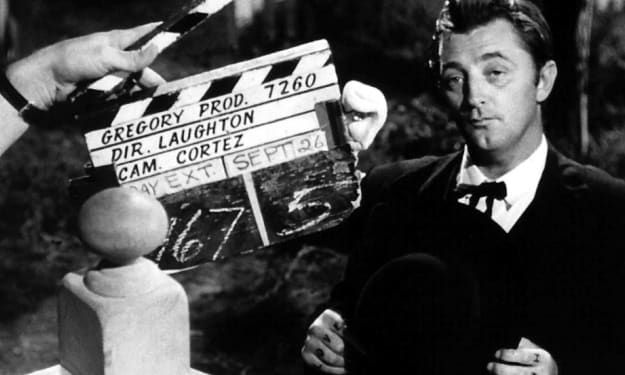
Notes on "The Night of The Hunter"
Bold, adventurous, and wonderfully singular would all be apt descriptors for The Night of The Hunter (Laughton, 1955). A picture bathed and cloaked in shadow and corruption, yet whose ideas are as optimistic and bright as sunshine. At the core, this is a story of good vs. evil, of religion, of childhood and family values. Rarely are children so understood and treated with such compassion in the movies as they are here. Our hero in this story is a little boy who protects his baby sister from all harm, at all costs. What could be more noble? The quest taken here is one of a child reclaiming the innocence and happiness of life, for himself and his little sister, after it was stolen by a seemingly unstoppable evil. As we grow, the purity of childhood and the tenderness of our parents grow farther and farther away. Good people expose themselves to the evil and pure vile of the world to cultivate empathy for others. Some people do this willingly while others are forced into this reality due to a personal tragedy. Regardless though, there is a selfish desire in us all to hide from this evil and escape down a river somewhere. The Night of The Hunter is heart-wrenching wish fulfillment. Indeed, this is the response to the call of the inner child in us all. What can be said about the centerpiece of this film? Two lullabies bookending a gothic odyssey down a river, as the creatures of the forest and swamp watch over our two young protagonists. This is pure fairy tale. And why not? The first lullaby represents the inner monologue of a child, and the confidence Charles Laughton has in his direction allows this moment to feel as if it is the most important thing in the world. He understands that there is probably nothing more insightful than the thoughts of a child, and he loves his characters so much that he grants them a moment of clarity that few characters are allowed to have in the movies. The second lullaby is for the audience. Although, it is more of a prayer than a lullaby. A disembodied narrator breaks the fourth wall to sing to these kids, but the lyrics should echo the viewer's thoughts. She pleads for the heroes inside the screen to rest, and to dream, and with one degree of separation, she is pleading for the audience to do the same. Again, she is talking to the restless and discontent child inside us all. The repeated motif of lullabies and hymns is some of the most beautiful and transportive use of music ever in film, especially in the context of the wonderful work done by the actors. Billy Chapin and Sally Jane Bruce deliver two of the most endearing child performances ever in film, but the groundbreaking work done by Robert Mitchum and Lillian Gish, playing two opposite sides of the religious coin, provide the thesis for the film. Religion at its most oppressive and evil as represented by Robert Mitchum, and at its most loving and kind as represented by Lillian Gish. Going back to the idea of song, their beautiful duet shows these opposing factions of religion converging and melding together and asks the audience to pick which path they will follow. Despite the threat of the film being the horror and evil of religion, this is a film that is unapologetically pro-religion and pro-God but warns that there is perhaps nothing as vile as a corrupted religious figure. The corruption of something as innocent as a loving God or a child, and how we “endure and abide” this corruption, as Rachel Cooper says, is the point Laughton is making. We are small, and it’s a hard world for little things, but not if we stick together. My life has been marked by before I saw The Night of The Hunter and after I saw it.
By Rowan Harper11 months ago in Geeks
Silver Screen Magic with Mae West
American actress and singer Mae West became a popular film actress during the Great Depression. She started entertaining in vaudeville, then performed on Broadway, and finally went to Hollywood. She signed up with Paramount Pictures and made her debut in the 1932 film “Night After Night.” She also starred in musicals, comedies, and crime dramas. The American Film Institute named her one of the best classic Hollywood actresses.
By Rasma Raisters11 days ago in Geeks
Beyoncé’s Powerful Message On Embracing Imperfection
Beyoncé Knowles-Carter has built a reputation for making the extraordinary look effortless. Her name conjures images of sold-out stadiums, chart-topping hits, and an aura of near-invincibility. Yet, in a world obsessed with perfection, Beyoncé’s most enduring lesson may be her willingness to talk about losing—and how it shapes us all.
By Dena Falken Esqa day ago in Geeks



Comments
There are no comments for this story
Be the first to respond and start the conversation.