
Surviving the Pandemic with Petronius, Fitzgerald, and Eliot, The Wrath of the Gods
THE COVID ERA

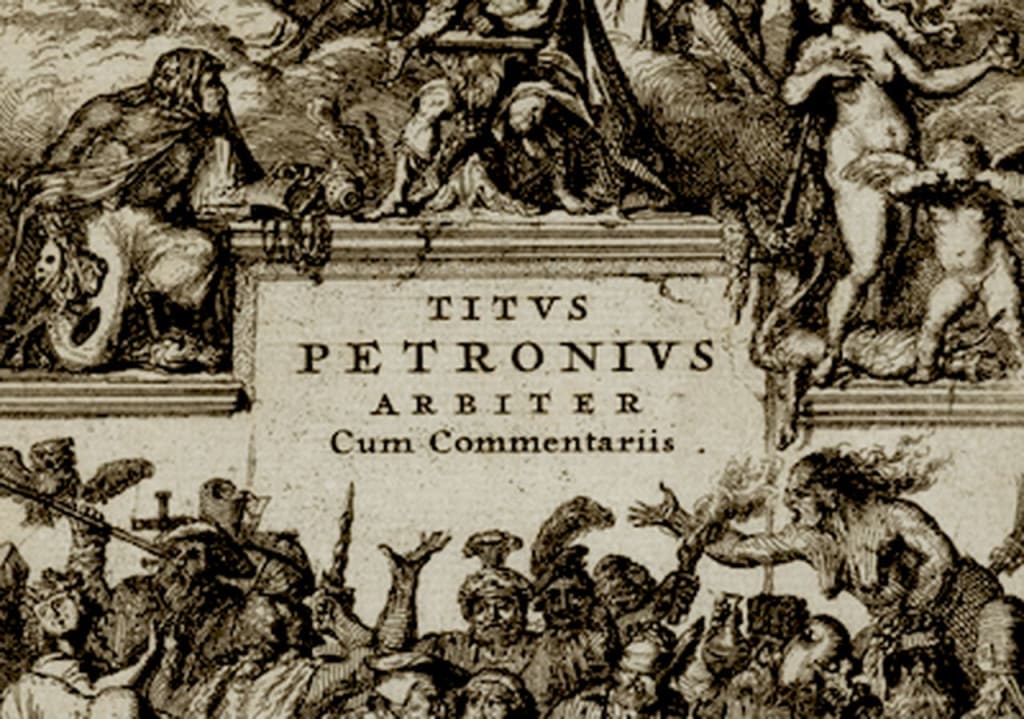
THE COVID ERA has resulted in many unusual adaptations, new obsessions, new habits, or a relapse into old ones. My most bookish COVID interest has been rereading my grad school Latin literature, particularly Petronius, courtier to Nero and author of the Satyricon. For a long time, I wasn't sure why the Satyricon had such a special pull on me; all I knew was that it was possibly the only book that consistently made me laugh out loud, even when I was at my lowest and gloomiest, despairing about the gray life of quarantine or depressed about living in a country that seemed to be collapsing into itself.
In a nutshell, the Satyricon is a picaresque Roman novel composed in a blend of prose and verse — a genre known as Menippean satire — that applies high epic conventions to some of the lowest and most vile behavior ever recorded in literature. The title quickly exposes readers to the pornographic content: Satyricon is a plural Greek term that translates to "a slew of filthy exploits." The term also implies that the author's attitude would be characterized by the literary and moral levity of satura, or satire. That is correct. As a result, we get a picaresque satirical anti-epic.
Aeneas is recognized for his piety, and he was punished for angering Juno; Odysseus is known for his wit, and he was cursed to roam for ten years because he displeased Poseidon. In a similar spirit, the Satyricon's protagonist, an aesthete and former gladiator named Encolpius, is famed for his passion and inability to satiate it since he has enraged Priapus, the fertility god, who robs him of his sexual function. Encolpius, our antihero, is impotent in love but amazingly durable in every other regard. and his unspeakably filthy antics resemble those of his legendary forefathers, with nonstop comedic effects. Reading the Satyricon is like watching a Looney Tunes cartoon that happens to be narrated by a pansexual orgy. Petronius sings of man and his third leg, whereas Virgil famously sings of "arms and the man."
But it wasn't only the constant laughter that drew me back to Petronius. Something about his portrayal of serious issues like slavery, income disparity, and empire collapse made him feel especially relevant at the pandemic's worst days. Despite the fact that Petronius seldom gives even a glimpse of a solution to any of the issues his characters bemoan — political corruption, the way imperial expansion depletes natural resources and degrades public morals – I continue to find him reassuring. I also wish we had more of the novel; the majority of the text has been destroyed, and the surviving parts are simply fragments of the original, probably only one-sixth of Petronius's whole work. In some ways, this omission may be appropriate, heightening the work's picaresque features and foiling fiction's tendency to close things up in a manner that life rarely does.
Petronius is one of the most famous chroniclers of societal decay and failure in literature. And the Satyricon holds a peculiar allure in times of uncertainty, when death and decay are on everyone's minds. This isn't just wishful thinking on my side. It can be proven historically.
Consider this: T. S. Eliot's The Waste Land (1922) and F. Scott Fitzgerald's The Great Gatsby (1925), two of the most widely read novels from the 1920s, are both rife with foreboding — and both take clear and explicit inspiration from Petronius. The Great War was finished, and America went through a period of frenetic excess, while England went through a period of uncertain recuperation. In both countries, a new era of new mechanization, new construction, new and sometimes dubious financial investment opportunities, and millions of new consumer goods was upending old class structures and creating new classes of people in danger of being mechanized themselves, while the one-percenters partied so freely that the system eventually crashed. As a result, Fitzgerald (a romantic elitist with a socialist bent) and Eliot (a romantic elitist with a socialist bent) (whose snobbery was existential in its scope and dire in its conclusions) recorded the era via poetic sadness in many forms. The new elite, according to Fitzgerald, were obnoxious, uneducated, and brutal to their economic inferiors, while an idealized past was unrecoverable (and, frankly, probably not worth recovering). The present for Eliot was a stale sequence of failed relationships, while the future was a valley of bones, all omens pointing toward infertility and catastrophe. Tiresias can attest to this.
It would be simple to argue that the Satyricon paints a similarly grim image of decadence in the Neronian period if the work wasn't so dang entertaining. Yet it is impossible to dispute that Encolpius is swimming against the river, that his journey through Campania, Crotona, and other southern Italian villages is a futile attempt to reverse Priapus' curse and reclaim Giton's affection (his boy-toy), and to seek sanctuary in the empire, where he will be secure from witches, creditors, sophistic tutors, and especially reciters of repulsive poetry, all while scrounging free dinners from the newly wealthy of the Roman Silver Age. Trimalchio, a former slave turned wealthy notorious for his gross excesses, which reflect the decadence of his class, his emperor, and his period, is the most prominent of the latter, and he would become a pivotal figure for Fitzgerald.
In the mid-60s CE, Petronius penned the Satyricon. The Golden Age of Rome is passed; Virgil's followers are mostly cultural parasites; and the novel's characters are very embarrassed of the cultural decay that their heinous behavior will only expedite. Of course, it's a riotously funny piece. However, for future chroniclers of decline, the beautiful cynicism that made it so enjoyable would emerge as a darker influence. The Petronian influence in Fitzgerald contributes to the spectacle of a dangerously decadent generation and class, and ultimately to the death of dreams. It contributes to Eliot's notion that the future is empty, that no matter how far one travels, one is certain to end up somewhere bleak — possibly in "rats' alley / Where the dead men lost their bones," or somewhere even worse. Tiresias and the Sybil, the poem's farthest-seeing voices, appear to want death more than anything else.
Of course, the presence of the Petronian strain in each of these works is no surprise. Trimalchio in West Egg was Gatsby's initial title, and The Waste Land begins with a direct quote from him: "I have seen with my own eyes the Sibyl hanging in a jar, and when the lads asked her, 'What do you want?' she said, 'I want to die." Yet, as far as I'm aware (and I've looked), no critic has examined these two works together via a Petronian lens, or questioned why the always light-hearted Petronius would cut such a significant figure amid narrators of misery and decadence. In the start of his 1936 Esquire article "The Crack-Up," Fitzgerald writes, "[A]ll existence is a process of breaking down." Fitzgerald's doomstruck and romantic fascination with the decline of whole generations of people, of communal dreams, is deeply personal in the context of the essay — Fitzgerald had already experienced numerous breakdowns and would go on to suffer a string of even worse ones that ended with his dramatic collapse and death in December 1940 — but it also applies to his doomstruck and romantic fascination with the decline of whole generations of people, of communal dreams. (Not to mention the awful reality that death has undone so many, as Eliot puts it.)
Anyway, I was stuck inside one day, giggling at a scenario in which Encolpius had shaved off all of his hair, including his eyebrows, and branded his forehead like a prisoner to avoid being identified by a furious man whose wife he previously seduced. These embarrassing efforts are futile - the guy reaches out, fondles our antihero's obviously identifiable nether regions, thus identifying him, and exclaims, "Greetings, Encolpius!" with a vengeful sneer. There was nowhere for me to go because it was raining outside. So, while gently pushing for more people to read the Satyricon — in times of misery, definitely, but also, one hopes, in times of optimism and wealth, whenever they may come — I thought I'd take a little tour of the impact Petronius creates in these two works.
Petronius Arbiter
Gaius Petronius was a Roman administrator, statesman, and ultimately courtier to Nero who served as proconsul and later consul of Bithynia in modern-day Turkey in the early 60s CE. When he returned to Rome, he established himself as an aesthete known for sleeping away his days and spending his nights in refined luxury, having acquitted himself well as an overseer of Rome's expanding and increasingly decadent empire (the Roman historian Tacitus, born a decade before Petronius's death, writes that Petronius "showed himself a man of vigor and equal to business" in Bithynia),
Petronius was quickly appointed as Emperor Nero's arbiter elegantiae, the court's arbitrator in issues of culture and pleasure, who advised the famously tasteless emperor on everything from poetry to haute cuisine. "The Emperor deemed nothing attractive or lovely in luxury unless Petronius had voiced his approbation of it," Tacitus writes. "Indolence had lifted him to prominence, as activity rises others, and he was reckoned not a debauchee and spendthrift, like most of those who squander their money, but a man of refined luxury," writes the famous historian in the Annales of Petronius.
Others, meantime, have regarded Petronius's graceful laziness admirable. In a 1923 poem, Oliver St. John Gogarty, the Irish poet and polymath notable for having inspired the character of Buck Mulligan in Joyce's Ulysses, exalted Petronius as a role model, inspired by Tacitus' statement about "indolence" (ignavia).
Proconsul of Bithynia,
Who loved to turn the night to day,
Yet for your ease had more to show
Than others for their push and go,
Teach us to save the Spirit’s expense,
And win to Fame through indolence.
While the Satyricon follows some epic poetry patterns, it also follows the legacy of Greek romances and lowbrow theater. Petronius was admired for his taste and literary ability; even some of the Satyricon's poor poetry are actually quite brilliant, and his allusive writing, however filthy the content, is frequently lovely. But he was also attracted by all things low and decadent, and he had an ear for the lower classes' talks, which contributes to the Satyricon's magnificent range of tone. True, he thought Nero was low and decadent, and Nero finally wanted Petronius' murder, not for his scathing sarcasm, but for his suspected involvement in an assassination plan with senator Gaius Calpurnius Piso. Petronius was uninvolved in Piso's conspiracy, according to Tacitus, but Nero was not renowned for leniency, and as we will see, Petronius terminated his life with what is arguably the most exquisite suicide in history.
Fitzgerald and Petronius
When commentators consider Petronius's often-overlooked effect on The Great Gatsby in the last two decades, they tend to write with a sorrow that borders on mournfulness. In 2009, the academic Nikolai Endres regretted that "[p]oor Petronius, the sage of Rome [...] has gotten little respect" among the authors who helped shape the moral and literary texture of that great tale. The sigh is practically audible. However, it is easy to sympathize with Endres and the Roman sage. Petronius was in a bad way! A century ago this year, it appeared as if the old man might experience a cultural renaissance that never materialized.
In 1921, under his imprint Boni & Liveright, the legendary publisher Horace Liveright, who had launched the Modern Library in 1917 (a perpetual supply of affordable, dependable copies of major books), was prepared to produce the first full English translation of Petronius, including the raciest sections. "Liveright made money publishing deluxe unexpurgated editions of oft-banned literary classics on a subscription basis, on the understanding that these books were available only to those who could afford them and thus stood no chance of corrupting the general public," writes classicist Ward Briggs of Boni & Liveright's M.O. during this period, as well as the authorities' small-c conservatism over some of the house's more risqué offerings. " formalized paraphrase (Between these expensive volumes and the affordable ones of the Modern Library, Liveright was cannily catering to every pocketbook.) The translation was created by W. C. Firebaugh, an English historian and Latinist, and was published the following year, incorporating several apocrypha (which Firebaugh, to his credit, sequestered from the original bits).
Soon after, the volume sparked a high-profile obscenity lawsuit when the Society for the Suppression of Vice filed a complaint trying to prohibit the book's sale. The issue was not quite a national scandal, but it rippled across New York's literary scene, and the Times even weighed in, writing in an editorial on July 27, 1922, "The existing bits of what must have been a large book reflect a tremendous intellect." "They contain great writing, some wonderful literary and aesthetic critique, and, above all, they provide proof of the socioeconomic conditions in certain sections of society in Rome in the first century A.D. that can be found nowhere else." Suppressing Petronius would be a huge loss to human knowledge."
Judge Charles Oberwager concurred, dismissing the case in late September after firmly siding with Petronius. "The Satyricon is a scathing satire on the ugliness of mere money, its vanity and grossness," Oberwager said of the work. The author was interested in both academic pursuits and the vices and follies of his own dark day. He was both horrified and captivated by the worship of the flesh and its lusts. (The judge's accuracy implies that he read the book, making him an even more appealing character — though it's likely that he created this thumbnail portrait of the work from the 80-plus tributes to Petronius that Liveright had sent him as part of his defense.)
The Society for the Suppression of Vice lost the lawsuit, but it had another important outcome: Petronius was likely reintroduced to F. Scott Fitzgerald's literary radar as a result of the trial. This return, according to Briggs, was owed in part to Fitzgerald's friend and regular correspondent Thomas R. Smith, who had commissioned Firebaugh's translation as Liveright's main editor. It was an opportune rediscovery. If we use Amory Blaine, the protagonist of Fitzgerald's 1920 first novel This Side of Paradise, as a stand-in for the author — as we should in most cases — then Fitzgerald was already familiar with Petronius. "Even [his] reading paled [...] he delved further into the misty side streets of literature: Huysmans, Walter Pater, Theophile Gautier, and the racier sections of Rabelais, Boccaccio, Petronius, and Suetonius," writes Amory after he loses his star status at Princeton after his romantic defeat with Isabelle Borge. " As a result, Fitzgerald would have been vaguely familiar with the Satyricon until the obscenity incident brought it more vividly to his notice, while also providing him with his first opportunity to read the entire work. By all accounts, his Latin was virtually as terrible as his Greek. "The markings in Fitzgerald's Loeb evoke the image of a curious reader whose appetite has been whetted by turns in the narrative that are clearly salacious but in a language he barely understands," wrote scholar Rose MacLean in 2016, after inspecting Fitzgerald's Loeb edition of Petronius, with facing-page Latin and English, at Princeton's Department of Rare Books and Special Collections. "These expurgations may have motivated him to seek the aid of Firebaugh's more complete translation," MacLean says. "In those days, the Loeb versions tended to leave parts of graphic sexuality untranslated."
Fitzgerald was starting notes for The Great Gatsby that year, and he was also seeing much of the high-class excess that shaped some of the novel's most iconic passages. Whatever portions of the Satyricon he studied, he would have found an old precedent for many of the same themes of aristocratic decadence and cultural degradation that occur in his most renowned work, The Satyricon. It is set in the year 1922. Even though the book's narrator, Nick Carraway, identifies the two right at the end: "It was when interest about Gatsby was at its height that the lights in his house failed to go on one Saturday night — and as obscurely as it had begun, his career as Trimalchio was finished." " Carraway is alluding to both men's reputations for lavish parties, however it's worth noting that Trimalchio's first commercial success was exporting wine, whilst Gatsby is finally revealed to be a high-flying bootlegger. These two places are where the characters' similarities begin and finish. The comparison piqued Fitzgerald's interest, but it was Petronius' broad critique of luxury in an age of waste that piqued his interest even more.
As various academics have lately pointed out, the Satyricon's effect on Fitzgerald extends much beyond Trimalchio. "Other Petronian figures provide insight on Fitzgerald's picture of earthly wants and foibles," MacLean argues, noting that Encolpius's ill-fated infatuation to a Crotonian lady named Circe "may readily explain Gatsby's misguided pursuit of Daisy Buchanan." " Furthermore, after Gatsby is assassinated in his pool, Nick Carraway notices the body floating among "little ripples that were hardly the shadows of waves"; MacLean draws our attention to a strikingly similar scene in the Satyricon following a shipwreck, when Encolpius notices a sailor's body "turning around in a gentle eddy" and laments: "Such is the end of mortals' plans Beyond these minor details, MacLean draws parallels between Encolpius' participation in one specific orgy and Nick's encounter with Tom Buchanan and his lover, Mrs. Myrtle Wilson, at a harsh party in Manhattan.
These are tight, vivid readings that deserve appreciation for drawing our focus away from Trimalchio's role in Gatsby. They also highlight the underlying Petronian feeling of ugliness and futility that lies underneath the seeming brilliance of both epochs, as well as the corrupted classes that predominate in each. Fitzgerald would return to this feeling of impending economic and cultural calamity in practically every moment of ostensible joy in The Great Gatsby. He reminisced about the extravagant coarseness of the elite during the boom years of the '20s in his 1931 essay "Echoes of the Jazz Age," without a trace of nostalgia: "It was borrowed time anyhow — the whole upper tenth of a nation living with the insouciance of grand dukes and the casualness of chorus girls." " It's a telling line, conveying both snobbery and inverse snobbery, the same admixture that makes Petronius, a nobleman who despises both Nero and Trimalchian arrivistes, such a rich arbiter of Rome's decline under the last of the Julio-Claudian emperors, such a rich arbiter of the decline of Rome under the last of the Julio-Claud
Eliot and Petronius
While Fitzgerald was alternatively partying and collecting notes about the failures of the one percent of which he yearned to be a part, 1922 gave us The Waste Land, in which the evocation of societal doom is more clearer. The Petronian inspirations are less startling in Eliot; unlike Fitzgerald, Eliot is virtually a Classicist, and while he employed translations, he didn't require them as much as Fitzgerald.
The principal literary sources of The Waste Land are well-known: James George Frazer's The Golden Bough (1890), Jessie L. Weston's From Ritual to Romance (1919), as well as Dante and the required ancients, Chaucer at the introduction, and far too many more to list. Petronius, on the other hand, provides the poem's epigraph concerning Sybil's incarceration at Cumae and her desire to die. Phlebas the Phoenecian's drowning in the poem's fourth part, "Death by Water," is often seen as a reference to Encolpius' shipwreck at the conclusion of the preserved chapters of the Satyricon. Similarly, Eliot's fortune-teller, who foretells Phlebas' drowning, harkens back to numerous particular incidents of divination in Petronius.
Eliot's debt to Petronius, like Fitzgerald's, is more obvious in its overall attitude than in its explicit allusions. (Listing the borrowings can, in fact, feel like mindless accounting at times.) The Satyricon "contributed to the propulsive combination of [The Waste Land], or at least to the process of ignition," as historian Francis Noel Lees noted in 1966. This is a beautiful and furious line about a poem dedicated to ashes, and it's hard to argue with Lees. The main goal of Eliot's poetry was to make it sound like genuine conversation, evoking the demotic tendencies of Petronius' seemingly casual narration in the Satyricon. Petronius, a well-traveled man of the world, combines vernacular with scholarly references in a way that I haven't seen in any other Classical author, and probably only in Eliot among moderns. According to Pericles Lewis' assessment, there is "approximately one allusion per two lines" in the opening portion of The Waste Land, in addition to Eliot's colloquialisms and snatches of common discourse. I haven't calculated it, but Petronius isn't far behind Eliot in terms of allusive frequency.
When compared to Eliot's most famous poem, Petronius' combination of prose and poetry appears to be a critical predecessor. April blends recollection and desire, Petronius combines genres and high and low language, and Eliot alternates between conversational free verse, hexameter, pentameter, and other forms, not to mention English, Italian, French, and German (a "propulsive combination" indeed). The Waste Land's general staccato aspect, with its sequence of failed contacts (Madame Sosostris, Lil, Mr. Eugenides, and so on), appears to mirror Encolpius, Giton, and the rest of Petronius' hedonistic crew's journeys.
For the reader, the effect of Eliot's changes is both intimate and alienating, and I would argue that this essential aspect in The Waste Land owes a large debt to Petronius. Rereading the Satyricon, on the other hand, has opened up previously locked doors in Eliot's poem, and has made me more at ease with the speakers' sorrow and overall detachment. It's also helped me see the numerous allusions for what they are: more than a display of expertise or the uncompromising manifestation of a lyrical philosophy. Thanks to Petronius, I've discovered that reading The Waste Land is more than just an academic exercise; I've learnt to read it not as a critic, but as a human being who has odd emotional reactions. "These shards I have shored against my ruins," Eliot writes at the conclusion, a passage that instills in me an unexpected sense of optimism — followed by a briefer sense of tranquility that mimics the poet's Sanskrit ending. For a little while, humiliation and sorrow fade away, and diverse situations appear less terrible.
Petronius and Hope
This year, I've been thinking about how Petronius' characters summon the will to keep going. And how can they keep a glimmer of hope when humiliation follows humiliation?
"The Crack-Up" has one of Fitzgerald's most famous lines: "The ability to keep two opposing thoughts in the mind at the same time and yet operate is the test of a first-rate intelligence." But the next line is much more crucial: "One should, for example, be able to understand that things are hopeless while being resolved to change them."
Encolpius has exceptional taste, especially for a gladiator — a class of Romans not recognized for their artistic sense — yet he is far from being a "first-rate mind." Indeed, his fumbling folly is what gets him into so many hilarious misadventures. Despite this, he remains the literary personification of the type of mentality Fitzgerald is describing: despite his awareness of his own affliction, he inevitably chooses to endure. The Satyricon often forces its protagonists into desperate and humiliating situations. Encolpius, clothed ludicrously in a wig and artificial eyebrows at the end, must appear to be the slave of a poet he despises as part of an elaborate ruse to defraud the citizens of Croton of enough money to ensure safe passage out of town. He considers suicide throughout the tale, a form of death that Petronius chose not long after writing the Satyricon. Encolpius is never so naive as to believe that he will be saved from the tragicomic occurrences that make up his existence. Despite this, he is always looking forward to the next petty intrigue, free supper, or sexual chance. He is one of the most tenacious characters ever written.
Petronius, like Encolpius, was not averse to the concept of suicide. He carried it out, unlike Encolpius, after being accused with treason. Many of Nero's courtiers perished in this way; notable Neronian victims included historian-poet Lucan and philosopher-playwright Seneca the Younger, both of whom Petronius mocks in separate incidents of the Satyricon. Petronius avoided a sad mood even in his final hours. The situation seemed dismal, but not for the convicted guy. Tacitus' colorful portrayal is worth repeating in its entirety (not least to highlight the contrast with Plato's iconically self-serious death of Socrates in the Phaedo):
Yet, having made an incision in his veins and then, according to his humour, binding them up, he reopened them while conversing with his pals, neither in a serious tone or on issues that may bring him the honor of courage. And he listened while they recited light poetry and entertaining poems, not meditations on the eternity of the soul or philosophical theories. [...] He ate and slept, hoping that death, despite being imposed upon him, would look natural. Even in his will, he did not flatter Nero, Tigellinus, or any other powerful person, as many others did in their final hours. On the contrary, he detailed the Emperor's heinous debauchery, including the identities of his male and female associates and their depravity innovations, and delivered the document to Nero under seal.
In periods of decline or disaster, whether in fiction, politics, or one's own life, how can one find hope? If we use Petronius as an example, the quickest response is art. Art teaches us to see that life is full of contradictions and to find beauty even in the most bleak of circumstances. While waiting for the blood to make its unhurried way out of our wrists, we may be listening to lovely poems. We might be desperately rowing against a river that threatens to swallow us whole. We may just have shards to shore up against our ruins. We may be clinging to a rose in the midst of a storm.
April is the month that "stir[s] / Dull roots with spring rain," according to Eliot. It was also the month this year when I chose to start electroconvulsive treatment to cure a paralyzing depression that had been plaguing me for months. The choice has mainly paid off, and I am no longer paralyzed as I was earlier this spring. But, in my haste to get out of the stone muck of sadness, I picked a medication that is notorious for destroying memory. As a result, my memories of the last year and a half are now a patchwork of shattered pictures, hazy moments of dread and love, and acts of generosity from people who kept me sane but whom I feel I can never fully repay. When you've forgotten so much — so many moments of love and adventure, rivers and trees, books and songs, all the joys, wants, and commitments that helped to shape who you are, or were — you're left to rebuild yourself based solely on the irreparably broken present. The key now is to acknowledge that you are more than the shards you've gathered to stave off your impending doom. In an attempt to reawaken as much of my memory as possible, I returned to the Latin texts that had been so crucial to my study in college and graduate school, especially the priceless parts of Petronius's magnificent book that remained. I quickly remembered why I had adored the Satyricon and who I had been when I first fell in love with it. If the novel's fragmented bits, much of which has since been lost to time, can nonetheless summon the joys, humors, and insights of the irreversible whole, then perhaps my own fragmentary recollections will suffice. Indeed, asking for more can be considered greedy.
It's easy to see why authors fascinated with sadness (and, in Fitzgerald's case, the beauty of tragedy) may go to Petronius for inspiration. The Satyricon, on the other hand, is not a depressing masterpiece. Rather, the chaotic world that Petronius depicts, a world on the verge of calamity, may serve as a strange but powerful source of consolation even in the worst of circumstances, as it did for me during the epidemic. The story remains viciously, shamelessly, obscenely enjoyable — a true comfort, rivaled only by Laurence Sterne's literature for me, with its astonishingly resilient protagonists, whose sardonic attitudes in the face of misfortune make their persistence conceivable. (Laurence Sterne was a delighted Petronian, and W. C. Firebaugh paid respect to the author of Tristram Shandy in the last lines of his 1922 translation of the Satyricon: "To me, personally, the fact that Laurence Sterne did not undertake a version [of the Satyricon] has caused considerable grief." Trimalchio and his colleagues would have admired the master [...].")
Many of us today feel adrift or cursed as things fall apart, and in Petronius we find the unlikely — and thus all the more delightful — possibility that such periods of doom and chaos can inspire their own brand of cockeyed optimism; that no matter how hemmed-in, pursued, or damned we may feel, art (along with, yes, sex and laughter) can prove stronger than terror.
About the Creator
Keep reading
More stories from Nishan Sandaruwan and writers in Geeks and other communities.
Silver Screen Magic with Mae West
American actress and singer Mae West became a popular film actress during the Great Depression. She started entertaining in vaudeville, then performed on Broadway, and finally went to Hollywood. She signed up with Paramount Pictures and made her debut in the 1932 film “Night After Night.” She also starred in musicals, comedies, and crime dramas. The American Film Institute named her one of the best classic Hollywood actresses.
By Rasma Raisters6 days ago in Geeks
Agnes Abdullahu's DiaMondaine Diamantaires Club partners with Isis Fashion Awards (Brings Diamonds, Luxury and Deluxe Dubai Flair to Amsterdam)
In the glittering world of high-end jewelry and haute couture, there are those who simply attend events, and then there are those who weave the very fabric of the experience. As the calendar turned toward the highly anticipated 4th edition of the Isis Fashion Awards (IFA) on May 6th, a new and formidable alliance began to take shape.
By postworldview3 days ago in Geeks
Miss Persephone's Manual to a Seemingly Ordinary Life
Miss Persephone was found at the dining table, her blue eyes swollen, her tears arriving and retreating like the tides of the ocean. Earlier that day, her family had visited her in the retirement home where she had lived for eight years. It was her eightieth birthday.
By Imola Tóth5 days ago in Fiction



Comments
There are no comments for this story
Be the first to respond and start the conversation.