
Snowflake vs Redshift: Choosing the Right Data Warehouse for Your Business Needs
Why Choosing the Right Data Warehouse Matters: A Comparison of Snowflake and Redshift for Scalable, Secure, and Cost-Efficient Data Management


Choosing the right data warehouse (DWH) is crucial for efficient data storage and effective management. The optimal solution powers seamless operations across your data ecosystem, enabling fast data retrieval and supporting advanced analytics — key factors driving business success.
What to Look for in a Data Warehouse
- A well-chosen data warehouse allows for rapid data queries, providing timely insights without delays.
- It should scale seamlessly with your business as data volumes grow, avoiding errors and performance issues.
- Making the right choice can lead to long-term cost savings.
- Strong security features are essential to protect your data from breaches and unauthorised access.
- The data warehouse must integrate easily with your current tools and platforms, simplifying data consolidation and analysis.
Snowflake and Redshift are both strong contenders, each offering distinct advantages. Redshift excels for those deeply integrated into the AWS ecosystem, while Snowflake provides unmatched flexibility and ease of use across multiple cloud environments. In the following sections, we’ll compare these solutions to help businesses make informed decisions tailored to their needs.
Exploring Snowflake and Redshift
Snowflake
Snowflake is a cloud-based data warehousing platform designed to easily manage all your data storage and analytics needs. Unlike traditional data warehouses, Snowflake's unique approach lies in separating storage from computing. Need more space? Simply scale up storage. Need faster queries? Just scale up computing.
Snowflake effortlessly manages both structured data (like SQL databases) and semi-structured data (such as JSON, Avro, and Parquet), making it adaptable for various data types and use cases. It provides end-to-end encryption, role-based access control, and compliance with industry standards like HIPAA and GDPR. Plus, forget about managing hardware, software updates, or performance tuning. Snowflake is fully managed, allowing you to focus on analysing your data instead of maintaining infrastructure.
Amazon Redshift
Redshift is a fully managed data warehouse service within the broader Amazon Web Services (AWS) cloud-computing platform. It is designed to handle petabytes of data from diverse business activities like sales, marketing, and customer interactions.
Redshift uses columnar storage and massively parallel processing (MPP) to boost query performance, enabling fast analytics and reporting, even on massive datasets. As part of the AWS ecosystem, Redshift integrates seamlessly with other AWS services. Whether you need to pull data from S3, analyze it with AWS Glue, or visualize it using QuickSight, Redshift makes it easy. It also provides encryption, Virtual Private Cloud (VPC) support, and compliance with various security standards to protect your data. Whether you’re dealing with structured or semi-structured data or need to scale up or down, Redshift handles it with ease.
Key Differences Between Snowflake and Redshift
Architecture
Snowflake separates storage and computation, providing greater flexibility and efficiency for scaling resources. In contrast, Redshift uses a traditional cluster-based architecture.
Pricing Models
Snowflake charges separately for storage and computing. Compute is billed per second, and you only pay for what you use, while storage is billed at a flat rate. Redshift, on the other hand, offers on-demand pricing for computing and storage, as well as a reserved instance pricing model for long-term commitments.
Performance and Scalability
Snowflake’s separation of storage and computing allows users to dynamically adjust resources for optimal performance and scalability. Redshift achieves high performance through its use of columnar storage and parallel processing.
JSON and Semi-structured Data Support
Snowflake natively supports semi-structured data formats like JSON, Avro, and Parquet, treating them as first-class citizens. Redshift supports semi-structured data through Redshift Spectrum, enabling users to query data directly from S3.
Automation and Maintenance
Snowflake is fully managed and automates most maintenance tasks, including scaling, tuning, and auto-suspending idle compute resources. Redshift requires some manual tuning and maintenance, such as vacuuming tables and managing workload queues, although AWS provides some automation tools.
Integrations and Ecosystem
Snowflake is cloud-agnostic, capable of running on AWS, Azure, and Google Cloud, and integrates with various data tools and platforms, offering more flexibility in multi-cloud environments. Redshift integrates closely with the AWS ecosystem, including services like S3, EMR, and Glue.
Security and Compliance
Both Snowflake and Amazon Redshift offer strong security and compliance measures to keep your data secure. Snowflake provides a range of security options, including advanced features like data masking, as well as a wide array of compliance certifications, making it well-suited for businesses with strict security demands. Conversely, Redshift offers customisable encryption and integrates well with AWS security tools, making it particularly suitable for those already invested in the AWS ecosystem. Let’s take a detailed look at how these platforms compare regarding their security and compliance features.
Snowflake Security Overview
Snowflake offers a comprehensive security framework that includes multiple layers of protection, such as end-to-end encryption and role-based access control. Its Enterprise and Business Critical editions come with advanced security features, providing robust security straight out of the box, with further options available as the business grows.
Comprehensive Compliance Features
- End-to-end Encryption: protects data both at rest and in transit using robust encryption standards.
- Role-Based Access Control: implements fine-grained controls to manage who can access and modify data.
- Network Policies: allows for network policies that restrict access to specific IP addresses or ranges.
- Data Masking: masks sensitive data to ensure it is shielded from unauthorised access.
- Compliance Certifications: adheres to numerous standards, including GDPR, HIPAA, SOC 1/2/3, ISO 27001, PCI DSS, and FedRAMP.
Amazon Redshift Security Overview
Amazon Redshift offers data encryption both at rest and in transit, giving companies flexibility in how they manage encryption. Businesses can use AWS-managed keys or bring their own keys (BYOK) through AWS Key Management Service (KMS), ensuring data is protected in line with their specific requirements.
Key Security Features
- Network Isolation: utilise Amazon Virtual Private Cloud (VPC) to isolate Redshift clusters and manage access.
- IAM Integration: leverage AWS Identity and Access Management (IAM) to implement fine-grained access control.
- Audit Logging: track all database activity to support monitoring and auditing.
- SSL/TLS Encryption: secure data in transit using SSL/TLS protocols.
- Compliance Certifications: compliance with standards such as GDPR, HIPAA, SOC 1/2/3, and ISO 27001.
Use Cases
Let's explore the scenarios where Snowflake and Amazon Redshift are best suited to help companies decide which DWH aligns with their requirements and business objectives.
👇 Use Snowflake
- If your business needs the flexibility to operate across multiple cloud platforms, Snowflake is cloud-agnostic, supporting AWS, Azure, and Google Cloud, offering unmatched versatility.
- When workloads fluctuate, and you need to scale resources quickly, Snowflake’s separation of storage and computation enables instant scalability, allowing you to easily adjust resources according to demand.
- If you frequently work with semi-structured data formats like JSON, Avro, or Parquet, Snowflake natively supports these formats, simplifying the process of loading, querying, and analysing data without complex transformations.
- When you require a fully managed solution with minimal administrative effort, Snowflake automates maintenance tasks such as performance tuning, scaling, and patching, allowing your team to focus on deriving insights from the data.
- If your business operates in a highly regulated industry and needs advanced security measures, including data masking and compliance with standards like PCI DSS and FedRAMP, Snowflake provides robust options.
- When you need to support multiple concurrent workloads without performance issues, Snowflake’s architecture efficiently manages concurrency, allowing numerous users and workloads to operate simultaneously without degradation in performance.
👇 Use Amazon Redshift
- If your organisation is closely integrated with the AWS ecosystem, such as services like S3, EMR, Glue, and QuickSight, Redshift will provide seamless and efficient workflow integration.
- When you need to run complex, large-scale analytics and reporting, Redshift’s columnar storage and massively parallel processing (MPP) capabilities help in querying large datasets quickly.
- If you prefer predictable costs and can commit to a long-term solution, Redshift offers reserved instance pricing that may be more economical for consistent, long-term workloads.
- When your focus is on extensive data encryption and fine-grained security controls, Redshift allows customisable encryption settings and integrates with AWS Identity and Access Management (IAM) for detailed access management.
Data Integration by Skyvia
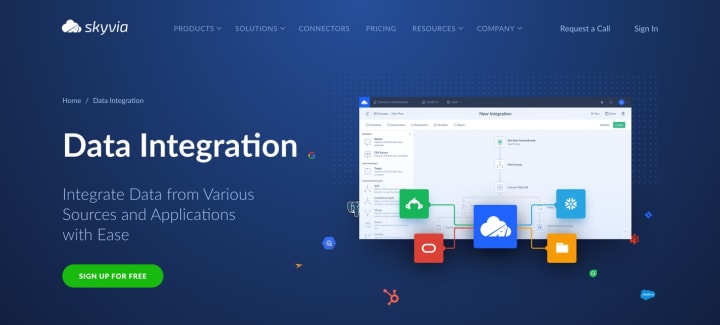
Companies using Snowflake or Amazon Redshift are well aware of the power of these data warehouses. Integrating data into Snowflake or Redshift enables unified data views, real-time insights, improved data quality, and greater operational efficiency. But how can you make data integration and management even smoother? Skyvia Data Integration works seamlessly with both Snowflake and Redshift.
Benefits
- Skyvia’s no-code platform ensures users don’t need advanced technical skills to set up data integrations, with an intuitive interface that makes the process simple and straightforward.
- The platform allows organisations to schedule data integrations at their convenience or even establish real-time synchronisations to keep their Snowflake or Redshift data consistently up-to-date.
- It includes powerful mapping and transformation tools to ensure data is perfectly aligned for Snowflake or Redshift. Users can clean, format, and transform data as needed throughout the integration process.
- Skyvia employs strong encryption to protect data during transfer and adheres to industry standards, including HIPAA, GDPR, PCI DSS, ISO 27001, and SOC 2 (by Azure), guaranteeing data security and compliance.
- Finally, Skyvia offers flexible pricing plans, including a free tier, making it an affordable solution suitable for businesses of any size.
To Wrap It Up
The choice between Snowflake and Amazon Redshift ultimately depends on the unique needs and environment of each business. Snowflake is an ideal solution for organisations seeking multi-cloud flexibility, handling variable workloads, or working extensively with semi-structured data. Conversely, Redshift is well-suited for companies deeply integrated with AWS, dealing with predictable workloads, and requiring advanced SQL capabilities.
Regardless of the chosen data warehouse, Skyvia simplifies the process. Its seamless integration, automated data synchronisation, and strong security ensure that data remains accurate, up-to-date, and ready for analysis.
About the Creator
Natalia Polomkina
Product Marketing Manager at Skyvia
Keep reading
More stories from Natalia Polomkina and writers in Geeks and other communities.
Zammad Streamlined HR and IT Data Processes with Skyvia
Challenge HR departments handle a diverse array of responsibilities, ranging from new employee onboarding to processing leave requests and managing system access. As businesses grow, these processes become increasingly strained by manual data entry and inefficient workflows that struggle to scale with the organization's expanding needs. Onboarding, in particular, requires seamless coordination between multiple departments, especially HR and IT.
By Natalia Polomkina10 months ago in Geeks
Silver Screen Magic with Mae West
American actress and singer Mae West became a popular film actress during the Great Depression. She started entertaining in vaudeville, then performed on Broadway, and finally went to Hollywood. She signed up with Paramount Pictures and made her debut in the 1932 film “Night After Night.” She also starred in musicals, comedies, and crime dramas. The American Film Institute named her one of the best classic Hollywood actresses.
By Rasma Raisters8 days ago in Geeks
Kathleen Kennedy
Few figures in modern Hollywood have shaped blockbuster storytelling as profoundly as Kathleen Kennedy. With a career spanning over four decades, Kennedy has been instrumental in producing some of the most influential films of all time. From her early collaborations with Steven Spielberg and George Lucas to her leadership role at Lucasfilm, she has become a central figure in contemporary cinema. Today, discussions around Star Wars, creative leadership, and franchise evolution are rarely complete without mentioning Star Wars Kathleen Kennedy. From Storyteller to Studio Leader Kathleen Kennedy’s journey began long before she became president of Lucasfilm. As a producer, she worked on classics such as E.T. the Extra-Terrestrial, Jurassic Park, and Indiana Jones. These projects established her reputation as someone who understood both creative storytelling and large-scale production. This balance would later define her tenure at Lucasfilm. When George Lucas selected Kennedy as his successor in 2012, it marked a turning point. Her appointment wasn’t just symbolic—it signaled continuity and transformation. As Kathleen Kennedy Lucasfilm took shape, she inherited one of the most beloved franchises in history, along with the immense expectations that came with it. Steering Star Wars into a New Era Under Kennedy’s leadership, Star Wars entered a new chapter. The sequel trilogy reignited global interest in the saga, introducing a new generation of fans while reconnecting longtime audiences. Films like The Force Awakens achieved remarkable commercial success, demonstrating Kennedy’s ability to blend nostalgia with contemporary storytelling. However, steering Star Wars was never going to be simple. The franchise carries deep emotional weight for fans, and creative decisions often spark intense debate. Kennedy’s approach emphasized diversity of voices and experimentation, opening the door to new directors, writers, and storytelling styles. This philosophy reshaped how Star Wars stories could be told across film and television. Collaboration with Dave Filoni One of the most significant creative partnerships during Kennedy’s tenure has been with Dave Filoni. Known for his deep understanding of Star Wars lore, Filoni emerged as a key creative force through animated series like The Clone Wars and Rebels. As Dave Filoni Lucasfilm expanded into live-action storytelling, the franchise found a renewed sense of continuity and character-driven narratives. Kennedy’s decision to elevate Filoni was strategic. By pairing her executive vision with Filoni’s lore expertise, Lucasfilm strengthened its creative foundation. Today, Lucasfilm Dave Filoni is often credited with bridging the gap between classic Star Wars themes and modern television storytelling. Their collaboration highlights Kennedy’s leadership style—empowering creatives while maintaining a cohesive vision. Expanding Beyond the Big Screen Another hallmark of Kennedy’s leadership has been expanding Star Wars beyond theatrical releases. Streaming series transformed how audiences engage with the galaxy far, far away. These shows allowed deeper character exploration and long-form storytelling that films couldn’t always provide. Behind the scenes, executives like Lynwen Brennan, Lucasfilm’s Chief Financial Officer, played a crucial role in managing this expansion. While Kennedy focused on creative direction, Brennan helped ensure the studio’s financial sustainability. This balance between creativity and business is often overlooked, yet it’s essential to maintaining a franchise of Star Wars’ scale. Facing Criticism and Cultural Debate No discussion of Kennedy and Star Wars is complete without acknowledging controversy. Creative changes, shifting release schedules, and bold narrative choices have drawn criticism from some fans. Kennedy has often found herself at the center of cultural debates about representation, legacy, and creative ownership. Yet, leadership at this level requires resilience. Kennedy has consistently defended the idea that Star Wars must evolve to remain relevant. Rather than viewing criticism as a failure, she has framed it as part of stewarding a living mythology—one that reflects changing audiences and values. A Legacy Still in Progress What makes Kathleen Kennedy’s story compelling is that it’s still unfolding. Unlike many producers whose legacies are defined in retrospect, Kennedy continues to shape one of the most influential franchises in real time. Her impact isn’t limited to box office numbers; it’s reflected in how Star Wars exists across generations, platforms, and cultures. Her leadership has also paved the way for broader conversations about women in Hollywood power roles. In an industry historically dominated by men, Kennedy’s success challenges outdated norms. She has demonstrated that creative authority and executive leadership can coexist without compromise. Looking Ahead As Lucasfilm looks to the future, the foundation Kennedy built remains central. New films, evolving series, and emerging storytellers all operate within a framework she helped establish. With creative figures like Dave Filoni continuing to grow in influence and executives like Lynwen Brennan supporting the studio’s structure, Lucasfilm is positioned for long-term storytelling. Kathleen Kennedy may not always be a visible presence on screen, but her influence is embedded in every frame of modern Star Wars. Whether praised or criticized, her role as a steward of one of cinema’s greatest legacies is undeniable. In the end, Kathleen Kennedy’s career is a reminder that storytelling isn’t just about heroes and villains—it’s also about the leaders behind the scenes who shape the worlds we escape into. And in that sense, her impact on Star Wars will be felt for years to come.
By Saboor Brohi 6 days ago in Geeks
Rachel Reviews: The Spiral Archive by Pieter Hendrik
It's difficult for me to know where to start with a review of this book as it was, for me, an entirely unique experience and one that I'll probably never have again. I don't want that to be interpreted as unenjoyable but it has left me scratching my head a little and ruminating on its content, its themes and its characters.
By Rachel Deeming4 days ago in BookClub




Comments
There are no comments for this story
Be the first to respond and start the conversation.