
Smith’s Cove: The Engineered Shoreline That Changed Everything on Oak Island
But on Oak Island — where shadows stretch across centuries and secrets live beneath stone — nothing is ever just what it seems.

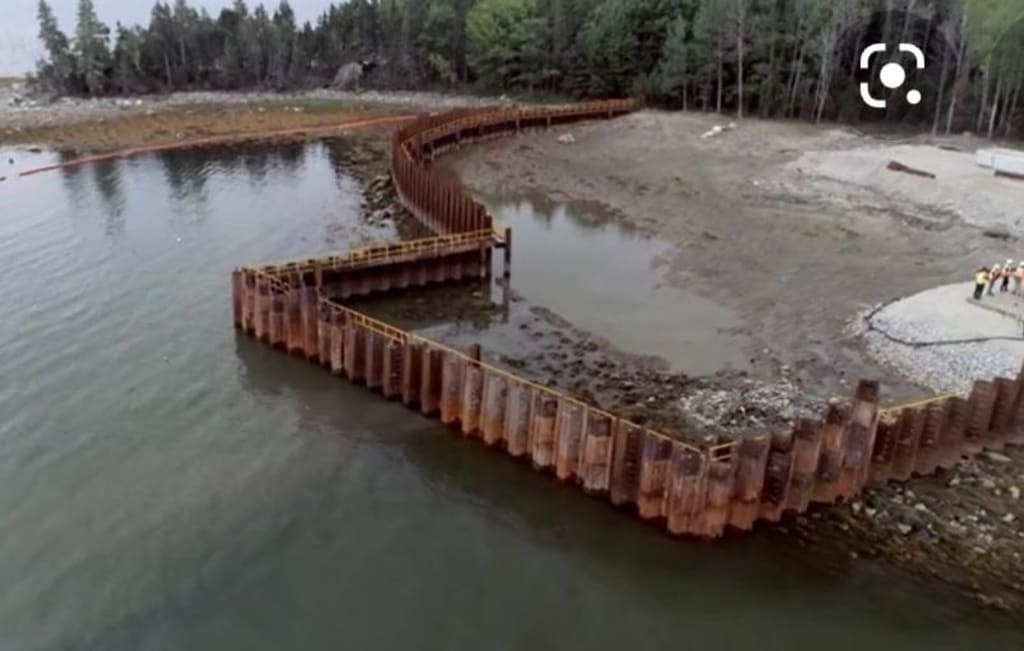
It was never supposed to be more than a shoreline.
But on Oak Island — where shadows stretch across centuries and secrets live beneath stone — nothing is ever just what it seems.
Welcome to Smith’s Cove.
A place once lapped by the tides of Mahone Bay, now excavated, drained, and dissected — revealing layer upon layer of bizarre engineering, foreign materials, and ancient artifacts that defy explanation.
This wasn’t just a beach.
It was a trap. A puzzle. A clue buried beneath water and time — waiting to be unearthed by the right hands.
And once it was, nothing on Oak Island would ever be the same.
The Cove That Called Back
Smith’s Cove has long been part of Oak Island lore. Early treasure hunters noticed strange rocks arranged along the shore, inexplicable layers of clay, and unnatural timber just beneath the surface.
But it wasn’t until modern excavations began in earnest — with heavy machinery, scientific teams, and high-definition cameras — that the site revealed its true identity.
Beneath the sand, beneath the silt and brine, lay structures.
Not random debris. Not driftwood. But constructed features.
Engineered, placed, and preserved — as if someone had buried the blueprints of a fortress and let the sea keep its secrets.

The Wooden Structures: Buried Architecture From an Unknown Era
As the Lagina team excavated the area, something astonishing began to take shape.
Timber beams. Angled joints. Planks precisely laid in geometric formations.
This wasn’t erosion. It was architecture.
A U-shaped wooden structure, its beams massive and purposefully joined.
A log wharf, seemingly part of an ancient dock or staging area
Post-and-beam assemblies beneath layers of clay and stone — structures no storm could form.
Carbon dating placed some of the wood as far back as the late 1700s, predating known infrastructure in the area. Some pieces even hinted at European origins, based on tool marks and construction styles.
Whoever built this wasn’t improvising.
They were planning.
The Box Drains: Sabotage Beneath the Sand
But the most chilling revelation came when researchers uncovered evidence of box drains — a lattice of flat stones and channels designed to funnel water directly into the island’s interior.
Let that sink in:
A trap system.
Designed centuries ago.
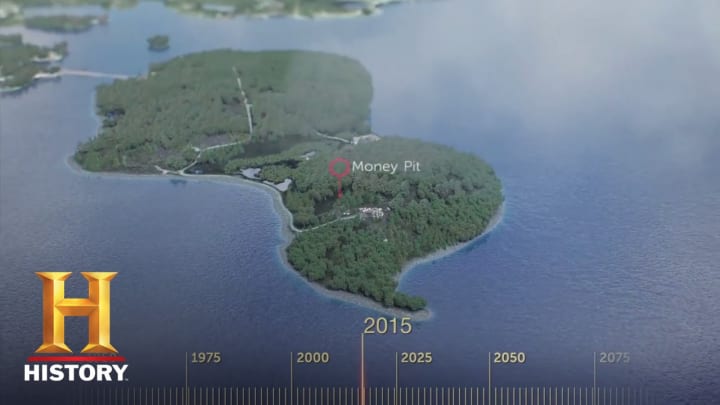
Capable of flooding the Money Pit and any shaft near it the moment someone dug too deep.
These weren’t accidental channels. They were deliberate sabotage — a defense mechanism built into the coastline itself.
It’s believed the system drew in seawater through coconut fiber filtration — an exotic material never naturally found this far north — and sent it inland through underground tunnels.
The complexity was staggering.
The message was clear:
You may dig. But you will not succeed.
Artifacts From the Past: Traces of Forgotten Hands
As Smith’s Cove gave up more of its shoreline bones, it also began revealing its soul — artifacts scattered like breadcrumbs from another age.
Among the most shocking:
An iron spike, hand-forged, its patina aged by centuries, likely part of a rigging or ship’s construction.
A medieval-style lead cross, eerily similar to those linked with the Knights Templar — discovered near the cove but echoing across time.
Pegs and dowels crafted with old-world precision, absent from local 18th-century styles.
Pieces of leather, iron, and ox shoes, suggesting Smith’s Cove was not just an engineering marvel — it was inhabited.
By whom?
For what purpose?
And why hide it?
Each relic raised more questions than it answered.
But each one added weight to the theory that Smith’s Cove wasn’t a construction site — it was a defensive front.
Who Built It — And Why? Theories Echoing Beneath the Tide
With so much infrastructure, so much effort, and such bizarre sophistication, theorists quickly went to work:
1. The Templar Engineers
If Oak Island hides sacred relics, then Smith’s Cove was likely a booby-trapped gateway — constructed by Templar fugitives to protect knowledge or treasure that could reshape the world.
2. Naval Smugglers or Military Engineers
Some suggest it was built by French or British naval engineers, hiding contraband or strategic information in a post-colonial race for supremacy.
3. Pirate Syndicates
Others believe Smith’s Cove was a landing site for organized piracy — not the lone rogue kind, but full-fledged, multi-ship operations that required loading docks, engineering traps, and contingency plans.
But the scale, the secrecy, the box drains — none of it feels like the work of smugglers.
It feels larger. Older. Designed not for theft, but for eternity.
Clay, Coconut Fiber, and the “Impossible” Beach
Perhaps most perplexing of all was the discovery of layers of non-native materials deliberately laid over Smith’s Cove:
Coconut fiber, used in filtration systems, never grows naturally in Nova Scotia.
Blue clay, known for its water-resistant properties, layered intentionally.
Piles of flat rocks, arranged like a drainage grid beneath the beach.
All signs point to something unthinkable:
That Smith’s Cove may have been built — not by accident, but as an engineered beachhead.
One not only capable of draining and channeling water — but of triggering a flood system meant to protect something inland.
A vault. A chamber. A secret meant never to surface.
Smith’s Cove Today: Sacred Ground for Treasure Hunters
Though many modern excavations at Oak Island have shifted back to the Money Pit and its surrounding boreholes, Smith’s Cove remains sacred ground.
Not just because of what it held — but because of what it proved:
That the island is not a natural mystery.
It is a constructed one.
That someone went to unimaginable lengths to hide something long ago.
And they chose Smith’s Cove to be the first — and fiercest — line of defense.

Conclusion: The Shoreline That Fought Back
In the grand tale of Oak Island, Smith’s Cove is not a footnote.
It is a frontline — one carved by foreign hands, layered with purpose, and haunted by questions no tide can wash away.
What lies beyond its drains?
What was meant to stay hidden beneath its beams?
And how many more secrets wait, just beneath the surface?
One thing is certain:
Smith’s Cove wasn’t built for convenience.
It was built for protection.
And whatever it was guarding… was meant to outlive the builders, the invaders, and even the tide itself.
About the Creator
Rukka Nova
A full-time blogger on a writing spree!
Keep reading
More stories from Rukka Nova and writers in Geeks and other communities.
The Politics of Playing Dress-Up
Well, to start off I'd like to say a happy world book day to all who celebrate. I know I haven't really posted anything on my socials about it but I'm not a jubilant kind of person. I lay low most of the time. Let's start off with a popular anecdote from the vaults...
By Annie Kapur5 days ago in Geeks
Quantum Computers: The End of the World as We Know It, or the Dawn of a Divine Era? 🌌
As a fan of new technologies and Artificial Intelligence 🤖, I watch the world accelerate every single day. But what is currently happening in the laboratories of Google, IBM, or Microsoft isn't just regular progress. It’s a revolution that will make today’s supercomputers look like an abacus compared to a smartphone. I’m talking about quantum computers 💡.
By Piotr Nowak7 days ago in Geeks
Early March 2026: 4 Goals Accomplished
It's early March and I've now accomplished my 4th writing goal for the year of 2026. Before diving into the behind-the-scenes of it... why not tell you up front what that accomplishment was? I was published in a 2nd publication for this year. Published in Helix Literary Magazine out of Central Connecticut State University. You can read it for free right now!
By Stephen Kramer Avitabile4 days ago in Writers




Comments (1)
This Oak Island stuff is fascinating. You mention the early hunters noticing oddities. Made me think of how sometimes in my work, we stumble on things that don't seem right at first. How do you think those early hunters' observations compare to what modern tech has revealed? And that U-shaped wooden structure? Sounds like it took serious planning. Wonder what its exact purpose was. Was it for loading and unloading treasure, or something else entirely?