
Robert Evans and Popeye (1980): A High-Noon Hollywood Gamble That Spiraled into Carnival Chaos
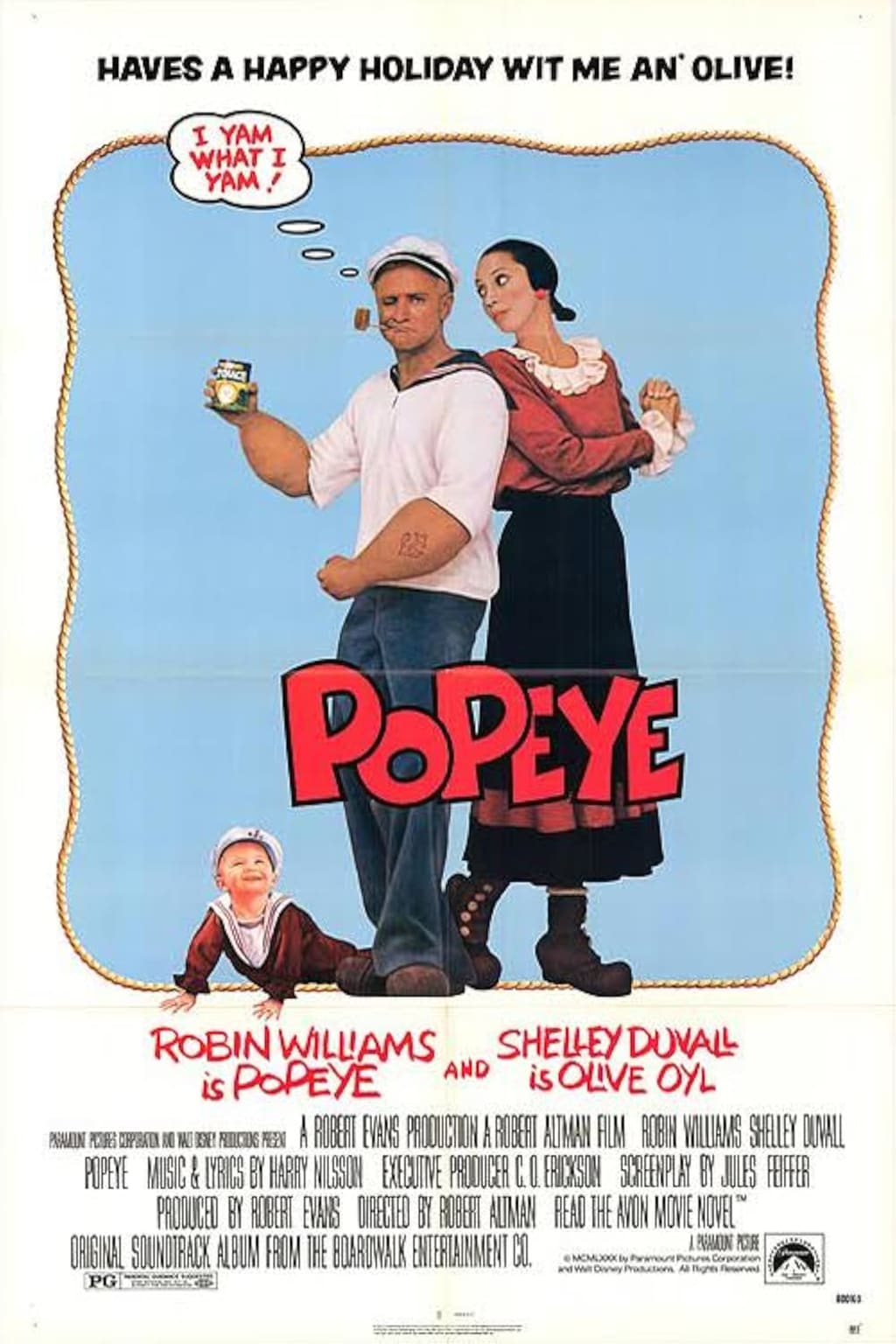
Producer Robert Evans’ Popeye (1980): a devotion to fidelity, set-built spectacle, drug-fueled mayhem, Altman clashes, and cult legacy created.

I. Old-Hollywood Ambition Meets Comic-Strip Oddity
After breathing new life into Paramount with The Godfather and Chinatown, Robert Evans set his sights on Popeye — not the rubbery cartoon, but E.C. Segar’s darkly quirky comic strip. He commissioned Jules Feiffer to adapt it, enlisted Robert Altman to direct, and cast Robin Williams in his first starring role. Evans envisioned a bold, musical comedy unlike anything audiences had seen.
Evans originally wanted Dustin Hoffman and Lily Tomlin to play Popeye and Olive Oyl, but Hoffman exited after script disputes. When producer Michael Eisner suggested Robin Williams — then a rising TV star — Evans later admitted breezily, “I didn’t really know who he was… I think I had seen his name on a magazine earlier that day.”
⸻
II. Building an Entire Village… in Malta
In one of his signature moves, Evans erected an entire seaside town — Sweethaven — on Malta’s Anchor Bay: crooked houses, fishing docks, docks belching steam, painted wood, and movie magic built from scratch. That set survives today as the tourist attraction Popeye Village.
Altman embraced the physicality: his ensemble cast wandered cluttered streets, sang live on-set, and improvised amid ramshackle realism. But that improvisational style collided with Evans’s insistence on comic-strip fidelity. Feiffer’s script went through revisions as Evans defended minor eccentric characters that animated cartoons had long sidelined.
⸻
III. Creative Clashes & Mechanical Mishaps
Altman and Evans reportedly came to blows—or near blows—during the shoot, as the two battled over tone, pacing, and script control.
Feiffer, the screenwriter, disliked Harry Nilsson’s songs — believing they didn’t fit the film — and felt the screenplay was overstuffed with minor characters. Meanwhile technical issues abounded: Popeye’s rubber muscle arms were hard to manipulate, prompting two Italian artisans to remake them on-set. Altman broke convention by having actors sing live during filming, complicating sound capture. Robin Williams would redub much of his dialogue later — his character’s mumbling, pipe-in-mouth style and ad-libs proving difficult to record cleanly.
⸻
IV. The Most “Coked-Up Film Set” in Hollywood
Here’s where legend meets wild truth. Barry Diller, then CEO of Paramount, later called the Popeye shoot “the most coked-up film set” he’d ever seen. He revealed attendees “couldn’t escape it” — and even said that film cans shipped for processing were used to smuggle cocaine back and forth between Malta and Los Angeles. “Everyone was stoned,” he said, observing the movie’s final cut plays at an unhinged pace — “like a record spinning at 78 rpm instead of 33.”
Composer Van Dyke Parks recalled a surreal moment: “I was the hero of the regiment for opening up a walkie-talkie to change the battery and finding a bag of cocaine … I recoiled, because I knew that it would be a component in the way people behaved, and the difficulties of the production right up to the top.”
SlashFilm adds that Evans himself was “partial to cocaine,” and nearly caused a diplomatic incident when luggage “full of cocaine” went missing at the airport. He was arrested on trafficking charges during post-production — charges later dropped — and quipped in a 1994 interview: “Bob ‘Cocaine’ Evans is how I’ll be known to my grave.”
⸻
V. Robin Williams, Addiction, and an Early Exit
Williams, fresh off Mork & Mindy, was battling addiction during filming. As he later confessed in 1988, “Cocaine for me was a place to hide… Most people get hyper on coke. It slowed me down.” Director Howard Storm quipped, “He was snorting coke, and if you snort coke, in order to come down you drink booze… He was out all night and screwing everybody in town.”
The chaotic environment overshadowed Williams’s talents. Although the film grossed about $60 million globally on a $20 million budget, it bombed critically and failed to cement his film career — that resurgence came later with Good Merrying, Vietnam.
⸻
VI. Fallout & Cult Reappraisal
For Evans, Popeye marked the end of an era. He’d gambled on spectacle and vision — and paid for it. The film’s audacious oddness alienated critics and damaged Altman’s career momentum. Altman didn’t helm another major studio film for nearly a decade.
Yet, over time, Popeye found a cult audience. Nilsson’s whimsical songs, Altman’s improvisational style, Williams’s elastic performance, and that weird, built-from-scratch village remain bizarrely captivating today. For cinephiles, it stands as a late New Hollywood relic, luxurious in risk but unstable in execution.
⸻
VII. Epilogue: A Movie That Embodies Excess and Ambition
Robert Evans’s Popeye is a case study in Hollywood gambit — a film where visionary faithfulness collided with creative chaos, and where excess wasn’t just thematic but tangible. Sweethaven still stands in Malta; the set endures as a tourist oddity and a monument to bombast. Robin Williams’s debut, brimming with fledgling star energy, emerged from an era when drug and ambition marched hand in hand.
For Movies of the 80s readers, it is a strange artifact: part Altman fever dream, part methodological implosion. It’s a story of sets built real, improvisation unchecked, drug-fueled frenzy, legal scandals, and enduring strangeness. Robert Evans, for all his hubris, delivered a film that lives on — as a caution, a curiosity, and a flickering testament to the risks of Hollywood’s bravest bets.
Subscribe to Movies of the 80s on YouTube.
About the Creator
Movies of the 80s
We love the 1980s. Everything on this page is all about movies of the 1980s. Starting in 1980 and working our way the decade, we are preserving the stories and movies of the greatest decade, the 80s. https://www.youtube.com/@Moviesofthe80s
Keep reading
More stories from Movies of the 80s and writers in Geeks and other communities.
When Midlife Melodrama Collides with Hollywood Politics: The Troubled Saga of A Change of Seasons (1980)
A purportedly witty dramedy about shifting romantic boundaries turns into a tale of studio meddling, clashing egos, director upheaval, sudden sex-symbol exploitation, Razzie notoriety—and, decades later, an obscure rarity. Here’s what went wrong behind the scenes of A Change of Seasons.
By Movies of the 80s5 months ago in Geeks
Silver Screen Magic with Mae West
American actress and singer Mae West became a popular film actress during the Great Depression. She started entertaining in vaudeville, then performed on Broadway, and finally went to Hollywood. She signed up with Paramount Pictures and made her debut in the 1932 film “Night After Night.” She also starred in musicals, comedies, and crime dramas. The American Film Institute named her one of the best classic Hollywood actresses.
By Rasma Raisters5 days ago in Geeks
Thoughts on Stranger Things 5
Recalling cultural zeitgeists like HBO's Game of Thrones or the BBC's Sherlock, especially their lacklustre final seasons, gave legitimate reason for audiences to apprehend the quality of Netflix's final run of the hit series Stranger Things, released in three volumes over the last two months of 2025. The sense of finality has been undeniably palpable, given the show's success and decade-long run. Fans wanted to experience a proper conclusion to a story many around the world have grown up with. And like Benioff and Weiss, or Moffat and Gatiss, Stranger Things' creators - the Duffers - have irrevocably and indisputably proven themselves to be... well... just another pair of hack writers.
By Andrei Babanin5 days ago in Geeks
My New Book is Finally Here
My poetry collection Beautiful and Brutal Things is done. It's actually done and finally published over 270 pages. Over a year of my life went into this book. More than a year, really. Long days at my computer, sometimes seven days a week because I couldn't stop even when I probably should have. Then two months of editing that felt harder than the writing itself. But it's finished, and I'm still standing, and the book is real.
By Tim Carmichaela day ago in BookClub



Comments
There are no comments for this story
Be the first to respond and start the conversation.