
Popular Genius
If The Queen's Gambit, then... other films and shows exploring extraordinary minds

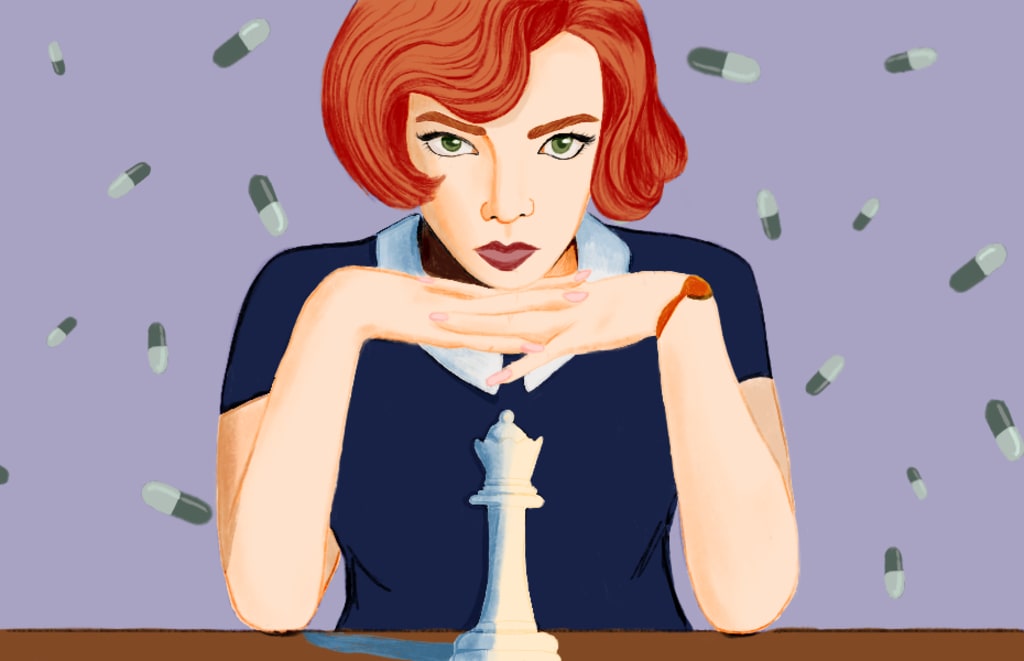
Madness and genius go hand in hand, so it's said. As Netflix's The Queen's Gambit took over the world in October 2020, the slight, brilliant figure of Beth Harmon, hauntingly portrayed by Anya Taylor-Joy, became a topic for reflection and her craft an object of fascination.
With just seven episodes, chess, that famous yet niche game that is 'everything - art, science, and sport' to its best players, and the catalyst for Beth Harmon's path to fame, saw a massive rise in spectator interest, with reigning world chess champion Magnus Carlsen joining in to give the miniseries a rating of 5 out of 6 (he also provides other comments on the style and realism of the series in the same video - linked here).
At the same time, critical reviews and amateur articles both gave high praise to the sensitivity and honesty with which the show explored Beth's addictions and alcoholism, as well as her emotional journey towards gaining an upper hand over the obsessive need to win.
Beth Harmon and the chess board are extraordinary, it's true. But it's worth recognising that they - this particular extraordinary mind and her medium of expression - are really only a minor piece in a long pattern of gifted and pioneering, yet also oftentimes broken individuals. Many of the greatest creative minds in history have suffered from issues of mental health, trauma, and addiction.
Evidence suggests that Vincent van Gogh suffered from a form of manic depression, Edvard Munch from neurasthenia (linked to hysteria and hypochondria) and panic attacks, Abraham Lincoln from depression, Kurt Gödel from persecutory delusions (for Gödel, an unfounded belief that someone was attempting to poison him), and Isaac Newton from bipolar disorder and schizophrenia.
Often, effects from their personal battles carried over to the lives of others. The lives of Ernest Hemingway and Sylvia Plath ended tragically in suicide, Plath while both of her children were still very young. Beethoven's notorious mood swings (today interpreted by researchers as being symptoms of biplolar disorder) led to regular personal frustration, and Gödel eventually starved to death when his wife was hospitalised for six months in 1978 and could not prepare his meals.
The image of the tortured genius - whether by circumstance or by illness - is indeed a common one, and also, unsurprisingly, one often capitalised upon by the media industry. Think about it. Depictions of geniuses in all fields - along with their relationships, societies, brightest joys and most tormented moments - have been wide and many throughout the recent history of film. From classics such as Good Will Hunting and Rain Man to The Imitation Game and The Man Who Knew Infinity, viewers have come to associate era-defining intelligence and creativity with an equivalent degree of suffering and pain.
Additionally, genius - and our social conception of it - holds powerful influence over our understandings of achievement and success, as well as, critically, happiness and fulfillment. We both embrace it and fear it. On the one hand, it's easy to become jealous of such incredible minds, not merely because of their powerful talent but also, more simply, because of the apparent clarity with which these minds find their place and purpose in the world. It's so deeply enviable to have found a passion - a drive for life - which wakes you up every day and motivates your whole focus, yet such a passion also seems like a sure-fire rabbit-hole towards single-minded obsession.
Regardless of our other thoughts on it, though, genius is fascinating, and I think an important subject which relates to many critical and practical aspects of society, progress, and the human life - not the least of which include education, family, and societal harmony.
Before the interest created by The Queen's Gambit fades away, then, here is a curation of films, documentaries, and shows to get you reflecting on the immense possibility, as well as limitations of, the human mind. Remember that not all of the subjects depicted are geniuses in the 'conventional' sense, and their individual circumstances are likewise diverse - and also take note that not all specific events may be portrayed exactly as they occurred in real life (but the post-watching reading can often be fun too!).
1. Hidden Figures (2016)
We start off with a film that is in several ways fairly similar to The Queen's Gambit. While Katherine Johnson, Dorothy Vaughan, and Mary Jackson held far different roles and ambitions to Beth Harmon, the parallels between their immediate circumstances - for the African-American NASA employees the daily racism and sexism faced at work and for Beth the lack of respect initially given to her as a female chess player, make for a stirring and thought-provoking watch.
Especially of note is Taraji P. Henson's powerfully emotive delivery of the 'bathroom speech' (for want of a better description) which led to the eventual removal of 'coloured' signs on the NASA bathrooms - I've attached a short excerpt of it here to whet your appetite:
"Picture that, Mr. Harrison. My uniform. Skirt below my knees, my heels, and a simple string of pearls. Well, I don't own pearls. Lord knows you don't pay coloreds enough to afford pearls! And I work like a dog, day and night, living off of coffee from a pot none of you wanna touch. So, excuse me if I have to go to the restroom a few times a day."
2. Good Will Hunting (1997)
Moving slightly back in time, we come to the film which for many represents a classic example of talent and prodigy which is limited (or arguably squandered) by both circumstance and choice. Matt Damon stars as Will Hunting, a janitor at MIT who is prodigiously mathematically gifted. With no apparent future ahead of him at work, Will spends his leisure time indulging in drinking and general tomfoolery, until a particularly ill-judged fight lands him in a position where he is forced to use his mathematical genius or be placed in jail.
The film, which also stars the prolific late Robin Williams, also touches sensitively on the close friendship between Will and his similarly working-class friends, as well as Will's emotional growth through childhood trauma and fear of commitment.
3. Rain Man (1988)
Moving to the discussion of how genius intersects with forming relationships, we come back to another classic - this time Barry Levinson's Oscar-winning Rain Man, starring Tom Cruise and Dustin Hoffman respectively as selfish and egoistic car dealer Charlie Babbitt and his autistic brother Raymond Babbitt.
Initially intent on using Raymond to gain access to his wealthy, recently deceased father's inheritance, Charlie discovers that Raymond is capable of many incredible feats of intellect and forms a loving bond with him in the process.
4. Magnus (2016)
I started this 'If-Then' article by discussing The Queen's Gambit and it seems only fitting now to take a quick change of direction and head back to the chess roots - this time focusing on the childhood and education of real-world world chess champion Magnus Carlsen. The documentary explores Carlsen's early life and interactions with chess in detail, including several of his key matches, as well as his love for Donald Duck comics and experiences of bullying at school.
If you're looking for a real-world glimpse into how era-defining minds are developed, stimulated, and supported, Magnus certainly makes for a relevant and fascinating watch.
5. Loving Vincent (2017)
I'm turning to one of my favourite films ever made - and one made stunningly and much differently from everything else in this curation - to close this list.
Notable for being the world's first fully painted feature film, Loving Vincent details van Gogh's intense struggles with mental illness and social ostracism leading to his eventual death, from the narrative viewpoint of a young man (painted by van Gogh) who seeks to investigate the apparently suspicious circumstances of the artist's death.
-
So there you have it. A curation of films and shows exploring the various aspects of a brilliant mind and how they both grow, work, and struggle. I hope this list can inspire and interest you, and, if there are to be any future films about genius coming out (which is bound to happen), that you will both appreciate and be pushed to reflect on them.
To leave you with a final thought, here is the closing quote from Loving Vincent - an excerpt from one of van Gogh's letters:
"In the life of the painter, death may perhaps not be the most difficult thing. For myself, I declare I don't know anything about it. But, the sight of the stars always makes me dream. Why I say to myself should those spots of light in the firmament bet Inaccessible lo us? Maybe we can take death to go to a star and lo die peacefully of old age would be to go there on foot. For the moment, I'm going to go to bed because it's late, and I wish you goodnight and good luck with a handshake, your loving Vincent."
About the Creator
A Knight of the Seven Kingdoms Series Review (Season 1)
As one of the biggest properties in fantasy, A Song of Ice and Fire remains immensely popular with audiences. After reaching far into the past with House of the Dragon, a second spin-off was on the cards. A Knight of the Seven Kingdoms serves up a bite-sized slice of action and drama, but it still claims a spot among the best small-screen titles.
By Robert Cain16 days ago in Geeks
REVIEW - The Redemption of Faust (Directed by Genel Mejia)
The Redemption of Faust, written by Justin Suran (Muse, Visitors, The Screenplay) and Genel Mejia (Visitors, The Screenplay, The Experiment, Normal, Splash Damage, La Mejia, Muse), and also produced and directed by Mejia, is a short film which takes its name from the famous 19th century work 'Faust' by Johann Wolfgang von Goethe.
By MegaFlix Movie Awards6 days ago in Geeks



Comments
There are no comments for this story
Be the first to respond and start the conversation.