
'Pokemon': The 7 Darkest Fan Theories In The Pokemon Universe
Gotta Catch 'Em.. Alive?

We're about to enter a new era in the Pokemon World. After over twenty years, Ash Ketchum will be officially retired as the main protagonist of the long-running Pokemon anime in just under a month, when the final episode of Pokemon: Aim To Be A Pokemon Master airs in Japan. This will be followed a few weeks later by the premiere of the Pokemon Scarlet and Violet anime, following new protagonists Liko and Roy.
Ash's impending departure, coupled with the relatively recent release of the Pokemon Scarlet and Violet games, has prompted a surge in interest in the Pokemon franchise, particularly those who have followed the series from the early days. Many believe that Ash's departure from the main series provides an opportunity to introduce a darker, grittier Pokemon anime, perhaps based on the popular, long running Pokemon Adventures manga. This series would not be intended to replace the existing children's anime, but rather air alongside it, a treat for the now adult fans who have grown up loving, and still love the Pokemon world.
On the other side of the coin, there are those who believe the wider Pokemon world is quite dark enough as it is. In the games, the Pokedex entries for some Pokemon are surprisingly creepy. While many of these are toned down for the anime, they are still technically canon. Then there's the number of horribly dark, yet scarily plausible fan theories.. Some so plausible that they have been latched onto as canon.
1. The Generation I Pokemon games take place in a post-war society
On the surface, Pokemon's Kanto region, the setting of the Generation I games Red, Blue, Yellow, and their remakes FireRed and LeafGreen, seems like the perfect world for a kid's adventure game. Children as young as Ten are free to explore the region unquestioned, battling other children with their cute but powerful pets. Adults rarely, if ever, intervene in the Player Character's journey to become a Champion Pokemon Trainer, or their tussles with the evil Team Rocket along the way. On the surface, it seems things are probably this way to cater to the target audience, however, some fans have come up with another theory: The Gen I Pokemon games take place in the aftermath of a war.
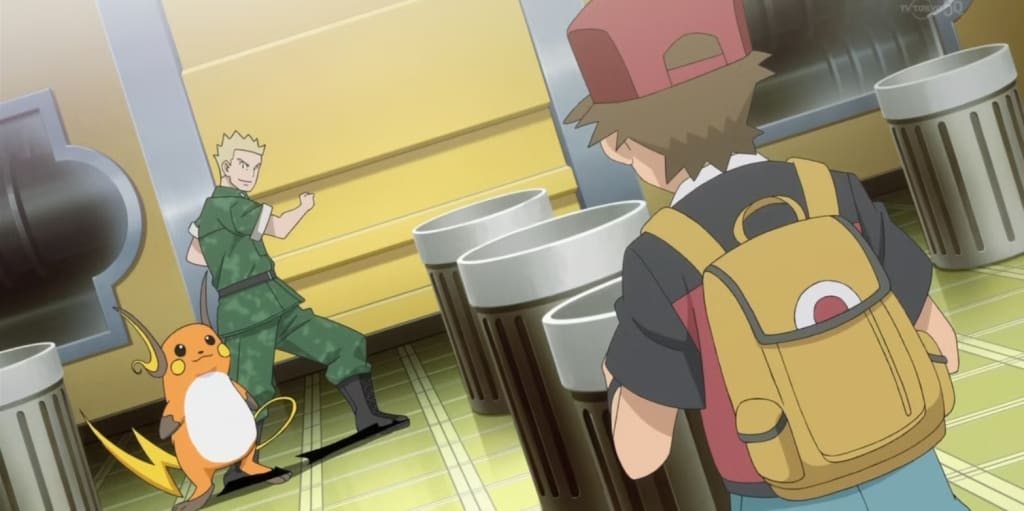
One character, the Vermillion City Gym Leader Lt. Surge, has a rank, wears an army uniform, and references a war directly, claiming in his pre-battle dialogue that his Pokemon are the reason he survived it. The other evidence supporting this theory are a little more subtle. Many children, including the Player Character, are being raised in what look to be Single Parent Households, with Fathers being the parent most commonly absent. The Oak children, Gary/Blue and his unnamed older sister, appear to be under the Guardianship of their Grandfather, Professor Oak, and the majority of male NPC's in the game are either young or elderly. Supporters of the Kanto War theory believe the lack of adult males is due to them having fought, and perished, in a war.
The Theory will probably never be openly confirmed in the interest of keeping Pokemon child-friendly, but for some, it adds depth to the franchise.
2. Red killed Blue/Gary's Raticate
In the first Generation Pokemon games, the player character's main rival is the grandson of Professor Oak, with the character's most common default names being either Gary (eventually used in the anime), or Blue. The Player Character (Canonically, Red) regularly battles their rival throughout the game. In the earlier battles between Red and Blue, Blue has a Rattata, which eventually evolves into a Raticate, on his team. One notable battle occurs aboard the S.S Anne, a ship docked in Vermillion City. After his defeat, the rival hastily departs.
Unknown to players at the time, the S.S Anne battle would mark the final appearance of their rival's Raticate. When Red next battles Blue in Lavender Tower, Kanto's Pokemon Cemetery, Raticate is notably absent from his line up.
Officially, Blue is at Lavender Tower for the same reason as the Player: To investigate reports of a ghost. However, Raticate's absence, as well as the usually arrogant Blue inquiring on the welfare of Red's Pokemon post-battle, has resulted in the theory that Raticate died of it's injuries following the battle aboard the S.S Anne, and Blue was in the tower either putting Raticate to rest or visiting it's grave. Word-of-God states Raticate was simply placed in storage in favour of more powerful Pokemon, seemingly debunking the theory, however some fans prefer to believe in the dark twist of a Pokemon's death.
3. Cubone is a baby Kangaskhan
Kangaskhan is a unique Pokemon for a number of reasons, one being that it is never seen without it's baby in it's pouch, and another that it is one of the very few remaining first-gen Pokemon to have not received an evolved or pre-evolved form in later generations. However, evidence suggests this may not always have been the case, with rumours of a unique and tragic evolution mechanic that would have made Kangaskhan both the first and final stage of the Cubone-Marowak evolutionary line.
This theory is mostly born from Cubone's heartwrenching PokeDex entries, and the fact that the glitch Pokemon 'M will sometimes evolve into a Kangaskhan, indicating that it was intended to be part of an evolution line at some point in Pokemon Red and Blue's production.
Cubone is described in-universe as the 'Lonely Pokemon', and it's PokeDex entry claims that the skull it wears belonged to it's Mother. Fans have noted that Cubone's skull-hat is not disimilar to Kangaskhan's head, and Cubone's body shape somewhat matches the baby in Kangaskhan's pouch. The theory goes that, at some point, Kangaskhan was planned to die after a certain number of battles, and Kangaskhan's baby would don it's skull and 'evolve' into Cubone, then Marowak, and eventually a new Kangaskhan. Some have speculated that, if this was the case, the resulting Kangaskhan would be stronger than the one before, encouraging players to continue the deadly cycle.
However, if such an idea existed, it was dismissed as too dark, and the code for Marowak's evolution to Kangaskhan was scrapped, resulting in a glitch, and the existence of 'M.
4. Ash/Red is the son of Giovanni
While briefly mentioned on a few occasions throughout Pokemon's early episodes, Ash Ketchum's Father has never appeared in person.. at least not that we know of. Officially, Ash's Father is simply away on his own Pokemon Journey. However, many fans have latched on to the theory that Ash's Father is Giovanni, the leader of Team Rocket, the main villains of the Gen I and II games. While in the games, Giovanni disappears after his defeat at Viridian Gym in Gen I, in the Anime, he has remained a background presence throughout Ash's run.
The theory around Ash's parentage was born from a scrapped plot that would have had Giovanni revealed as the Player Character's Father in the Gen I games. Rather than actually trying to steal Pikachu, Team Rocket members Jessie, James, and Meowth have been tasked by Giovanni to watch over Ash and help him grow stronger. The theory also proposes that at least part of the reason Giovanni left Viridian Gym before Ash's arrival was to avoid battling his son.
Some view this theory as having been debunked in later seasons when Giovanni has more directly encountered Ash, but doesn't acknowledge him as anything other than an annoyance. Others think it simply adds a darker twist. Far from the secret doting Dad of the original theory, Giovanni knows exactly who Ash is, but doesn't care if he gets hurt interfering in Team Rocket's plans.
5. Red jumps to his death after being defeated in Pokemon Gold/Silver
While many of the Pokemon games have the Player travelling through a single major region, the Gen II games (Gold, Silver, Crystal, and remakes HeartGold and SoulSilver), have the distinction of including two. After completing their journey through Johto, players are given the option to travel through Kanto, the location of the Gen I games, and complete that region's Gym Challenge.
After defeating all eight Gym Leaders and Kanto's Elite Four, the Player makes a lonely trek to the top of Mt. Silver, where they encounter and battle Red, the canon protagonist of the Gen I games, and Kanto's Pokemon Champion. If the Player defeats Red, he disappears. Some fans developed a dark theory that he jumped from Mt. Silver, humiliated at his loss.
Of course, this discounts the fact that Gold/Silver's clock system has Red return to the Mountain for an optional rematch each day. This, coupled with the fact that Red appears for special battles in later games, means we can call his suicide well and truly debunked.
6. Max has been taken/cursed by Banette.
In the Pokemon: Advanced Generation series, set in the Hoenn Region, Ash and Pikachu travel with three companions: Brock, May, and May's tag-along little brother, Max. Usually, Ash's companions will return for a guest appearance in other regions. Max, on the other hand, has been seen mostly in flashback for the vast majority of his post-Gen III appearances.
A dark theory has sprung up around Max's absence. In an early Pokemon Advanced ep, Max forms what seems to be a sweet friendship with a ghost Pokemon, Shuppet, while separated from Ash and the others in a creepy mansion. They share a fond goodbye when Max leaves at the end of the episode. However, Shuppet is destined to evolve into the rather creepy Banette. Per Banette's Pokedex entry, it is a lost plush doll brought to life by vengeance, and a need to track down and curse the child who left it behind.
Some fans propose that Max's absence from other Pokemon seasons is because his one-time friend Shuppet evolved into Banette, hunted him down, and cursed him. However, Max has since eventually been seen in a few non-speaking cameos, so this theory also appears debunked.
7. The Coma Theory
One of the most iconic moments in the Pokemon anime's history occurs in the very first episode. Ash proves himself to Pikachu by defending it from a flock of angry Spearow, and Pikachu, in turn, protects Ash by unleashing a massive Thunder attack on the Spearow. This moment cements their bond for the remainder of the series. However, it may not be as sweet as it seems.
The Coma Theory puts forward the idea that Ash was left seriously injured and comatose after the Spearow attack, with all his subsequent adventures taking place within a coma dream. Details of the theory vary from fan to fan, but the most common factors are that his travelling companions represent the various nurses and orderlies who care for him. Some believe that the departure of Brock's departure from the series to train as a Pokemon Doctor after Pokemon: Diamond and Pearl potentially represents his wish to become a real Doctor and help Ash, who had been his favourite patient. Team Rocket are a pair of particularly bumbling Orderlies or Janitors who's actions cause disturbances to Ash's fantasy, hence their portrayal as villains. The theory also explains why Ash has never aged.
Of course, the coma theory is much too dark to ever become the ultimate resolution of a popular children's franchise, but some fans choose to believe anyway.
We'll see the true conclusion of Ash's story onscreen soon.
About the Creator
Kristy Anderson
Passionate About all things Entertainment!
Keep reading
More stories from Kristy Anderson and writers in Geeks and other communities.
'The Mandalorian': Why Some Fans Are Excited Over The 'Space Whales' In 3x01
After nearly two years of waiting, The Mandalorian has returned to Disney Plus for its third season. With the events of Book of Boba Fett having returned Grogu to his rightful place at Mando's side, episode 3x01, 'The Apostate', was able to dive right back into Din Djarin's main goal for the season: Travelling to the supposedly destroyed Mandalore and bathing in the waters there so he can regain his Mandalorian status in the eyes of his cult-like Mandalorian sect, the Children of the Watch.
By Kristy Anderson3 years ago in Geeks
Silver Screen Magic with Mae West
American actress and singer Mae West became a popular film actress during the Great Depression. She started entertaining in vaudeville, then performed on Broadway, and finally went to Hollywood. She signed up with Paramount Pictures and made her debut in the 1932 film “Night After Night.” She also starred in musicals, comedies, and crime dramas. The American Film Institute named her one of the best classic Hollywood actresses.
By Rasma Raisters5 days ago in Geeks
The Devil's Cut
“Comrade, finally you’re awake.” The voice was smooth, sensual. A flickering incandescent bar was all that lit the white, sterile room. All Vladimir remembered was everything going black. He tried to move his arms and found them strapped to the gurney.
By Matthew J. Fromm4 days ago in Fiction


Comments
There are no comments for this story
Be the first to respond and start the conversation.