
PANDORA'S BOX OFFICE GOLD: DECONSTRUCTING JAMES CAMERON'S 'AVATAR'
James Cameron’s 'Avatar,' released in 2009, wasn't just a movie; it was a cultural phenomenon.


More than a decade later, it remains a benchmark in filmmaking, particularly in visual effects and 3D technology. This ambitious sci-fi epic transported audiences to the breathtaking alien world of Pandora, immersing them in a conflict between human greed and the Na'vi, Pandora's indigenous inhabitants. From its groundbreaking visual presentation to its environmentally conscious themes, 'Avatar' sparked conversations, controversies, and ultimately, redefined what was possible in cinematic storytelling. Its legacy extends beyond box office records, influencing filmmaking techniques and reigniting a passion for science fiction on a grand scale.
Plot:
The year is 2154. Earth's resources are depleted, and the Resources Development Administration (RDA) has its sights set on Pandora, a lush moon rich in the valuable mineral unobtanium. However, Pandora is inhabited by the Na'vi, a sentient, blue-skinned humanoid race deeply connected to their environment through a neural network called Eywa.
Jake Sully (Sam Worthington), a paraplegic Marine, is recruited for the Avatar Program. Using a genetically engineered Na'vi body ("avatar") controlled by his mind, Jake is tasked with infiltrating the Na'vi and persuading them to relocate from a massive unobtanium deposit located beneath their sacred Hometree.
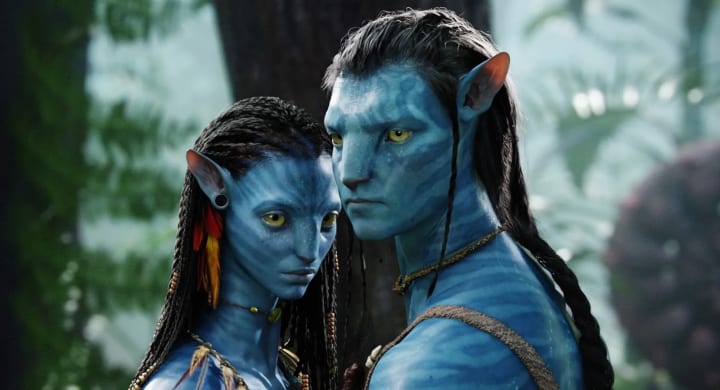
Initially, Jake's mission is purely strategic, under the command of Colonel Miles Quaritch (Stephen Lang), a hardened military man who sees the Na'vi as savages impeding progress. However, as Jake spends time with the Na'vi, he begins to understand their culture, their spiritual connection to Pandora, and the devastating consequences of the RDA's actions. He falls in love with Neytiri (Zoe Saldana), a fierce Na'vi warrior who teaches him their ways.
The plot thickens as Jake grapples with his conflicting loyalties. He's torn between his mission for the RDA and his growing affection for Neytiri and the Na'vi people. He becomes increasingly disillusioned with the RDA's ruthless methods, witnessing firsthand the destruction they inflict on Pandora's ecosystem.
The major turning point comes when Quaritch, impatient with Jake's progress, launches a devastating attack on Hometree, destroying it and killing many Na'vi. Jake, now fully committed to the Na'vi's cause, reveals the RDA's plans and defects. Branded a traitor, he unites the Na'vi clans and leads them in a desperate battle against the RDA's superior firepower.
The climax sees a brutal conflict between the Na'vi warriors, riding direhorses and banshees, and the heavily armed RDA forces. Just when the Na'vi are on the verge of defeat, Pandora itself intervenes, as the planet's interconnected ecosystem fights back, overwhelming the human invaders. Jake, now fully transformed into a Na'vi through Eywa, defeats Quaritch in a final, dramatic showdown. The remaining RDA forces are expelled from Pandora, leaving Jake to permanently transfer his consciousness into his avatar body and remain with Neytiri and the Na'vi.
The narrative style is straightforward, employing a classic "hero's journey" structure with clear moral distinctions between the benevolent Na'vi and the exploitative RDA. While the plot might be familiar – echoing themes from 'Dances with Wolves' and 'Pocahontas' – Cameron's masterful execution and the sheer spectacle of Pandora elevate the story beyond its simplistic premise.

Cast:
- Sam Worthington as Jake Sully: Worthington's portrayal of Jake is initially somewhat stiff, but as the character undergoes his transformation, his performance becomes more nuanced. He effectively conveys Jake's internal conflict and his growing empathy for the Na'vi.
- Zoe Saldana as Neytiri: Saldana brings a fierce grace to Neytiri, capturing her strength, her vulnerability, and her deep connection to Pandora. Her performance is particularly impressive considering the extensive motion capture involved.
- Stephen Lang as Colonel Miles Quaritch: Lang delivers a chilling performance as the ruthless Quaritch, embodying the military's unyielding determination to exploit Pandora's resources. He's the perfect antagonist, embodying the film's themes of environmental destruction and unchecked corporate greed.
- Sigourney Weaver as Dr. Grace Augustine: Weaver's portrayal of Dr. Augustine, the head of the Avatar Program and a sympathetic advocate for the Na'vi, is both intelligent and compassionate. She provides a crucial counterpoint to Quaritch's militaristic mindset.
- Michelle Rodriguez as Trudy Chacón: Rodriguez plays a tough-as-nails pilot who ultimately sides with the Na'vi, displaying a moral compass that challenges the RDA's authority.
Reviews:
'Avatar' received generally positive reviews upon its release. Critics lauded its groundbreaking visual effects, immersive 3D experience, and Cameron's ambitious world-building. The film was praised for its technical achievements and its ability to transport audiences to another world.
However, some critics found the plot to be derivative and lacking in originality. They argued that the story was a rehash of familiar tropes and that the characters were underdeveloped. Others criticized the film's heavy-handed environmental message.
Audience reviews were overwhelmingly positive, with many viewers praising the film as a visually stunning and emotionally engaging experience. The film's 3D presentation was a major draw, and many viewers felt that it was a must-see in theaters.
Production:
The development of 'Avatar' began in 1994, with Cameron envisioning a film that would push the boundaries of visual effects technology. He wrote an 80-page treatment for the film but shelved the project due to the limitations of available CGI technology at the time.
In 2005, Cameron revisited the project and began developing the necessary technology to bring his vision to life. He collaborated with visual effects companies such as Weta Digital to create a new generation of motion capture technology that could accurately capture the nuances of human performance and translate them to the Na'vi characters.
The film's production was a massive undertaking, involving hundreds of artists, technicians, and actors. The total budget was estimated at over $237 million, making it one of the most expensive films ever made at the time.
Writing and Casting:

Cameron wrote the screenplay for 'Avatar' himself, drawing inspiration from science fiction literature and environmental themes. He spent years developing the Na'vi culture, language, and ecosystem, creating a richly detailed and believable alien world.
The casting process was extensive, with Cameron searching for actors who could bring the Na'vi characters to life through motion capture. Sam Worthington was chosen for the role of Jake Sully after Cameron saw him in the Australian film 'Somersault.' Zoe Saldana was cast as Neytiri for her ability to convey both strength and vulnerability.
Principal Photography:
Principal photography began in April 2007 and lasted for several months. The film was shot in New Zealand and Los Angeles, with extensive use of motion capture technology.
One of the challenges of the production was the sheer scale of the virtual sets. The actors had to perform in a large, empty studio, relying on their imagination to visualize the lush jungles and towering mountains of Pandora.
A humorous anecdote from the set involves the actors getting so immersed in their roles that they would start speaking in Na'vi even when the cameras weren't rolling. According to Zoe Saldana, she once accidentally ordered a coffee in Na'vi at a local coffee shop, much to the confusion of the barista.
Production Design:
The production design of 'Avatar' was a crucial element in creating the immersive world of Pandora. The set designers created detailed models of the Na'vi villages, the RDA base, and the various creatures that inhabit Pandora.
The costumes were designed to reflect the Na'vi's connection to nature, using natural materials and intricate patterns. The visual aesthetics were inspired by a variety of sources, including rainforests, coral reefs, and bioluminescent organisms.
Sound Design & Music:
The sound design of 'Avatar' was equally important in creating a believable and immersive soundscape for Pandora. The sound designers used a combination of real-world recordings and synthesized sounds to create the unique sounds of the Na'vi language, the alien creatures, and the RDA technology.
The film's score, composed by James Horner, was a blend of orchestral music and electronic elements, reflecting the film's themes of nature and technology. The score was widely praised for its emotional impact and its ability to enhance the film's visual spectacle. Horner incorporated musical elements and instruments from various world cultures to further develop the other-worldly feel of the film's score.
Visual Effects:

The visual effects in 'Avatar' were groundbreaking, setting a new standard for what was possible in CGI filmmaking. Weta Digital created incredibly realistic and detailed Na'vi characters, as well as the lush and vibrant environment of Pandora.
The film's use of motion capture technology allowed the actors to deliver nuanced and believable performances, which were then seamlessly translated to their CGI avatars. The visual effects were so realistic that many viewers were unable to distinguish between the real and the CGI elements.
The depth and complexity of the visual effects were astonishing. Cameron and his team perfected a 3D camera system that truly immersed viewers into the screen.
Influences:
'Avatar' draws inspiration from a variety of sources, including science fiction literature, environmental themes, and historical events. The film's plot echoes themes from 'Dances with Wolves' and 'Pocahontas,' exploring the conflict between indigenous peoples and colonizing forces.
The Na'vi culture is inspired by various indigenous cultures around the world, particularly those with a strong connection to nature. The RDA's exploitation of Pandora's resources is a commentary on the destructive impact of unchecked corporate greed.
Scientific Knowledge:
'Avatar' incorporates elements of scientific knowledge, particularly in its depiction of Pandora's ecosystem. The film explores the concept of a planet-wide neural network, where all living things are interconnected through a complex web of communication.
The Na'vi's ability to connect with Pandora through Eywa is based on the scientific concept of neural networks and the idea that information can be transmitted and shared between different organisms. The film also incorporates elements of biology, botany, and ecology to create a believable and scientifically plausible alien world.
The mining of Unobtanium, though fictional, draws parallels to real-world resource extraction and its environmental consequences.
Marketing, Release & Box Office:
The marketing campaign for 'Avatar' was extensive, generating massive buzz and anticipation for the film. The campaign focused on the film's groundbreaking visual effects and its immersive 3D experience.
'Avatar' was released in theaters on December 18, 2009, and quickly became a global phenomenon. The film broke numerous box office records, becoming the highest-grossing film of all time, surpassing Cameron's own 'Titanic.'
The film's success was driven by its widespread appeal, its innovative 3D presentation, and its positive word-of-mouth. 'Avatar' was a must-see cinematic event, attracting audiences of all ages and backgrounds.
Critical Responses:
'Avatar' remains a controversial film, with some critics praising its technical achievements and its immersive world-building, while others criticizing its derivative plot and its heavy-handed environmental message.
Despite the mixed critical response, 'Avatar' remains a significant cultural phenomenon, influencing filmmaking techniques and inspiring a new generation of science fiction fans. Its legacy extends beyond box office records, cementing its place as a landmark achievement in cinematic history. Even with its flaws, the film managed to strike a chord with audiences worldwide, a testament to the power of visual storytelling and the enduring appeal of epic adventures.
About the Creator
Xavier
Global news reporter covering science, tech, environment, Entertainment & sports. Delivering balanced insights to inform and inspire readers worldwide. Sometimes a poet.
A Knight of the Seven Kingdoms Series Review (Season 1)
As one of the biggest properties in fantasy, A Song of Ice and Fire remains immensely popular with audiences. After reaching far into the past with House of the Dragon, a second spin-off was on the cards. A Knight of the Seven Kingdoms serves up a bite-sized slice of action and drama, but it still claims a spot among the best small-screen titles.
By Robert Cain6 days ago in Geeks
Two Grumpy Old Men Solve the Problem
Marty and Steve were two grumpy old men who lived together. They had known each other for years. Marty had been a bachelor all his life. Steve said it was because no one could stand to ever live with. Marty’s standard reply was “Well, you are, so what sort of a moron does that make you!”
By Calvin Londona day ago in Humor


Comments
There are no comments for this story
Be the first to respond and start the conversation.