

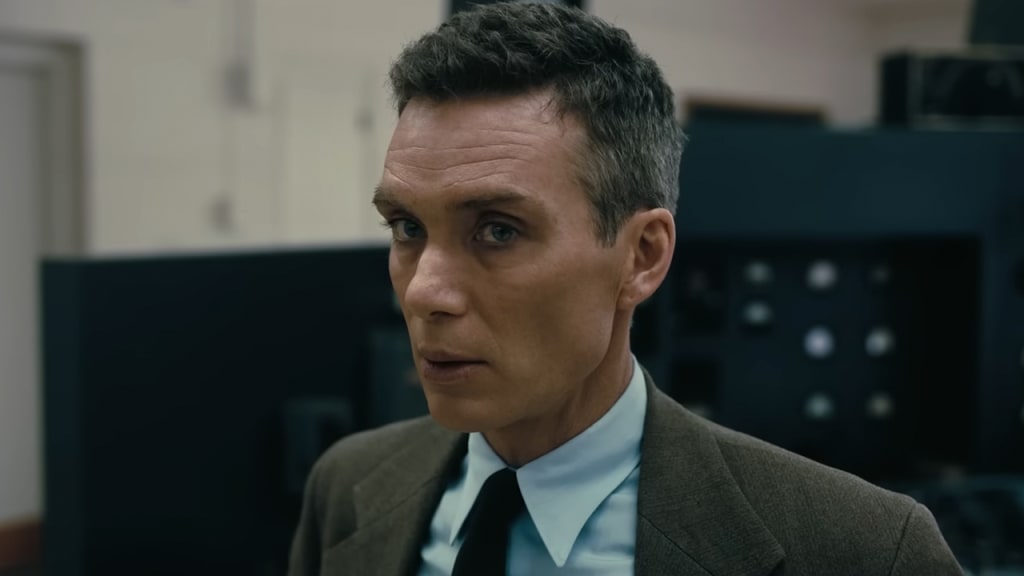
Christopher Nolan’s Oppenheimer releases this weekend and I thought it prudent to do some background on the real person. Historical fiction walks a fine line in Hollywood, it is either very well adapted and humanized so it feels closer and more personal to the audience, or it is a bastardization of actual events and doesn’t even resemble the real thing. Normally the good adaptations add a love story (Titanic, Pearl Harbor) and keep all historical details the same. Now Nolan strikes me as a director that does his research and so the historical accuracy of this film doesn’t necessarily concern me, especially considering that there are 32 pages of production notes. So here we go, how much effort and research went into the Hollywoodized version of Oppenheimer?
Robert J. Oppenheimer, the father of the atomic bomb, was the most important person in history according to Nolan.
“It’s an extraordinary moment in human history. I wanted to take the audience into that room and be there for that conversation and then be there when the button is pushed. It’s just the most incredible moment if you think about it. The risk of it. The relationship between science, theory, intellect-the things we can imagine-versus the practical nature of bringing these abstract ideas into the real world, dealing with them as concrete realities, and all their consequences”.
Nolan’s fascination with the story only bodes well for how it is portrayed. It seems that Nolan really wanted to get into the psychological aspects of Oppenheimer and the team that surrounded him. We can expect this film to be very cerebral, and everything film bros are going to be annoying about for the next decade.
We as the audience should also be prepared for a story told from two different perspectives in two different ways. The parts of the story that center around Oppenheimer himself will be told from first person and in color, the parts that center around Lewis Strauss, the commissioner of the Atomic Energy Commision, will be told in black and white.
Ruth De Jong was Nolan’s production designer and they worked very hard together to keep the film’s authenticity intact.
“Our process was to see the real thing, understand its essence, and then divorce ourselves from its form and go make our picture.”
I appreciate this approach because it means that the research was done but they didn’t get so close to the real story that they were unable to tell the story properly. Often as a writer if you get too emotionally attached to a story the audience can tell. The characters will sound forced, and it will be clear that the writer is holding back. It doesn’t appear that this will be the case for Oppenheimer.
Something that has been spectacular across all of Nolan’s movies is his cinematography. He’s an expert at hiring photography directors that understand the scale and scope of his vision so that no matter the quality of the story, the images the audience sees are beautiful. Now with a story this powerful, this grandiose, the cinematography is arguably the most important part of the story. And Nolan never disappoints in that aspect.
To be completely honest, I wasn’t super excited to see this movie (I mean it's three hours long). However after reading the production notes and seeing Nolan’s thought process and attachment to the story I am very excited to see what he does with this story. We are waiting to see the film on the IMAX 65MM screen and I can’t wait to see the film how Christopher Nolan truly intended it to be seen.
About the Creator
Alexandrea Callaghan
Certified nerd, super geek and very proud fangirl.
Keep reading
More stories from Alexandrea Callaghan and writers in Geeks and other communities.
Secret Invasion
Secret Invasion has been a wildly boring disappointment thus far and as the series begins to come to a close there seems to be little to no hope for a turnaround. The penultimate episode is consistent, and therefore leaves little to praise. But here we go with the second to last episode of Secret Invasion.
By Alexandrea Callaghan2 years ago in Geeks
Silver Screen Magic with Mae West
American actress and singer Mae West became a popular film actress during the Great Depression. She started entertaining in vaudeville, then performed on Broadway, and finally went to Hollywood. She signed up with Paramount Pictures and made her debut in the 1932 film “Night After Night.” She also starred in musicals, comedies, and crime dramas. The American Film Institute named her one of the best classic Hollywood actresses.
By Rasma Raisters5 days ago in Geeks
Why The Last Holiday Still Resonates Even 20 Years Later
Plot Summary Georgia Byrd, a kindhearted but shy department store employee, discovers she has a terminal illness. Faced with her mortality, she decides to abandon her mundane life and take a lavish vacation to Europe, determined to live life to the fullest before her passing. Along the way, Georgia embraces adventure, discovers her own courage, and forms unexpected friendships that change her outlook. Amid luxury hotels, fine dining, and breathtaking scenery, she also encounters romance and laughter, learning to cherish every moment. The Last Holiday is a heartfelt story about finding the true joy of life and self-discovery.
By TheScreenAnalyst3 days ago in Geeks




Comments
There are no comments for this story
Be the first to respond and start the conversation.