
🚀 “No More Dead Zones? Huawei’s Bold Satellite Leap Puts Apple & Google on Notice”
Huawei brings both calls and messages to satellites—while Apple still sticks to texts
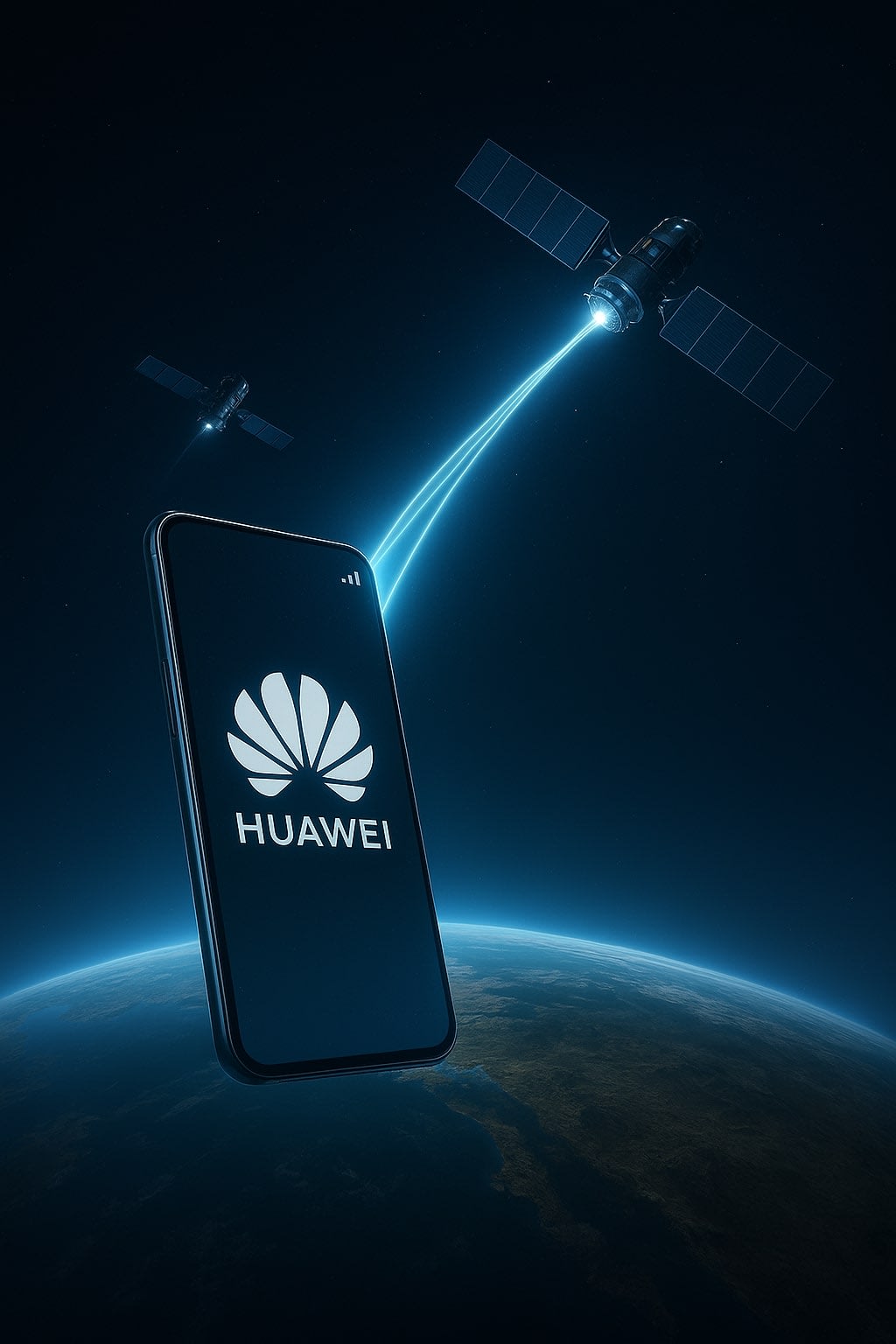
For many years, smartphone users all over have been haunted by the vexatious "No Service" message. Finding oneself on a desolate road, searching mountains, or soaring miles over the ocean, the quiet that comes with losing contact has proven to be risky as well as irritating.
Huawei boldly announces a radical revolution, though, in 2025. The top Chinese technology business has unveiled an amazing technology that links satellites straight to smartphones, therefore facilitating not just text messaging but also voice calls. even when the cell towers are far apart.
This big breakthrough questions how mobile connectivity functions, thereby applying considerable stress on Apple and Google to keep up, rather than just resolving a long-running irritation.
📡 Why Connectivity Still Allows Us Down
Our everyday lives depend on connection. Though dead zones remain even in busy cities, we depend on unseen signals for navigation, employment, and communication. Areas where phones still do not work include rural roads, mountain tracks, underground parking lots, and disaster-hit sites.
Though 5G technology promised broad coverage, the reality demonstrates otherwise: building towers is prohibitively expensive, and networks frequently fail during crises. Although for years thought of as the best solution, satellite communication was difficult, costly, and restricted to large satellite devices until lately.
🌐 Hybrid Innovation at Huawei
Huawei has developed an innovative hybrid communication system fusing direct satellite links with traditional mobile devices.
Here's the functioning:
1. When you are around cell towers, your phone works exactly like any standard smartphone.
2. Your phone will automatically interact with low Earth orbit satellites when you enter a dead zone, whether at sea, in arid regions, or during flights.
3. Both calls and messages run without interruption, so nearly vanishing the dreaded "No Service" message.
China's Tiantong satellite network, which is flawlessly incorporated into Huawei's flagship smartphone, the Mate 60 Pro, and more modern devices, allows this achievement to be made possible. Unlike Apple's satellite solutions that are exclusively for emergencies, Huawei aspires to turn its system into a dependable means of everyday contact, not just a safety net for desperate circumstances.
🍏 Apple’s More Cautious Approach
Apple, on the other hand, has selected a more cautious approach. Emergency SOS via Satellite, one of the iPhone 14's most noteworthy features since its debut, lets users send emergency communications. even without any cellular connection. Along with the release of iOS 18, Apple has enhanced this service to include Messages over Satellite, which allows basic SMS and iMessage communication in areas with no connectivity.
There are, however, some constraints:
1. Voice calls are not feasible over satellite.
2. No images, videos, or huge files are permitted; communication is limited to text only.
3. Among the places included are Canada, regions of Europe, Australia, and the United States.
4. Users have to physically angle their phones up to make a connection.
Apple sees satellite service as a fallback option instead of a conventional means of communication.
⚖️ In the evolving race toward satellite connectivity, Huawei, Apple, and Starlink/T-Mobile are taking notably different approaches. Huawei’s Mate 60 Pro+ currently leads with the most advanced everyday features, offering satellite SMS, voice calls, and seamless switching between cellular and satellite networks, though its coverage is largely limited to China via the Tiantong system. Apple’s iPhone 14+ supports satellite SMS strictly for emergencies, with limited text capabilities and no satellite voice calls or data connectivity; it mainly serves as a backup lifeline in the U.S., Canada, parts of Europe, and Australia. Meanwhile, Starlink and T-Mobile’s 2025 beta program aims to fill roaming gaps by providing satellite SMS in regions like the U.S. and New Zealand, with voice calls and seamless switching still in testing. Data over satellite remains limited across all three players, but Huawei stands out for positioning its service as an everyday global communication tool, while Apple frames its solution as an emergency safeguard, and Starlink/T-Mobile experiments with bridging coverage gaps during early trials.
🌍 The importance of this development
The results go beyond just convenience:
1. Satellite aid offers continuous contact in emergencies when cell towers might fail.
2. Tourists, explorers, and mariners may stay connected worldwide via travel.
3. Emerging Economies: Where telecommunications is weak, satellite connections can be used directly instead of towers.
4. Reliable worldwide communication helps workers in remote locations and logistics firms.
Should Huawei expand outside of China, the mobile sector's competitive environment could change. Imagine a Huawei user having crisp conversations in the Himalayas, while an iPhone user next door struggles to even send short messages—if they can at all.
💬 Online Chatter
Already under discussion in communities are the results of this invention.
1.Huawei fans are celebrating this as regions without coverage end.
2. Apple supporters contend that Huawei's solution could have cost, battery life, and legal issues before it could become widely used.
3. Critics of technology point out that dependable connectivity remains difficult due to satellite bandwidth constraints.
Though everybody agrees on one important fact: healthy competition benefits all. Huawei's aggressive project is forcing Apple, Google, and Samsung to expedite their satellite technology plans.
🔮 The Future of Forever Connected
We may be on the cusp of a major change. Just as 4G transformed video streaming and 5G opened the door for new businesses, a hybrid of cellular and satellite connectivity may make seamless global communication commonplace.
Children might start to wonder what No Service means, much as we now laugh at the sound of dialup internet.
Huawei made the first bold decision. The planet is now expecting to see if Apple and Google will react or risk vanishing into the vastness of space.
About the Creator
Keep reading
More stories from Shahjahan Kabir Khan and writers in Geeks and other communities.
🎬 Every Nolan Movie Budget vs. Box Office: Films, 1 Flop
Christopher Nolan is an experience, not only a filmmaker.Fans circle the date when he reveals a new project; studios wait breathlessly in excitement; IMAX theaters ready themselves for massive audiences.Unlike many other directors, Nolan has built a reputation for producing spectacular, thought-provoking films that have received both critical acclaim and financial success.Still, among this amazing record, there is one exception: a movie that did not equal the grandeur of the others.
By Shahjahan Kabir Khan5 months ago in Geeks
Silver Screen Magic with Mae West
American actress and singer Mae West became a popular film actress during the Great Depression. She started entertaining in vaudeville, then performed on Broadway, and finally went to Hollywood. She signed up with Paramount Pictures and made her debut in the 1932 film “Night After Night.” She also starred in musicals, comedies, and crime dramas. The American Film Institute named her one of the best classic Hollywood actresses.
By Rasma Raisters5 days ago in Geeks
Bikini-Clad Lauren Sánchez Goes Makeup-Free as She Reflects on Lavish St. Barths Vacation: Photo
Lauren Sánchez is savoring every last second of her tropical escape. The former journalist recently shared a sun-soaked selfie from her lavish getaway, offering fans a rare look at her natural, makeup-free glow while relaxing near the water.
By Dena Falken Esq7 days ago in Geeks


Comments
There are no comments for this story
Be the first to respond and start the conversation.