
Movie Review: 'Man Under Table'
Writer-Director-Star Noel David Taylor explores the self-involved emptiness of modern culture in Man Under Table.

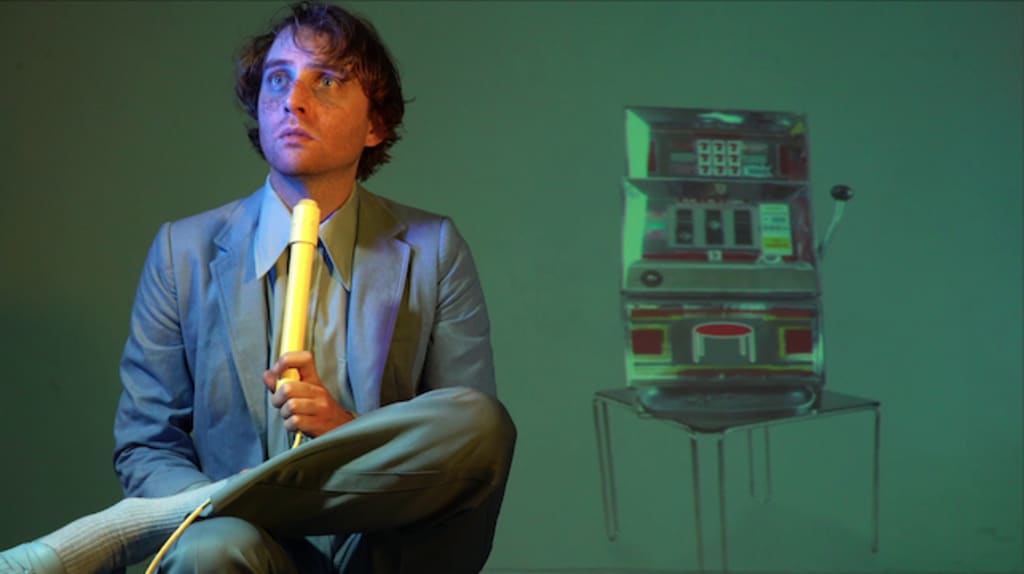
Man Under Table is a lively and odd mix of Hollywood satire and self-referential humor about a filmmaker fighting with imposter syndrome. Written, directed by and starring Noel David Taylor, there is nothing remotely traditional about Man Under Table and yet the themes will be familiar to anyone who has struggled with watching others succeed while failing to find success for yourself, simultaneously blaming the world for your failure while castigating the world for not letting you succeed.
A traditional plot description is difficult with Man Under Table. For much of the movie Taylor’s protagonist doesn’t have a name, the credits reveal his name to be Guy, perhaps, but that could just as well be a description of him as it is a name. For shorthand we will call him Guy. Guy is allegedly a screenwriter, that’s certainly what he tells people that he does. However, we rarely see Guy doing any writing. His moment to moment existence is a series of conversations about possibly writing a screenplay and being simultaneously disgusted by the trendy concepts others seem to want him to write about.
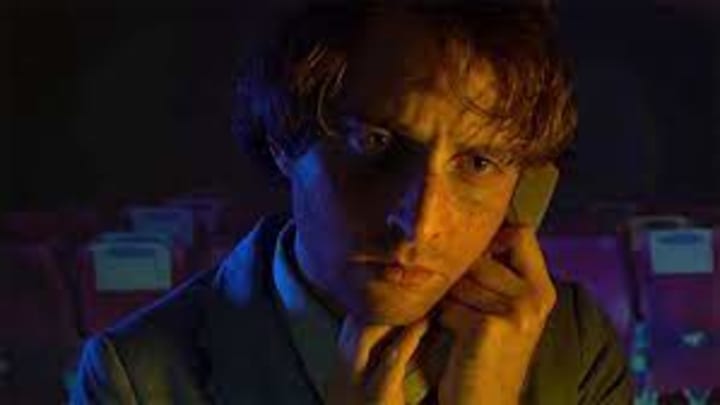
The story, such as it is, begins with Guy talking to Ben (Ben Babbitt). Both are wearing industrial strength facemasks but they remove them to have this conversation. Guy says he’s writing a screenplay but his manner indicates that he’s not saying this because he is writing a screenplay, being a screenwriter is a persona he’s wearing. Ben doesn’t appear to care, he’s actually making a movie with an up and coming artist named Jill Custard (Katy Fullan).
The notion that Ben is actually making a movie and that someone he knows might become successful as a screenwriter appears to upset Guy and he walks off. Later, at a bar, Guy watches Jill’s movie, a pretentious one person performance direct to camera filled with vaguely deep dialogue about a failed relationship. A man at the bar recognizes the video and tries to engage Guy in praising Jill’s work, further inflaming Guy’s hatred of the movie.

Another encounter with Ben furthers Jill’s legend building, she’s making another movie and this one will be filmed at the bar they are currently in and may feature Guy as a performer, though Guy is deeply opposed to this. Besides, he has his screenplay to work on. On the television at the bar is a vapid YouTube persona, Lyle (Robert Manion), star of ‘Nothing But Lyle,’ an insipid V-Log that Guy becomes obsessed with. He can’t understand how Lyle became famous and neither can we from the evidence of his mindless commentaries that, at one point, become a series of references to his own work and how his fans can enjoy that work. It becomes at once surreal and bizarrely familiar if you spend time watching v-logs.
Desperate to actually work, Guy begins working with a delusional man named Gerald (John Edmund Parcher) on a movie about fracking. Working with Gerald is another construct, something for Guy to say that he's doing when people ask, or when they don't ask and he's able to force the conversation back to being about him. Every interaction in Man Under Table plays out in this fashion with Guy plagued by the notion that he wants to talk about himself and everyone else seemingly capable of making about themselves effortlessly. Guy is consumed by his need to talk about himself and plagued by how easy it is for everyone else to do so without feeling anything about their self-involved persona.
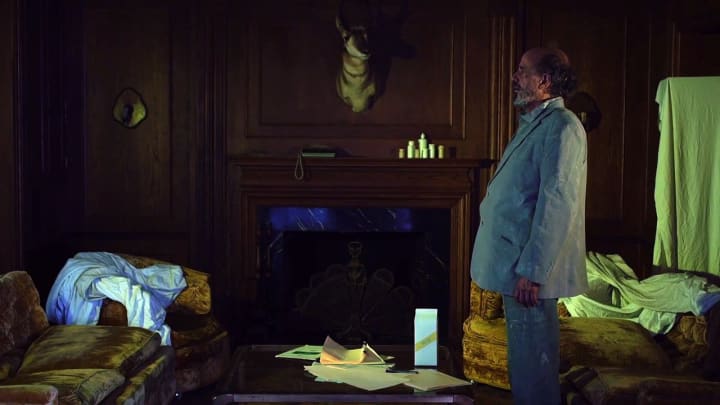
Fracking comes up a lot in Man Under Table as it becomes symbolic of a vague political issue people can use for faux outrage or something they can pretend to care about. This is laid bare in a conversation Guy has with a pair of film producers who speak in empty buzz phrases about making movies. The two smile large empty smiles and speak like robots whose default mode is a mechanistic optimism. All guy has to do is say his movie is metaphorically about fracking and identity politics and the pair are eager to work with him.
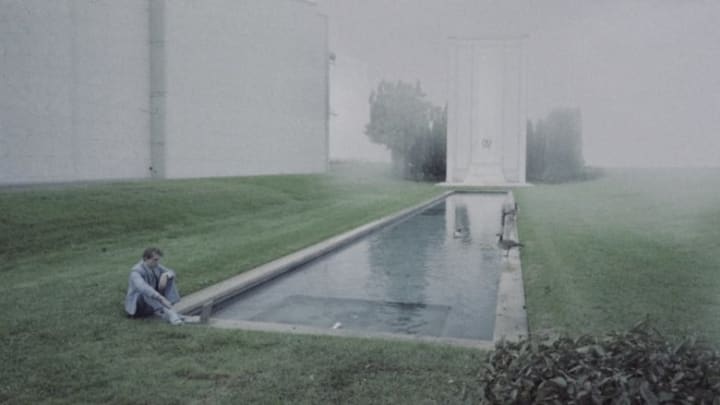
The aesthetic of Man Under Table is striking in how cheap and apt it is to what Noel David Taylor wants to accomplish. All of the costumes look as if they were pulled from a dumpster and then, rather than being cleaned, they were sold as found in a hip shop that marketed the clothes as homeless chic. The sets are undersized or oversized to varying degrees and Taylor employs intentionally bad green screen effects and heavy doses of fake smoke, to underscore the artifice. These are actual filmmaking techniques that are used in major movies.
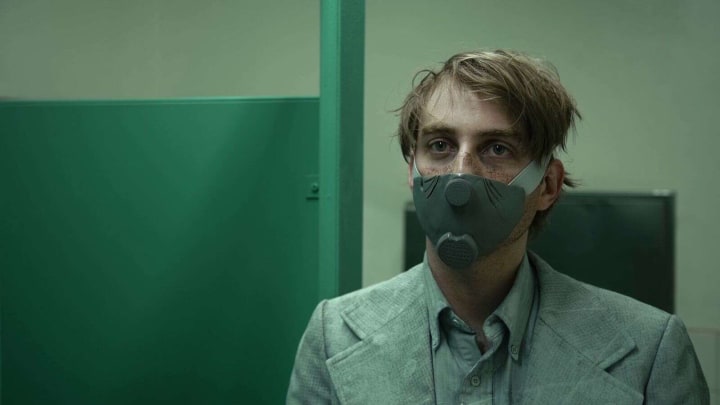
Or, more to what I think the point is, the shabby effects are an attempt to show how Guy sees the world around him, a mess of fakery and inauthentic encounters. In the end, Man Under Table becomes about Guy’s own mental health, an exploration of how the artificial world he exists within magnifies the absence of something real within himself. Whether that something real is a vision, a genuine voice, or a personality, is for you to think about as you watch Guy joylessly navigate this artificial world.
I’m not making Man Under Table sound all that appealing but I do really like it. The film is challenging and odd in very intriguing ways. The layers of meaning Taylor finds in his bizarre low budget aesthetic and unhinged interactions with his supporting players was, for me, fascinating. I liked thinking about this movie and the numerous ways it could be interpreted. It’s filled with strange visual treats, a trenchant satire of the meaningless interactions people have everyday in every industry, not just Hollywood, and it has an especially sharp take on the artificial constructs we invent for our own lives to hide whatever it is we don’t want the world to know about us.
In that way, I feel Man Under Table is rather brilliant. It’s a movie that is at once bitter toward a world that constantly engages in fake politeness that disguises our true, self-involved natures. Are we all just looking for ways to introduce ourselves and what we think to others, not caring about what they have to say? Are we mad when other people tell us about themselves when all we want to do is talk about ourselves? That’s a deeply cynical perspective but it is one worth exploring and while Man Under Table is more about introducing that question than exploring it, asking the question is still intriguing.
In another way, the movie is about what it can feel like when you don't have a strong construction of yourself to talk about be proud of. What is it like to feel like an imposter, to be barely be able to conceal you're envy of the success of others and their ability to talk about themselves without the crushing sense of lack you are carrying inside yourself. Guy isn't an empty vessel but he's missing what he thinks he needs to be happy and is bitterly jealous that everyone else appears to have that ineffable thing. Guy at once wants what he feels is an inauthentic sense of pride and is bitter toward those who have that inauthentic pride and carry it with confidence and unearned success.
Man Under Table will be available via Arrow-Player.com, a new streaming platform for cult movies, new and old. Check it out at Arrow-Player.com.
About the Creator
Sean Patrick
Hello, my name is Sean Patrick He/Him, and I am a film critic and podcast host for the I Hate Critics Movie Review Podcast I am a voting member of the Critics Choice Association, the group behind the annual Critics Choice Awards.
Keep reading
More stories from Sean Patrick and writers in Geeks and other communities.
Classic Horror Movie Review: 'House' 1977
House or Hausu has its origins in a strange place. According to legend, the film was dreamed up after executives at Toho, the company famed for creating Godzilla, had seen Jaws become a worldwide phenomenon and they wanted their own horror phenomenon. The executives tapped well known commercial director Nobuhiko Obayashi to develop the concept and after failing to find anyone inside the company to direct House, and after Obayashi used his commercial instincts to create a small cult around the movie before it had been made, Toho allowed Obayashi to bring his bizarre vision to life.
By Sean PatrickExclusive • 5 years ago
Marvel Zombie
The last entry into our 2025 superhero projects catalogue is Marvel Zombies. This was a show that was anticipated by absolutely no one and it disappeared from the public consciousness as quickly as it was released. There was nothing special about the project that made it a must see, or a must remember. In fact if anything it's a must forget.
By Alexandrea Callaghan26 days ago in Geeks
In the Blink of an Eye: A Forgotten Thriller That Explores How Fast Life Can Shatter
Some movies don’t rely on spectacle or big budgets to leave an impression. Instead, they unsettle you quietly, planting a sense of unease that lingers long after the credits roll. In the Blink of an Eye (1996) is one such film—a made-for-television thriller that may not be widely remembered today, but one that delivers a chilling message about how quickly trust, identity, and safety can disappear.
By David Cook7 days ago in Geeks


Comments
There are no comments for this story
Be the first to respond and start the conversation.