
Movie Review: 'Conclave'
Conclave comes up short at the end.

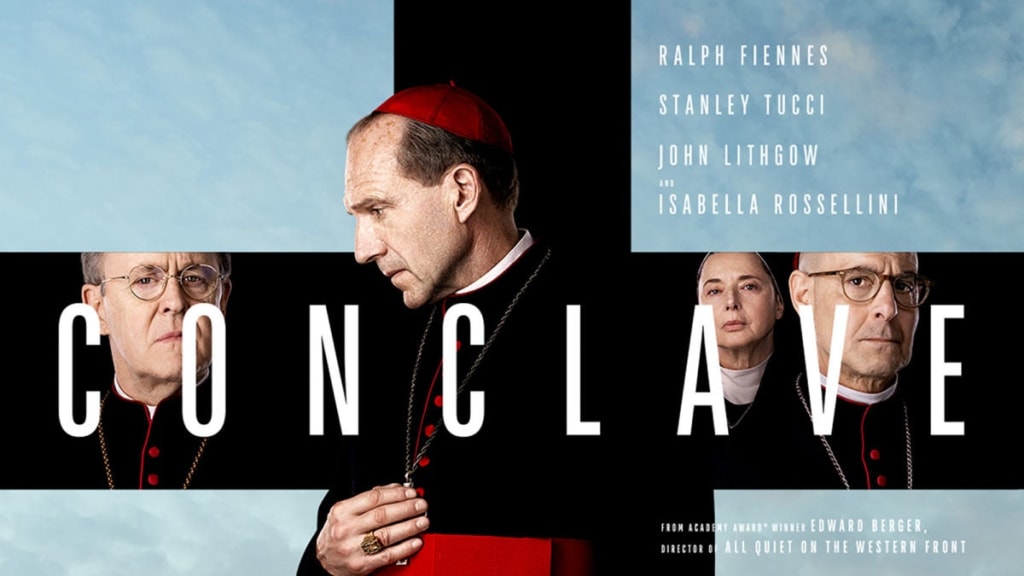
Conclave
Directed by Edward Berger
Written by Peter Straughan
Starring Ralph Fiennes, John Lithgow, Stanley Tucci
Release Date October 25th, 2024
Published October 28th, 2024
I am divided over the new movie Conclave. On one hand, I admire the boldness of its drama and the exceptional acting. On the other hand, the ending feels forced. The ending of Conclave feels like it came out of left field. As much as there are some seeds planted here and there, and while I can see the real life parallels the director Edward Berger and writer Peter Straughan are striving for, I can’t escape the feeling that the ending is so shocking and such an outlandish twist that it undermines the recognizable drama of the rest of the movie.
Conclave begins with the death of a Pope. We never meet this Pope, he’s dead just as the story begins. Our gateway to the story is The Dean of the College of Cardinals, Cardinal Lawrence, played by Ralph Fiennes. The Dean of the College of Cardinals is the man tasked with overseeing the choice of the next Pope. It’s a job that Cardinal Lawrence does not want and tried to relinquish only for the Pope to refuse his resignation. For whatever reason, the late Pope wanted Lawrence in this position.
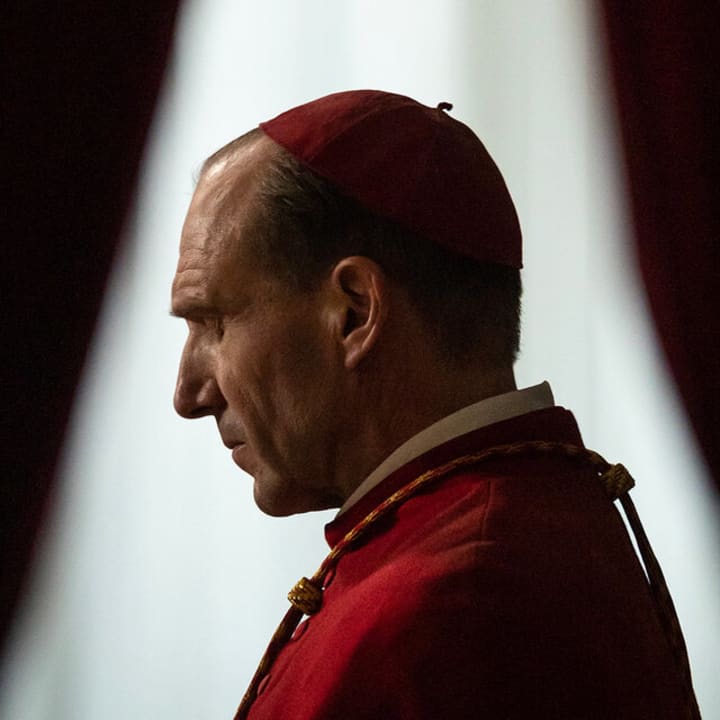
The reason Lawrence may be the right man for this job is that he has doubts. He has doubts about his faith and questions regarding the role of the church in the modern world and its place on the world stage. This doubt defines Lawrence as it unintentionally makes him a more objective observer in the midst of a battle for the soul of the Church. As the College of Cardinals gather to choose the next Pope, battle lines are being drawn and factions are emerging in support of ideological leaders who want to move the church to either a more conservative or liberal leadership.
On the conservative side is Cardinal Tedesco (Sergio Castellitto), a right wing hard liner who wants the Catholic church to stop embracing other religions and viewpoints. He has a particular distaste for working with Islamic leaders as the now late Pope had done. Also on the conservative side is Cardinal Joshua (Lucien Msamati), a leader of the Church in Nigeria whose views on Homosexuality place him in the camp of potential war criminals. He’s popular however as he has the chance to become the first African Pope.
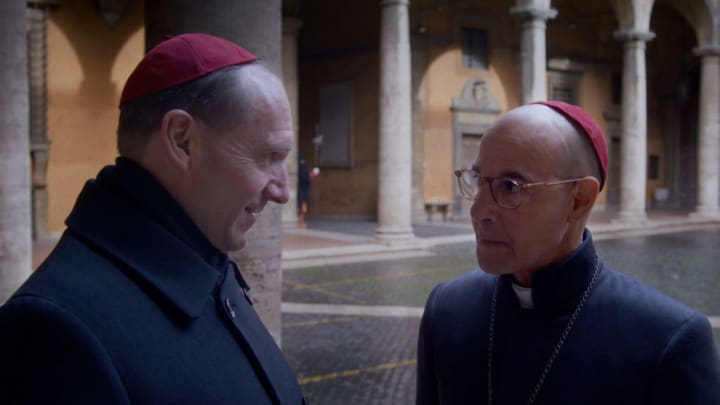
Leading the liberal faction, seemingly by default, is Cardinal Bellini (Stanley Tucci), a man who professes no interest in being Pope. That is until it seems that one of his conservative opponents looks to be the front runner. Then, Bellini finds a cunning and ambitious side of himself that even he seems surprised by. Taking up the middle ground is Cardinal Tremblay (John Lithgow). Tremblay’s play is to unite the undecided Cardinals while courting liberals and conservatives as a candidate of compromise. His candidacy however, is clouded by scandal as the late Pope may have asked for his resignation just before he died. Why? You will have to watch and see.
At the center of it all is the stalwart Cardinal Lawrence who must investigate multiple potential scandals all at once. This includes dealing with Cardinal Tremblay and welcoming a surprising new Cardinal, Cardinal Benitez (Carlos Diehz), a Cardinal who was made in secret by the late Pope. Appointed to lead the Church in Afghanistan, Cardinal Benitez was appointed in secret to protect him while he worked in a dangerous part of the world. But, he was also kept secret for another reason that will become clear as the voting for a new Pope commences.
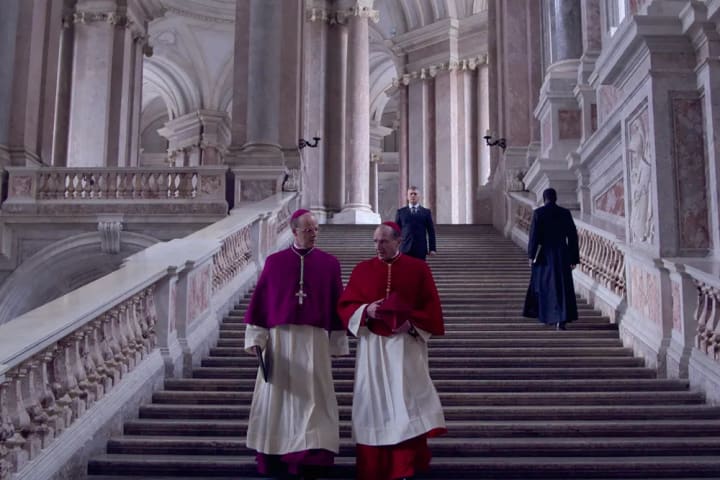
Conclave is filled with heavy drama and number of plot twists as candidates' secrets are exposed and front runners become also rans. The shifting loyalties and the way outside events pierce through the veil of secrecy that sequesters the College of Cardinals from the outside world provide plenty of rich veins of storytelling. And all of it builds to a shocking conclusion that left me a bit cold. As much as I admire the boldness of the ending, it’s so outlandish that it doesn’t feel at all possible. The real world implications of this twist ending are so unfathomable that it undermined the drama that built to this ending.
The ending of Conclave is so shocking and surreal that it doesn’t feel like the movie did enough to set the table for it. I feel like the movie could have done a better job of sowing the seeds of deceiving the audience so drastically. There is simply nothing to prepare you for the ending of Conclave and that feels like a shock for the sake of a shock. It feels like the movie could do anything at this point and call it a day and that’s just not thematically satisfying. Even a shock ending should have some underlying connection to the rest of the story and Conclave lacks in giving this ending a deeper meaning beyond the big surprise.
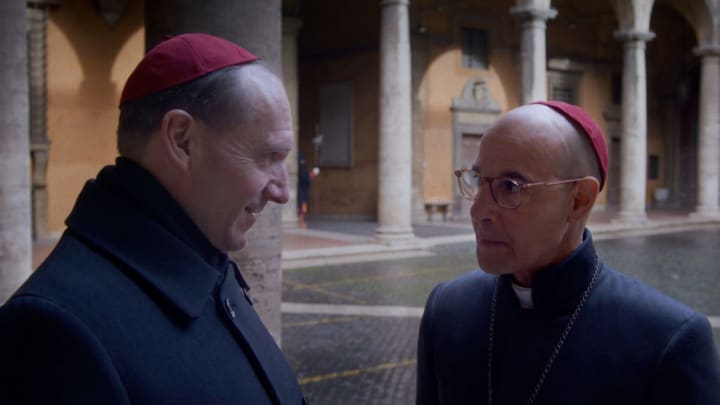
That said, the performances in Conclave are exceptional. The cast is first rate and dotted with awards nominations and legendary gravitas. Ralph Fiennes in particular is the perfect actor to hold the center of this story. Fiennes’ performance is richly nuanced and his agony is palpable as he tries to balance his questions about his faith with the monumental task of helping to lay the foundation of the future of the church. When Fiennes breaks down and finally weeps over the death of the Pope in private, it’s a heartbreaking example of his remarkable talent.
Conclave is also a great looking movie. Cinematographer Stephane Fontaine is on track for serious accolades during awards season. The same should be said for the set design team who brilliantly recreate the famed Sistine Chapel, where the College of Cardinals is sequestered for voting. The costumes and score will also see some attention during awards season as the richly detailed and elegantly crafted robes, slippers, and hats are more than merely recreated from what we expect of the Church finery.
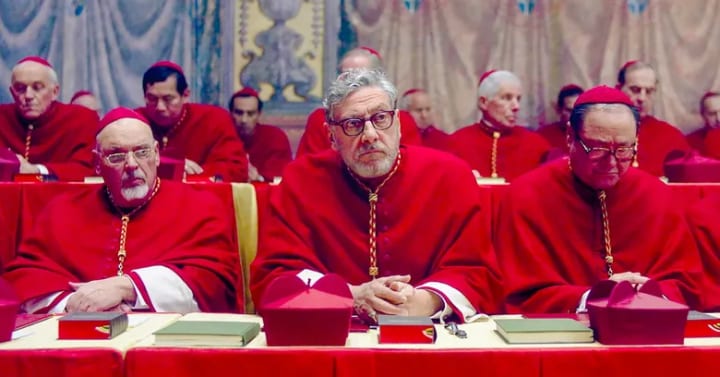
Nearly all of the pieces are in place to make Conclave one of the best movies of 2024 and yet I find myself resistant. The ending feels like a taunt. The ending feels like a jab at the church and not a genuine critique of the membership. The ending of Conclave plays like an attempt at being edgy. It’s a hot take on the myriad issues with the church, as if one swift maneuver could address all of the problems that exist in the world. I am not religious, I was born Catholic, but I have not been inside a church for a religious service in more than three decades.
That is to say, that I have no stake in how other people address the church and its many, many, issues. In my objective position, the ending of Conclave is brave and unique but it’s unearned. The film fails to make the case for this ending. It fails to provide the logical building blocks to get to this ending. The ending of Conclave is a fatal flaw. The filmmakers choose to try and shock the audience instead of actually watering the seeds that had actually been planted throughout the earlier portions of the film.

I would love to see this ending truly matter. I would love to see this ending be fully engaged for all of its repercussions. But this is the end of the movie. There is no time to actually grapple with what this ending means. I understand that the filmmakers are intentionally leaving that grappling for us to take with us, but that only underscores the lack of depth of this ending. Conclave wants to be provocative without having to engage with its own provocation.
Find my archive of more than 20 years and more than 2000 movie reviews at SeanattheMovies.blogspot.com. Find my modern review archive on my Vocal Profile, linked here. Follow me on Twitter at PodcastSean. Follow the archive blog on Twitter at SeanattheMovies. Listen to me talk about movies on the I Hate Critics Movie Review Podcast. If you have enjoyed what you have read, consider subscribing to my writing on Vocal. If you’d like to support my writing, you can do so by making a monthly pledge or by leaving a one time tip. Thanks!
About the Creator
Sean Patrick
Hello, my name is Sean Patrick He/Him, and I am a film critic and podcast host for the I Hate Critics Movie Review Podcast I am a voting member of the Critics Choice Association, the group behind the annual Critics Choice Awards.
Keep reading
More stories from Sean Patrick and writers in Geeks and other communities.
The Politics of Playing Dress-Up
Well, to start off I'd like to say a happy world book day to all who celebrate. I know I haven't really posted anything on my socials about it but I'm not a jubilant kind of person. I lay low most of the time. Let's start off with a popular anecdote from the vaults...
By Annie Kapur3 days ago in Geeks



Comments
There are no comments for this story
Be the first to respond and start the conversation.