
More Monster Movies Like The Shape of Water
Maybe monsters are friends we haven't made.

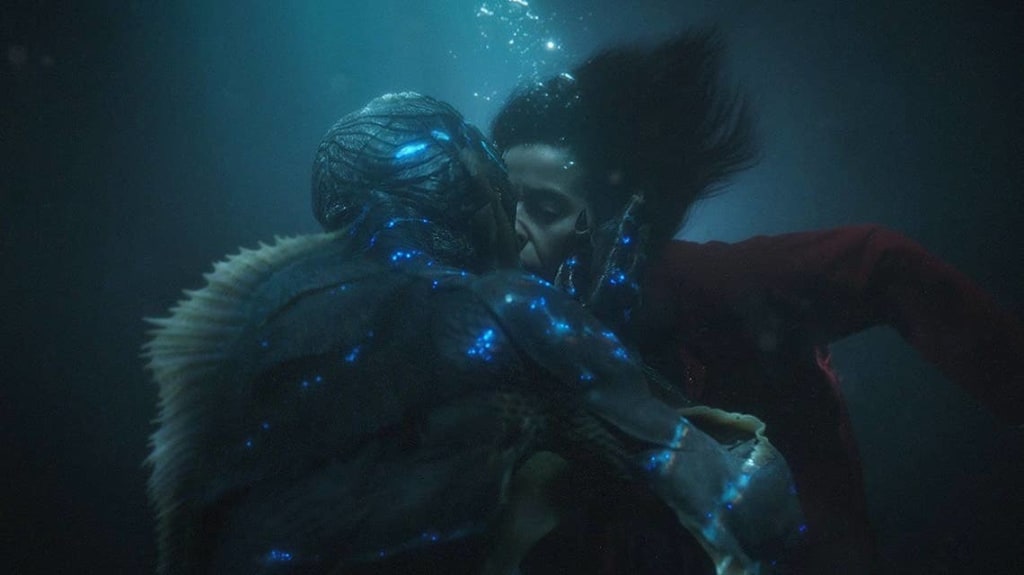
Draw a monster. Why is it a monster?
— Janice Lee, Daughter
What makes a monster? Nature, or nurture?
We tend to call what we fear, what we don't understand, and what's different from us "monstrous." If you've seen The Shape of Water, you'll have heard that answer and seen why it's not so clear-cut after all.
Elisa meets her monster in a time and place where most humans are othered, too. And despite Cold War–era America labeling her muteness as a deficiency, she learns to cross a communication divide no one else can bridge.
Ironically, every viewer relates to Elisa because we all perceive ourselves as incomprehensibly individual. No man is an island, but each man is one mind. And to see beyond ourselves is difficult.
The Shape of Water has a formula for its success with an audience. Check for these three points when searching for a film like it and you'll have yourself a great movie recommendation.
1. A lovable monster.
The monster needs to be sympathetic to the viewer. Guillermo del Toro's creature is humanoid, instantly building sympathy with the audience. We assume that what looks like us can act like us.
Then, del Toro gives us pity for the creature. We see how he is tortured and rationalize the rebellion against his captors.
Once pitied, the monster shows its characteristics, both feral and humanizing. The Shape of Water's fish man eats cats and learns sign language. He likes boiled eggs and looking at art. But most importantly: he knows how to love. His capacity to give love is what makes him lovable to us, the audience.
2. A fairy-tale spin.
The Shape of Water presents a clear moral. That's why it's best told as a universal fairy tale. The movie could take place in any time period and still follow a similar arc. In fact, del Toro initially wanted to call the movie A Fairy Tale for Troubled Times for the reason that it will universally apply to our culture.
The film also includes a narrator, a musical number, and elements of magical realism to lean into the genre. (Not to mention the grotesque gore evokes memories of the Grimm Brothers' fairy tales.)
3. A shared moral.
The moral of each movie listed here is the same: overcome your differences. In most movies, monsters are obstacles for the real stars to kill, not part of the solution to a conflict. The Shape of Water is different. And if you're reading this, you probably liked that difference.
Could you be a monster, too? Enjoy more movies about loving a monster, or more simply (though macabre), overcoming a barrier of difference.
Let the Right One In
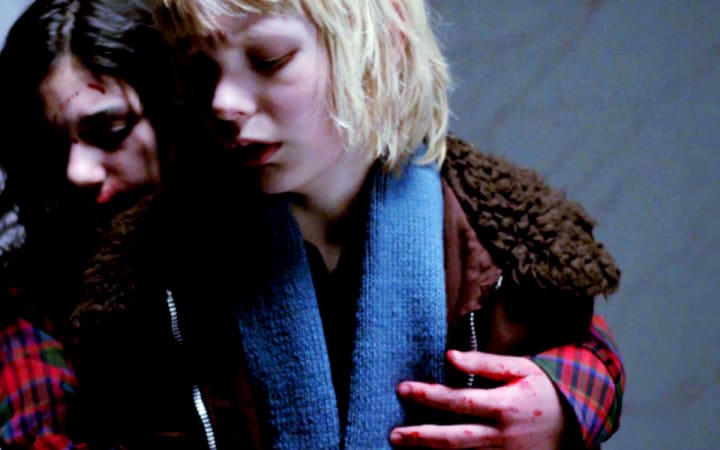
Coming of age never feels ordinary. And developmentally, some are trapped in their youth forever. Both are true if you're a vampire, like Oskar's new best friend, Eli.
In Let the Right One In, these two kids both have to grow up fast. Eli is robbed of a childhood by her thirst for blood, and Oskar faces off against merciless bullies and life with neglectful parents while he longs for his revenge. They end up as friends and foils when she moves into his development.
Eli is a monster who never reached adulthood, and it makes you wonder what normal childhood experiences she lacks. The book suggests she was castrated before she turned, preventing her from maturing sexually alongside her inability to age physically. Yet innocent love still finds her.
"I'm not a girl," Eli tells Oskar when he asks her to be his girlfriend.
"Do you want to go steady or not?" Oskar replies.
It's clear that writer John Ajvide Lindqvist wanted to share how children can love unconditionally.
Let the Right One In shares The Shape of Water's message about discovering something introspective in the unfamiliar, even if it's despised by consensus. Let the Right One In paints another layer onto this theme with Eli representing the darker side of Oskar's nature. The film suggests that it's no sin to have a conversation with your predilections, to hold a thought and understand it before you let it go.
Good Manners
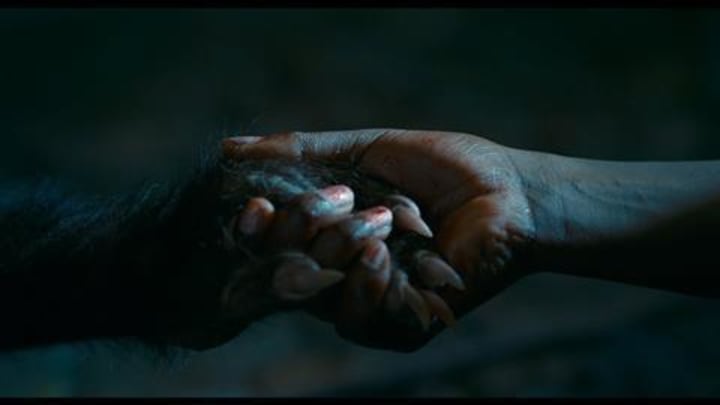
Clara Macedo planned to be Ana's nanny. But something more? Lover, perhaps even mother? Clara navigates these questions as she watches after the pregnant mother-to-be and her gestating monster.
Like the other films on this list, loneliness melts our two characters together while they bond over being the outcasts. Ana tells the fairy tale of a werewolf who held her heart for one night and estranged her from her family forever. Clara skips from job to job as she tries to fish herself out of poverty.
But as Ana comes to term, they're more isolated than ever with questions no expert can answer. If Ana's child is born, Clara must decide whether she can love a monster as her own.
Good Manners explores being a werewolf — and being a mother — in a way you've never seen before. It captures the day-to-day struggles of transforming and reverting, clipping sharp nails and shaving off extra hair in the bathtub after a violent evening, making myriad excuses for classroom absences and slumber party no-shows. In these minutiae, viewers can identify with what it means to quietly hide away a part of yourself that others can't understand. You'll also be familiar with the rift it eventually creates among you and your friends, family, and colleagues.
The film's singsong score and bright colors add whimsy to a fable that you can assume has an Aesop moral at the end, much like The Shape of Water, on denying cultural consensus in favor of personal understanding.
Beauty and the Beast (1946)
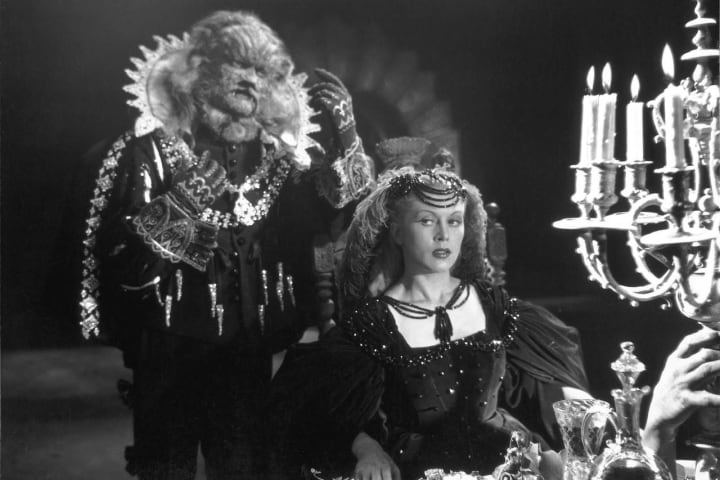
It's no secret that Disney took cues for some of its best movies from international cinema, which were inspired by timeless tales themselves. Art is derivative.
Disney and Jean Cocteau's adaptations include memorable costumes, scores, and narrative beats. They are both allegorical, about a man hiding away an essential element of his identity while the public despises him. Cocteau directed in post–World War II France with his lover, Jean Marais, as the leading man. Howard Ashman wrote Disney's Beauty and the Beast lyrics during the AIDs crisis, with "Kill the Beast" being a pointed take on the ignorance and fear brewing in America.
While you may prefer Disney's rendition, anyone can agree: The Beast is best left the Beast. In the 1946 retelling, Belle seems almost disappointed when the Beast transforms into the handsome visage of her brother's friend. That's not why she loved the Beast. And fans for years have shared the sentiment the Disney's Beast is way cooler with magic, horns, and a tail.
Maybe we don't just love the Beast, we prefer him for his differences.
Ready to Watch?
Guillermo del Toro wanted to make a fairy tale for troubled times, but he wasn't the first to make this kind of monster story. This tale has deep cultural roots; beauty-and-the-beast stories have been told worldwide for centuries. It would seem all times are troubled.
All four movies aren't merely for troubled times, but for troubled people. Their characters and creators know what it is to feel impossibly different, but to be loved regardless.
Even if you're a party of one, enjoy these monster movies next time you need something to watch. They'll help you feel less alone.
About the Creator
Rochelle Burnside
Book editor, copywriter, and happy human being. (:
Keep reading
More stories from Rochelle Burnside and writers in Geeks and other communities.
Midsommar, and Six Other Female Fury Films
Maybe it’s an exaggeration to say you like Midsommar. But if you found it thought-provoking, you’re in good company. Midsommar sparked a conversation. Its horrific imagery, cutting screenplay, and authentic performances won a bouquet of awards and accolades.
By Rochelle Burnside5 years ago in Horror
Silver Screen Magic with Mae West
American actress and singer Mae West became a popular film actress during the Great Depression. She started entertaining in vaudeville, then performed on Broadway, and finally went to Hollywood. She signed up with Paramount Pictures and made her debut in the 1932 film “Night After Night.” She also starred in musicals, comedies, and crime dramas. The American Film Institute named her one of the best classic Hollywood actresses.
By Rasma Raisters5 days ago in Geeks
Jay Kelly - A Netflix Movie Review
Are you running to something or from something? Jay Kelly is a 2025 film about a famous movie actor who is beginning to have doubts about his career. While on the train to his next job, Jay reflects on his life, confronting his past and present.
By Marielle Sabbag6 days ago in Geeks
The Devil's Cut
“Comrade, finally you’re awake.” The voice was smooth, sensual. A flickering incandescent bar was all that lit the white, sterile room. All Vladimir remembered was everything going black. He tried to move his arms and found them strapped to the gurney.
By Matthew J. Fromm4 days ago in Fiction


Comments
There are no comments for this story
Be the first to respond and start the conversation.