
Love in 8-Bit
A Retro Romance Where Pixels Meet Passion

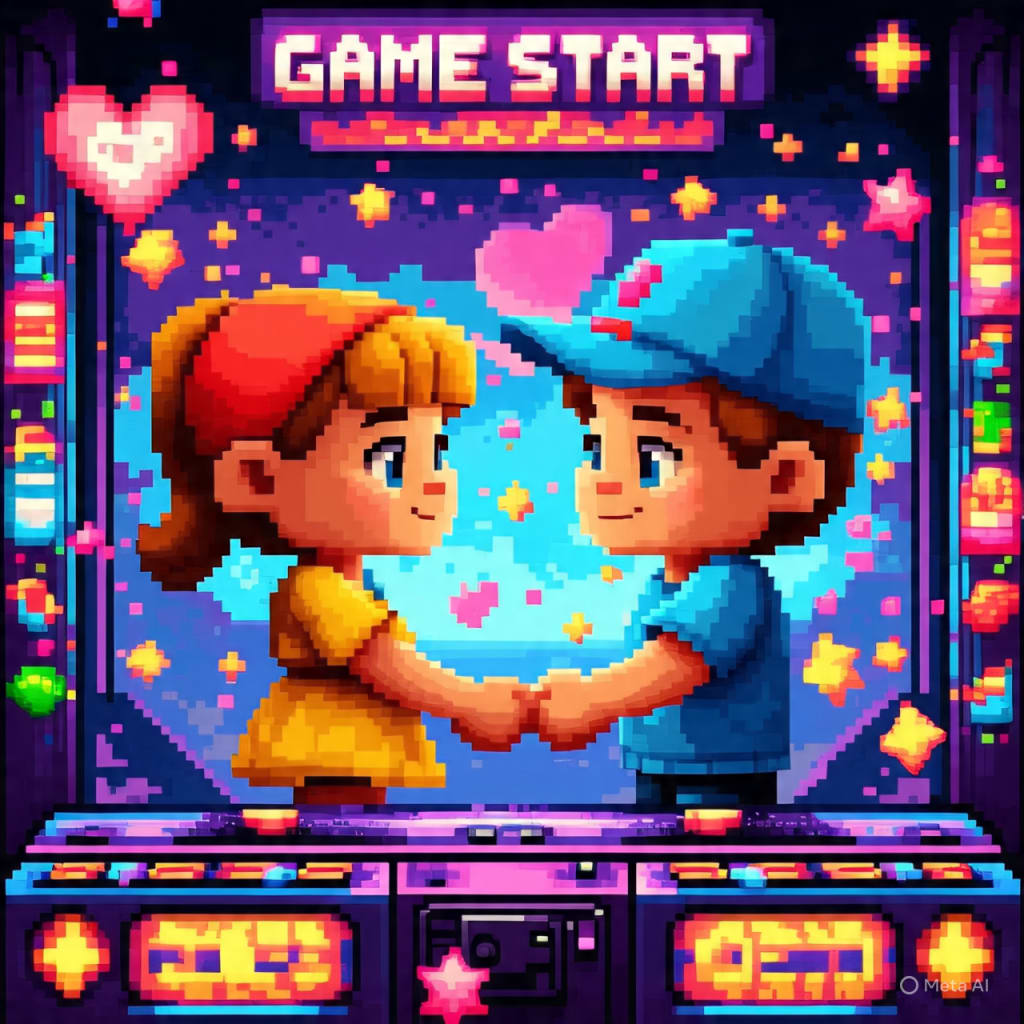
Nathan’s world was pixel-perfect.
He spent his days debugging code and nights immersed in 8-bit games, where the soundtrack of his youth—chiptunes and soft clicks of a joystick—soothed his soul better than any lullaby. In the real world, he was just another developer at BitBloom Studios, a retro gaming company quietly nestled in Portland. But online, he was “BitKnight,” a legend in the underground ROM-hack scene. There, he created love stories between 8-bit avatars—simple, blocky, timeless.
Love, however, had always remained a concept for him—data, algorithms, storylines. Until Ava joined the team.
She breezed into the office with neon-dyed hair and a hoodie that read “I speak Java & sarcasm.” Unlike Nathan, she didn’t just play the classics—she reimagined them. She pitched a radical idea during her first team meeting: “Why not make an 8-bit dating sim that challenges stereotypes and rewrites love?”
Everyone chuckled, including Nathan. But something in her voice—half code, half poetry—stuck.
She began staying late, tinkering on her prototype. And so did Nathan, though he told himself it was purely “code curiosity.” The project became their shared universe: Love.exe, a game where pixelated characters had emotional depth, contradictions, fears, and hopes. Ava wrote branching narratives that broke genre norms. Nathan built AI routines that mimicked organic, unpredictable choices.
As lines of dialogue filled the screen, Nathan noticed how hers sparkled with subtle emotions—awkward pauses, coded vulnerability, jokes hidden like Easter eggs. It felt personal, yet universal.
One night, while testing a dialogue tree between two characters—a warrior who feared abandonment and a rogue who longed for trust—Ava looked up from her laptop.
“Do you think love is predictable?” she asked.
Nathan blinked, caught off guard. “You mean... like an algorithm?”
“Yeah. Or maybe... not.”
He stared at the pixels on the screen. “In games, sure. You write enough conditions, test enough outcomes. But real life? I don’t know. Sometimes, I think I skipped the tutorial.”
Ava smiled. “Me too.”
From then on, the late nights blurred. They shared playlists, childhood stories, the time she set her curtains on fire soldering her first circuit board, the time he skipped prom to finish a Mega Man mod. They laughed. They disagreed—fiercely—on game mechanics and endings. They stayed silent a bit too long when conversations veered toward relationships.
Then came the beta test livestream.
Thousands tuned in. Love.exe broke the studio’s record for demo downloads. Comments exploded with praise for its nuance, charm, and unapologetic weirdness. But it wasn’t until Nathan scrolled to one comment that everything clicked:
> “I cried at the line: ‘Maybe you weren’t coded for me, but I’m still choosing you.’ Whoever wrote that... you get it.”
Nathan didn’t write that line.
Ava did.
He turned to her after the stream. “Did you mean it?”
She laughed. “It’s just a line.”
But her eyes said otherwise.
A week passed. Then two. They went back to being developers, attending meetings, fixing bugs. But Nathan felt the glitch in his heart every time she walked by. He’d written hundreds of love stories for characters who didn’t exist. But when real life gave him one, he froze.
Until she quit.
Her note was brief: “Time for a new level. Thank you for being my favorite co-op player.”
Nathan panicked. He opened her final build of Love.exe, combed through every dialogue path, hoping for a clue.
And he found it.
A hidden Easter egg—an unreachable scene between two NPCs. One, a stoic knight. The other, a rogue with neon hair. The knight says: “I was waiting for the perfect moment. But maybe moments are made, not found.”
Nathan didn’t wait this time.
He packed his laptop, caught the next train to Seattle, where Ava had moved to join an indie collective. At the studio’s open-house event, surrounded by strangers and digital art, he found her sipping soda beside a VR setup.
She looked up, surprised.
“You came all this way?”
He opened his laptop without speaking, launched a custom version of Love.exe. A new path appeared—one she hadn’t coded.
Her character walked up to his and said: “If love was an algorithm, I’d rewrite it every day... just to make sure I’d always find you.”
Ava blinked. “You added that?”
He nodded. “I think I finally got the code right.”
She smiled. “Took you long enough.”
They laughed.
And just like that, in a world of ones and zeroes, two flawed humans found each other. Not because of perfect lines or logic trees, but because they dared to press ‘Start’—together.
About the Creator
Syed Kashif
Storyteller driven by emotion, imagination, and impact. I write thought-provoking fiction and real-life tales that connect deeply—from cultural roots to futuristic visions. Join me in exploring untold stories, one word at a time.
Keep reading
More stories from Syed Kashif and writers in Geeks and other communities.
The Quantum Vows
The screen flickered softly in the dimly lit apartment, illuminating Nora’s glasses with strings of code. Somewhere across the city, a parallel window glowed in Leo’s room, syncing byte by byte. They were writing a program that didn’t just run on hardware—it pulsed through their hearts.
By Syed Kashif 10 months ago in Geeks



Comments
There are no comments for this story
Be the first to respond and start the conversation.