
The Quantum Vows
When Two Programmers Hack the Code to Eternal Love
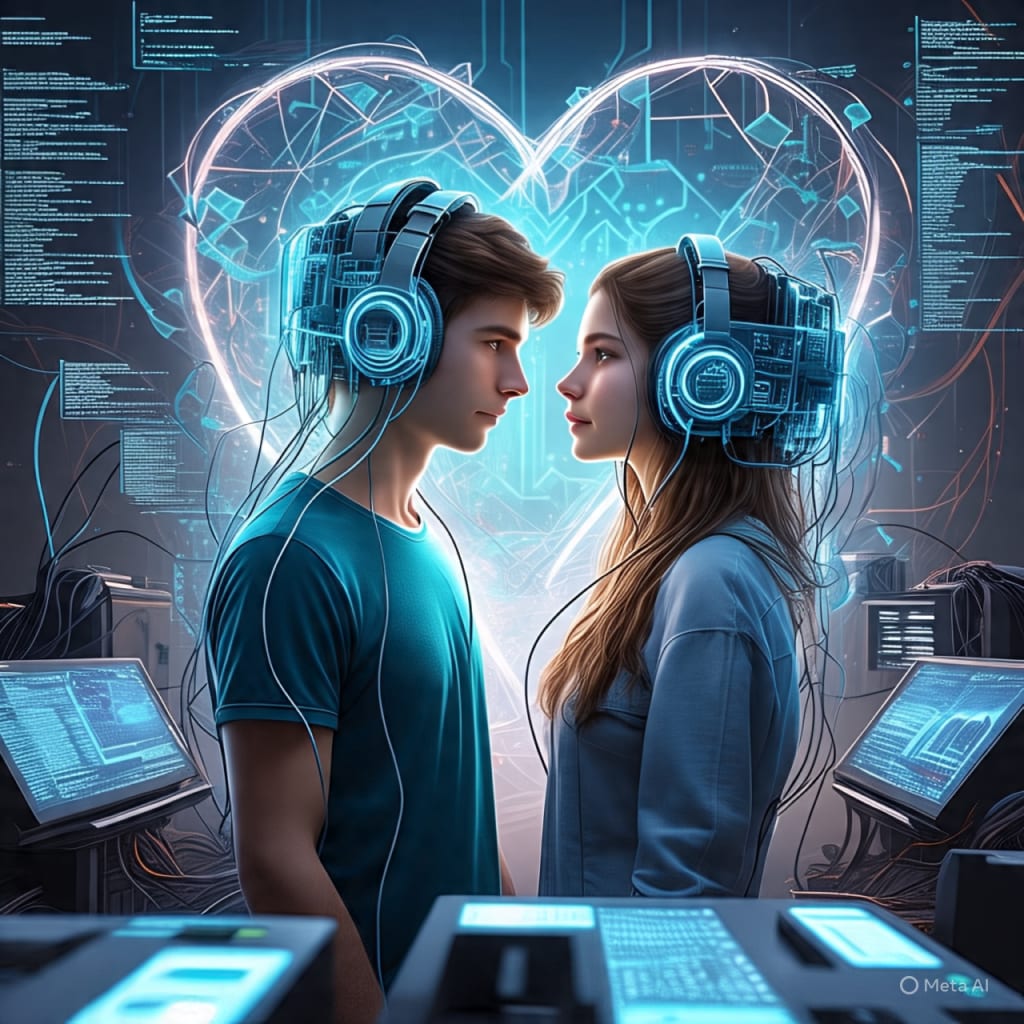
The screen flickered softly in the dimly lit apartment, illuminating Nora’s glasses with strings of code. Somewhere across the city, a parallel window glowed in Leo’s room, syncing byte by byte. They were writing a program that didn’t just run on hardware—it pulsed through their hearts.
It all started on an obscure forum where quantum programmers geeked out over Qubit theory and time-entangled algorithms. Nora had posted a puzzle—a theoretical program that could store emotional states and replay them as real-time simulations. It was a thought experiment, a poetic idea more than a practical one. But Leo responded with 300 lines of code that actually worked.
That thread turned into direct messages. Then video calls. Then midnight coffee shared across time zones. They never said the word "love," but it was encoded into every laugh, every finished sentence, every variable name they left for each other: nora_heart, leo_soul, forever_loop.
Months passed. Their lives outside their screens blurred. Nora was a robotics engineer by day, and Leo freelanced cybersecurity fixes for startups. But their real work—the thing that made their hearts race—was Project Vow.
They envisioned a wearable neural link that could translate their thoughts and feelings into encrypted quantum packets, store them, and even transfer them. An emotional time capsule. They wanted to “quantify connection”—to prove that love could be measured, transferred, and never lost.
“Why do we do this?” Nora once whispered into her mic as she stared at the sunrise through her window.
Leo had smiled, fingers pausing above his keyboard. “Because I don’t want to forget what love feels like. Not even for a second.”
On their one-year virtual anniversary, they met in person for the first time—at DEFCON, of all places. Two geeks surrounded by hackers and surveillance jokes, exchanging the most heartfelt handshake of their lives. They laughed over cold pizza and soda and then found a quiet hallway. Their first kiss was shy, electric, and awkward enough to make them both giggle.
Then came the breakthrough. With a quantum-ready chip Leo had been experimenting on, and a neural-signal decoder Nora had been building for her lab’s robot empathy project, they actually synced a single emotional state.
It was joy. Pure joy. Amplified, encoded, then mirrored.
They cried. Together. Then they saved the moment, labeling it vow_entry1.
Over the next six months, they refined it. They didn’t need words anymore. They could send affection, calm, safety, and even nostalgia. It wasn’t perfect. The bandwidth was limited. Sometimes signals corrupted. Once, Leo received a packet Nora had meant to delete—her feeling of fear after nearly getting into a bike accident. It rattled him, but also made him realize how connected they truly were.
Then the diagnosis came.
Nora’s neural scans showed early signs of a rare degenerative brain condition—one that would erase memory over time. Her doctor said she might have a few years of clarity left. Maybe five. Maybe less.
She wanted to give up Project Vow. Said it was foolish to keep chasing permanence when her own mind wouldn’t last.
Leo refused. “Then we finish it now,” he said. “Not for tomorrow, but for today. I want you to feel everything we’ve built, every line of code, every heartbeat we shared—even when memory fades.”
And so, they built the final version of Vow.
On the day of their wedding—held on the rooftop of a co-working space, surrounded by friends in VR headsets and family waving from screens—they wore the final version of the device.
Their vows weren’t spoken.
They were felt.
Everyone watched as Nora and Leo stood silently, eyes closed, hands intertwined. The device blinked once, green. Then again.
Nora gasped.
Leo smiled.
The guests erupted into cheers, some confused, most deeply moved. No one quite understood the tech behind it, but they felt the emotion ripple like a pulse through the air.
Years later, after Nora’s memory began to fail, Leo still sent her love—packets of encoded laughter, joy, and calm. She’d forget who he was, but she would smile when she received a signal. Sometimes, she even whispered, “Leo,” without knowing why.
When she finally passed, Leo uploaded their complete sequence to the cloud—a final tribute labeled QuantumVows_Complete.
He now teaches emotional computing to new programmers, telling them their most powerful tool isn’t the quantum chip, but the human heart behind it.
About the Creator
Syed Kashif
Storyteller driven by emotion, imagination, and impact. I write thought-provoking fiction and real-life tales that connect deeply—from cultural roots to futuristic visions. Join me in exploring untold stories, one word at a time.
Keep reading
More stories from Syed Kashif and writers in Geeks and other communities.
Goodbye, Mr. Duvall
It is turning out to be an interesting year. I was in the middle of teaching a class when a pop-up appeared on the screen announcing the death of Mr. Robert Seldon Duvall (yes, that was his full name). I was in the middle of a discussion on the obsession we have with winning when it comes to sports (the Winter Olympics was a theme), and I felt as though things were coming full circle. We had already lost Gene Hackman last year, and along with that titan, it feels though one particular golden age has closed off to be replaced by...?
By Kendall Defoe 25 days ago in Geeks
Book Review: "The Palace"by Gareth Russell (Pt. 5)
This review covers chapter 18 to the end of the book *** Chapter 18 covers the reign of Queen Anne, the final queen of the Stuart household and mostly seems to look at the idea that she could barely marry, she had lots of miscarriages and in the end the only child she had lived to eleven years' old and so, she had no heir. There were many questions of Queen Anne's marriage, from her husband participating in homosexual affairs to the ideas put forward in the film The Favourite in which it is Queen Anne who is homosexual and promiscuous. Whatever it was, I definitely feel sorry for Queen Anne - everything must have hurt by the end of her reign, too many pregnancies and miscarriages meant her health was declining quickly towards the end. It's quite sad.
By Annie Kapurabout an hour ago in Geeks


Comments
There are no comments for this story
Be the first to respond and start the conversation.