

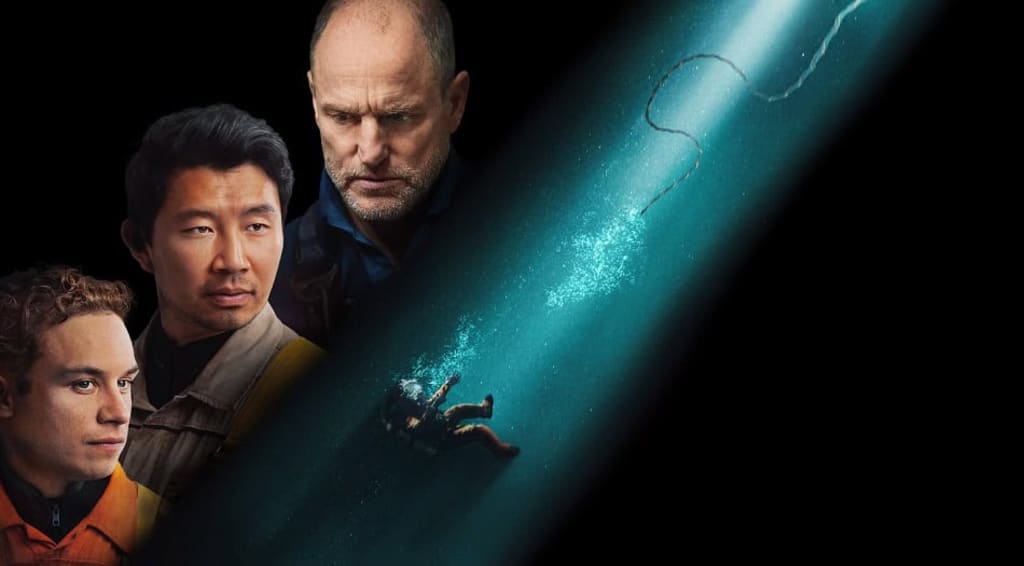
It takes little effort to grasp the sheer peril associated with the profession of a saturation diver. As *Last Breath* emphatically declares in its opening sequence, these divers undertake one of the most dangerous jobs on the planet. The film wastes no time in setting the stakes: thousands of miles of undersea pipelines, vital for energy transport, rely on human intervention for maintenance. To perform this daunting task, divers must remain in pressurized chambers for extended periods before descending over 1,000 feet (approximately 300 meters) into the icy, impenetrable darkness of the ocean’s depths. One diver’s fiancée succinctly likens it to venturing into outer space—a metaphor that perfectly encapsulates the extreme isolation and risk these professionals face.
Alex Parkinson’s *Last Breath*, a feature adaptation of his 2019 documentary of the same name, brings this intense and high-stakes occupation to life with striking realism. Unlike films that rely heavily on exposition, *Last Breath* allows the audience to witness the intricacies of the divers’ work—lever systems, gas regulators, massive machinery, and above all, the extraordinary mental and physical endurance required to function in such an inhospitable environment—without excessive explanation. Even for those unfamiliar with the profession, the sheer complexity of their work is mesmerizing, making the film’s early sequences compelling even in the absence of immediate danger.
However, this is a disaster thriller, and where there is deep-sea exploration, there is inevitable peril. Inspired by real-life events that unfolded in 2012 beneath the North Sea, *Last Breath* dramatizes a routine underwater repair mission that spirals into a terrifying fight for survival. The film effectively captures the constant tension between methodical procedure, rapid improvisation, and the unwavering composure required in high-pressure situations. As the divers navigate their dangerous environment with unnerving calm, the audience is left in a perpetual state of anxiety. The film’s realism resonates particularly for those who have encountered footage of real-life maritime disasters; even watching giant waves batter oil rigs on YouTube is enough to affirm the warning issued by diver fiancée Morag (Bobby Rainsbury): “Humans have no business being at the bottom of the North Sea.”
And yet, the human spirit drives individuals to explore the most uninhabitable places on Earth. Though the actual events have been documented for years, going into the film without prior knowledge enhances its impact. The sudden descent into crisis occurs one stormy September night off the coast of Aberdeen, a moment that alters the mission’s trajectory from a standard maintenance operation to a harrowing survival struggle. While the film does introduce some land-based segments, these moments, though necessary for context, feel somewhat underdeveloped compared to the high-intensity drama unfolding underwater. Ultimately, *Last Breath* is at its strongest when it immerses the audience in the deep-sea environment where the real battle takes place.
At the core of the story is Scottish diver Chris Lemons (played by Finn Cole), an eager yet relatively inexperienced recruit on a multi-day mission to repair an underwater pipeline critical for providing heating to homes. The mission is a team effort, with divers operating in groups of three: Chris and his seasoned colleague Dave Yuasa (Simu Liu), renowned for his expertise and steady hand under pressure, carry out the underwater repairs, while Duncan Allcock (Woody Harrelson), a veteran with two decades of experience, oversees operations from the diving bell—a compact, pressurized chamber that serves as their link to the surface. Harrelson’s signature charm brings a relatable, grounded presence to the role, balancing the film’s intensity with his easygoing demeanor.
What sets *Last Breath* apart is its documentary-like attention to detail. Parkinson, staying true to the film’s factual origins, meticulously reconstructs the divers’ working environment with striking authenticity. The film vividly captures the elaborate machinery that enables these deep-sea missions: the mechanized thrusters that keep the diving vessel precisely positioned, the heliox gas mixtures (a blend of helium and oxygen) pumped into the divers’ chambers to help them acclimate to the intense pressure, and the indispensable “umbilical cords” that supply the divers with air, heat, and a tether to safety. Even the smallest details—such as the tan Crocs worn by crew members—lend an additional layer of realism, reinforcing the sense that the audience is peering into an unseen and often underappreciated world.
Cinematographically, the film makes excellent use of both real-time footage and cinematic re-creations, seamlessly blending these elements to enhance the sense of immediacy. The vessel’s onboard cameras provide a stark, almost clinical view of the divers’ situation, while the dramatic sequences immerse viewers in the suffocating darkness of the ocean’s depths. The contrast between these perspectives heightens the tension, especially as the film approaches its crisis point. With visibility near zero, even rescuers only inches away struggle to locate their target. The oppressive blackness, combined with the chilling reality of oxygen depletion, turns every moment into an agonizing test of endurance.
Without revealing too much, it is worth emphasizing just how gripping *Last Breath* becomes as it transitions from tense procedural drama to full-blown survival thriller. The moments of crisis are executed with masterful precision, plunging the audience into the same claustrophobic horror faced by the divers. Every second counts, and the film leans heavily on visual and auditory cues to amplify the tension—a dwindling oxygen counter, the ominous beep of life-support systems failing, and the suffocating silence that follows when all else fails. Parkinson’s direction ensures that the chaos is never disorienting; instead, he skillfully navigates between the perspectives of diver, bell, and ship, maintaining a coherent and relentless narrative flow.
One of the most remarkable aspects of the film is how it eschews melodrama in favor of stark realism. While the performances of Liu, Cole, and Harrelson are not heavily laden with emotional outbursts or extensive backstories, they are all the more compelling for it. Their characters are defined by their expertise and professionalism, making their plight feel all the more authentic. The absence of exaggerated Hollywood-style dramatization allows the audience to focus entirely on the life-and-death stakes at hand.
However, where *Last Breath* excels in its depiction of survival under extreme conditions, it slightly falters in its conclusion. Once the immediate crisis is resolved, the film’s momentum wanes. Given how meticulously Parkinson constructs the survival sequences, one would expect the aftermath to be just as engrossing. Instead, the resolution feels somewhat abrupt, with a final scene that, oddly, carries an almost romantic-comedy-like tone. While this minor flaw does little to detract from the overall experience, a more nuanced exploration of the psychological and professional repercussions of the event would have made for a stronger ending.
Despite this, *Last Breath* remains an engrossing and visually arresting thriller that highlights the extraordinary resilience of those who work in the most extreme conditions imaginable. With its combination of technical authenticity, breathtaking cinematography, and relentless tension, the film serves as a testament to human endurance, teamwork, and survival against overwhelming odds. It is a story that lingers long after the credits roll—one that truly, in every sense, takes your breath away.
*Last Breath* is set for release in the U.S. on February 28, in the U.K. on March 14, and in Australia on May 8.
This review was amended on March 4, 2025, to clarify that the underwater repair operation depicted in the film occurs at approximately 300 feet below the North Sea’s surface, not 3,000 feet.
About the Creator
Jeno Treshan
Story writer Jeno Treshan creates captivating tales filled with adventure, emotion, and imagination. A true lover of words, Jeno weaves unforgettable stories that transport readers to far-off lands.
Keep reading
More stories from Jeno Treshan and writers in Geeks and other communities.
Superman trailer review
The first trailer for James Gunn’s Superman has arrived, and it’s safe to say that DC and Warner Bros. are steering the franchise in an exciting new direction. With this being the inaugural film under the new DCU banner, there’s a lot riding on its success, and the teaser hints at a fresh yet reverent take on the Man of Steel.
By Jeno Treshan 12 months ago in Geeks
The Politics of Playing Dress-Up
Well, to start off I'd like to say a happy world book day to all who celebrate. I know I haven't really posted anything on my socials about it but I'm not a jubilant kind of person. I lay low most of the time. Let's start off with a popular anecdote from the vaults...
By Annie Kapur2 days ago in Geeks


Comments
There are no comments for this story
Be the first to respond and start the conversation.