
Just a Few Landmark Queer Moments in Classic Star Trek
Nowadays it’s easy to forget that LGBTQIA+ representation on TV was once an uphill and losing battle. But one franchise, Star Trek, chose to fight that battle, sometimes winning, often losing. But since the beginning, queer people have been drawn to the show’s universe, for it’s promise of a utopian future of justice and tolerance; and well, the writers did try to come to the party. When Star Trek: Discovery premiered in 2017 with three gay main characters, and a non-binary and a trans character from season 3 onward, queer moments became unremarkable, as they should be. But for the fifty years before that, we took what we could get. Here are a few landmarks that predate the new age of Trek.

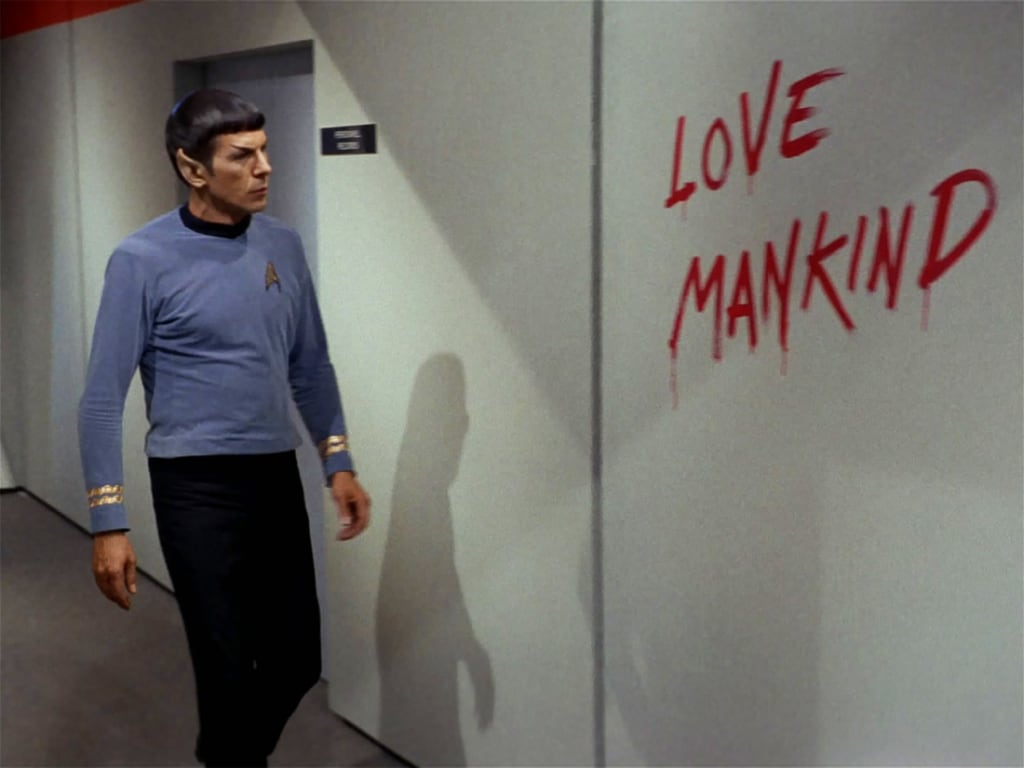
“Please captain, not in front of the Klingons” is my safety word
Ok, let’s get this out of the way first… You won’t find any moments in The Original Series that didn’t leave their queerness to the imagination. According to actor George Takei, Gene Roddenberry was reticent about addressing queer rights, as they had done for issues like race and civil rights, because of the need to keep the show on the air. But show business has a proud tradition of inserting plausibly deniable dog-whistle queer references wherever they could. So, whether or not those sultry suggestive looks between Kirk and Spock were intentional, we’ll never know. But boy, did certain members of the audience see them, notice them, and run with that ball!
And it seems that Roddenberry was keen to see the fans boldly go where the show officially couldn’t. When interviewed in 1979, Roddenberry was asked what he thought of the fan belief that Kirk and Spock were in love. His response was really something…! “Yes, there’s certainly love overtones. Deep love. The only difference being, we never suggested in the series [that there was any] physical love between the two. But we certainly had the feeling that the affection was sufficient for that, if that were the particular style of the 23rd century.”
The Skant. Or how do you get men to wear skirts?
You give it a new name, and pretend it’s a sci-fi thing.
The behind-the-scenes reason for the scant is obvious. How do they reconcile those objectifying miniskirts that women wore on TOS, with the new agey progressive vibe of TNG? You put the men in miniskirts too. The Skant was only seen in the first season, and only on background characters. So, the image of Worf in a miniskirt only exists in my mind (and all of yours now too).
(or you could just say that fashions change. Too easy?)
How thick do you like your AIDS metaphors laid on? Really thick, or really really thick?
Gene Roddenberry was an old coot who’s directives on how Star Trek: The Next Generation should be written almost sunk the show. But we’ll say this for him, he was committed to the promise of a gay character. Writer David Gerrold attempted an episode involving a positive depiction of a gay couple, and an outbreak of Regulan bloodworms, a deadly disease that can be treated with a blood transfusion, a plot point that was meant to address the public’s fear about donating blood during the AIDS crisis. But alas, this was one of those losing battles, with the episode being nixed by executive producer Rick Berman, leading to Gerrold leaving the show in protest.
Remember that name, Rick Berman. He’s a recurring villain for those of us who follow the history of queerness on Star Trek, leading to the refrain on the forums: ARBAB, All Rick Bermans are Bastards. In 1991, Roddenberry renewed his commitment to having a gay character, in response to a letter writing campaign by the Gaylactic Network (yes, really), but died two months later, leaving Berman at the reins of the franchise until 2005.
…And we’re back to innuendo, and dog-whistle references.
With our saga having its villain, it’s good to have a hero or two, too. Or just one. One’s enough, right? Enter, Whoopi Goldberg, who fought to have a single line of dialogue changed. In The Offspring, one of the most Trekkiest of Trek plots, the Android Data builds himself a daughter, named Lal. Goldberg, as the Enterprise’s sage, ageless bartender Guinan tutors her on the birds and the bees, her line, as written, began “When a man and a woman are in love…”. Whoopi Refused, saying “'This show is beyond that. It should be 'When two people are in love.” She got her way. And thus, Trek’s first undeniable queer moment was a single line of dialogue that didn’t happen without a fight.
Oh, and the suggestion that there should be a same-sex couple in the background of that scene was 86’d when some narc called the production office. Thanks narc!
Gee, this is a lot less uplifting than I was expecting
Ah, the old ‘what if things were the other way around?’ trope!
Remember how Planet of the Apes, was a metaphor for racism, but that was kinda problematic, because it likens one race to apes, then talks about how horrible it would be if they were in charge?
The Outcast stood for years as Trek’s queerest moment. And it is pretty jaw-dropping what they did do with that one, all things considered.
The Enterprise encounters the J’naii, a race with no gender (or one gender, I guess. Even I don’t really know the semantics of alien gender dynamics). Riker falls for Soren, who identifies as female. See it turns out that some individuals identify as gendered,. and wouldn’t you know it, they’re discriminated against. This leads to the single greatest line of dialogue in all of Star Trek.
"Commander, tell me about your sexual organs."
Say what you will about the Original Series vs. TNG battle of the nerds, but Kirk was never straight up asked to describe his dick.
It’s pretty amazing how far they went this one. But still, there are issues…
The first issue is that the J’naii’s dystopian society, with its uniform brown jumpsuits and bowl cuts, resembles some Rush Limbaugh, Pat Buchannan nonsense about how feminists and progressive will turn us all into sexless androgyns, by challenging gender roles. Planet of the Apes all over again.
The other problem with this episode isn’t even one that it took fans on message boards to identify. Commander Riker himself, Jonathan Frakes has called this one out for its lack of guts. "I didn't think they were gutsy enough to take it where they should have. Soren should have been more obviously male. We've gotten a lot of mail on this episode, but I'm not sure it was as good as it could have been – if they were trying to do what they call a gay episode." The actor who played Soren was female, thus apart from a few sci-fi embellishments, the “gay episode” never really challenged heteronormantivty.
Still, Kirk was never straight up asked to describe his dick.
The Trill, one big deniable trans analogy.
When we first meet the Trill, TNG’s doctor Crusher is crushing on the Trill ambassador Odan. But it turns out that Odan is actually a big wormy parasite, and that the humanoid that she’s thinks she’s having the affair with is just the host. When the host dies, and Odan returns in a woman’s body, Crusher is… not into it. Fans sighed at the cop out; but what really did we expect? Until a few decades later we got Crusher herself, Gates McFadden saying on Twitter that “Bev would’ve [a] male or female [host]”, it was just that the switch was too quick for Crusher to handle.
Makes sense. And playing it safe probably saved us from a bigoted meltdown or three, too.
Trek’s First Gay Kiss!
On Deep Space Nine though, there was a Trill main character. Jadzia Dax was a young female Starfleet officer, while her wormy thing’s previous host was Curzon Dax, an ornery old male raconteur. Thirty years later it’s hard not to see the parallel between a species that hops between bodies wwith different sexes and genders, and the trans experience (though DS9 did retcon the Trill so that host and wormy thing had a more symbiotic relationship, creating a “joined” entity).
Of course, that parallel was never really addressed (probably because it was unintentional), but it did lead to a moment possibly gayer than The Outcast. See, the Trill have a taboo against continuing relationships from previous lives. So, when Jadzia meets Lenara Kahn, a previous host’s lover, their love is forbidden, leading to Trek’s first gay kiss. Like Trek’s first interracial kiss 25-odd years earlier, the scene was far more controversial than it ever should’ve been. Some networks cut the scene from their broadcast, while producer Steve Oster recalls “a man called the show and complained, ‘You're ruining my kids by making them watch two women kiss like that.’ It was a production assistant who took the call. After hearing the man's complaint, the PA asked if the man would've been okay with his kids seeing one woman shoot the other. When the man said he would be okay with that, the PA said, ‘You should reconsider who's messing up your kids.’”
I only wish that once in my life I could feel as smug as that production assistant must’ve felt for the rest of that day!?
An Actual Gay Main Character? Well, you can guess how that turned out…
Remember how Gene Roddenberry promised a gay character, before promptly dying back in 1991? Well, when the franchise’s new flagship show Star Trek: Voyager needed a new character in 1997, rumours swirled that that character would be gay. GLAAD became involved, launching the Voyager Visibility Project to pressure Paramount to make good on the promise of a gay main character. And producer Jeri Taylor was on board.
That character was reformed Borg drone Seven of Nine, and suffice it to say, she was not gay. We’ll never know quite what happened. Taylor told TV Guide "The idea [of Seven being gay] is something I'm absolutely sympathetic with, and I have tried several times to do it. But there has been opposition, and it gradually became clear that this is a fight I could not win." However, Voyager’s captain Janeway, Kate Mulgrew intimated that the reason was our old friend Rick Berman. In 2002, she said: “I've approached [Rick] many, many times over the years about getting a gay character on the show — one whom we could really love, not just a guest star… and so I thought, this is now beginning to look a bit absurd. And he said, ‘In due time.’... I couldn't get it done on [Voyager]. And I am sorry for that.” To add insult to objectification, Seven was clearly designed to appeal to the male gaze, being poured into a figure-hugging cat suit that cut off blood flow, and caused actor Jeri Ryan to pass out more than once
In 2020, however, Seven was reintroduced into the newest iteration of Trek, Star Trek: Picard, wearing a completely normal jeans, sweater, and leather jacket, and she held hands with another female character. It was a single shot that lasted a few seconds. But we saw it. Damnit, we saw it!
Another shot at an AIDS metaphor. Now Just as thick, but Also Super convoluted.
Star Trek: Enterprise is the unloved red-haired child of the franchise (we thought that was Voyager, until Enterprise came along), and it toyed with multi-episode arcs, which usually just meant that its story lines were super convoluted.
So, I’ll try to explain this story with as few details as possible; because it’s a lot!… So, Enterprise was a prequel. And back in the time covered, the Vulcans were not the benevolent philosophers we knew them as. Back then, they were prejudiced against the Vulcans who could mind-meld. The Enterprise’s Vulcan science officer, T’Pol had nascent mind-melding ability that she was trying to hide, until the titular starship encountered a group of V’tosh Ka’tur, or Vulcans who have rejected their people’s ways. What happens next gets real queasy and gross. One of the V’tosh Ka’Tur forcibly mind-melds with T’pol, and she contracts a neurological disease that’s transmitted by mind melding. Sufferers are obviously stigmatised. The conundrum is that T’pol can save her reputation by saying that she contracted the disease through being violated, but that would continue the stigmatisation of other sufferers.
Yeesh! So, it took them fifteen years plus to get an AIDS metaphor to the screen, and when they did, it involved mind rape, and implied that queer people were to blame for AIDS. The other problem is that it ended up being pretty meaningless; addressing queer issues like the AIDS epidemic would’ve been a bold move in the 80s, but in the 2000s, it was a day late and a buck short. That’s the thing about staking a progressive position on representation; you have to act at the time - tomorrow’s too late. There is no “in due time”. You can’t just be complacent about your franchise having been anti-racist forty, fifty, or sixty years ago. So it’s good to see that the new age of Trek has learned that lesson.
About the Creator
Michael Atkins-Prescott
Non-binary artist, DJ writer, bird fancier and licensed forklift driver.
I'm in New Zealand, with my wife and a cat, a pretty decent kitchen,and a turntable I fixed myself.
pssstt... https://linktr.ee/michaelatkinsprescott
Keep reading
More stories from Michael Atkins-Prescott and writers in Geeks and other communities.
Daisy Chains
To me now, the image of a seven-year old girl as a stern and humourless technical instructor is comical. It’s an image that must have been purged from my memory shortly after experiencing it, only to be reconstructed when I reached an age where Catherine O’Reilly’s inscrutable withering glare was not so intimidating. At the time, I had assumed that she was as skeptical as everyone else of a boy wanting to learn how to make a daisy chain. But as I avoided eye-contact, instead watching her hands as she described the proper place to pierce the daisy’s stem (“here”, she said, tolerating no differing opinions about proper stem piercing placement), something in her voice told me that it was not my gender that bothered her. Daisy chains were serious business to her, not something for amateurs to trifle with, and artisans do not teach.
By Michael Atkins-Prescott3 years ago in Fiction
The Politics of Playing Dress-Up
Well, to start off I'd like to say a happy world book day to all who celebrate. I know I haven't really posted anything on my socials about it but I'm not a jubilant kind of person. I lay low most of the time. Let's start off with a popular anecdote from the vaults...
By Annie Kapur10 days ago in Geeks


Comments
There are no comments for this story
Be the first to respond and start the conversation.