


To me now, the image of a seven-year old girl as a stern and humourless technical instructor is comical. It’s an image that must have been purged from my memory shortly after experiencing it, only to be reconstructed when I reached an age where Catherine O’Reilly’s inscrutable withering glare was not so intimidating. At the time, I had assumed that she was as skeptical as everyone else of a boy wanting to learn how to make a daisy chain. But as I avoided eye-contact, instead watching her hands as she described the proper place to pierce the daisy’s stem (“here”, she said, tolerating no differing opinions about proper stem piercing placement), something in her voice told me that it was not my gender that bothered her. Daisy chains were serious business to her, not something for amateurs to trifle with, and artisans do not teach.
The lesson ended as soon as I had demonstrated adequacy in the basic technique.
Catherine O’Reilly did not much care for the daisy chains I produced myself. I suppose she saw her assessment of me as a rank amateur confirmed. I was missing the point of a daisy chain, she probably thought, as I never bothered to link the last daisy back to the first, to form a garland that one could wear. I simply enjoyed the exercise of creating those perfect links with my child-sized fingernails, forming the longest chain possible (I assumed wrongly that she would relate; she seemed to be as focused on the process as I was, only completing the garland as an obligatory last step. But to her, I suppose, even obligatory steps were essential).
Once daisy chain making crossed the gender barrier, it spread like a virus among the boys. The boys were too self-conscious to go gathering daisies, so any plant growing around the scrubby areas around the rugby field could stand in. And of course, the competitive aspect, helped it spread among the boys too. I never failed to be amazed by boys’ ability to turn everything into a competition; though I suppose I only had myself to blame, as I was the first to try and make the longest chain possible. Dandelions and cat’s ear were favoured among the boys, for their length.
Catherine O’Reilly and her clique washed their hands of the whole thing
I still cannot fathom the link between that trend and the next. It happened while I was home from school for a week with chickenpox. When I returned, a Weetbix box with a toilet roll core taped to it had become an essential tool for making daisy chains. There was only one such construction, and it was perfect. The toilet roll core was placed perfectly in the middle of the front of the Weetbix box, with just the right amount of sellotape, no clumps of tape. Many claimed to be the one who’d made it, and noone wanted to compete with such perfection by making another.
It was a camera.
They took turns making daisy chains (made from anything but daisies), while sat in front of the “camera”, narrating the process in the same excitable attempt at a basso profundo that they used to imitate Skeletor. The narration on that TV show where they do computer simulations of a fight between a bear and a shark lent the boys’ self-narration its cadence, and rugby commentary gave them the script. As a “daisy” chain reached a length longer than the last boy’s, the volume of the narration rose, as if a player on the rugby field had made a break for the try line.
Eventually daisy chains became passé (“daisy” chains did not last much longer). The next craze was hucking pebbles at the goalposts on the field where daisies were once gathered. That was concurrent with scratching the chalk board with nails they’d stolen from the groundskeeper on rain days.
Then bouncing a tennis ball between the walls of a toilet cubicle.
Then thwacking the goalpost pads with bamboo stakes from the garden.
Then tossing one and two cent coins at a bin lid.
Then dropping tuck shop pies off the second storey balcony.
Then karate chopping strips of construction paper.
Then holding onto the radiator and jumping up and down, in an attempt to pry it loose from the wall.
All of these activities were conclusively narrated by each participant.
Then one day the “camera” was left out on the field during the morning tea break. It was found at lunchtime a collapsed soggy mess, due to a brief but heavy hailstorm. It’s replacement, a toilet roll core with no Weetbix box or sellotape had the advantage of not being too perfect to imitate or replicate, and “cameras” proliferated. In a matter of weeks, it had become a habit, then a compulsion for the boys to natter constantly, describing every move they made, with their gaze fixed into a toilet roll core. During class time, when they had to sit quietly, the tension of the boys having to suppress the compulsion permeated the air like white noise. During quiet reading time, you’d hear it, incomprehensible, barely louder than breathing, but with the unmistakable cadence of narration, your eyes would follow the sound, and at its source you’d see a toilet roll core sat on a stack of books opposite the boy whose lips were fluttering, minutely and deliberately.
About the Creator
Michael Atkins-Prescott
Non-binary artist, DJ writer, bird fancier and licensed forklift driver.
I'm in New Zealand, with my wife and a cat, a pretty decent kitchen,and a turntable I fixed myself.
pssstt... https://linktr.ee/michaelatkinsprescott
Keep reading
More stories from Michael Atkins-Prescott and writers in Fiction and other communities.
Lest we Forget: Respectfully, We Need to Fix Our National Day of Remembrance.
Every ANZAC Day I am reminded of the old adage about the American civil war. ‘As a child you are taught that the civil war was about slavery. As you grow older, you learn that there were a myriad of complex factors that contributed to the war. But as you grow up, you learn that it was about slavery.’ Situations are always more complex than they seem, but a greater understanding of those complexities sometimes obscures simple truths. As a contrarian teenager, I believed that ANZAC Day was a bunch of old people glorifying war, so that us youths would be happy little soldiers for the next imperialist expansionist adventure. Of course, I grew out of that view, as I realised that the sacrifices made by those who fought for our rights deserves to be honoured. But every April 25th, my heart sinks as I see the glorification of war seep into that sombre reflection on sacrifice. ANZAC Day may not be about the glorification of war, but it’s sadly used that way.
By Michael Atkins-Prescott4 years ago in The Swamp
THE QUIET RULE
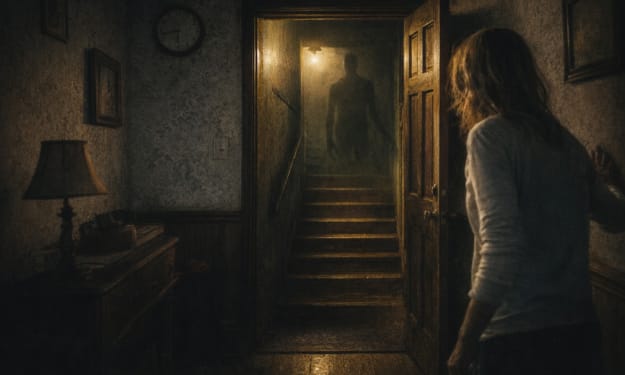
(A family keeps one simple rule: never go into the basement after 9 p.m. But when something begins knocking from below - patient, deliberate, and alive - the real horror isn’t what’s waiting in the dark… it’s that everyone else has already accepted it.)
By Lori A. A.4 days ago in Fiction
I wanted to title this something different, but worried that my chosen title might cause problems entering the United States in the future so this is the new title. It's the greatest title. No one has ever written a title better than this. (All titles unrelated to content).
Let me be honest. I am finding this difficult. Now, I like a challenge, a stretch, a bit of an obstacle course. “Write about the decline of the British Empire in the form of a narrative poem in which your protagonist is an artichoke” I read, and flex my fingers. “Write a haiku to evoke the sensation of sibilance using only the first half of the alphabet.” “Well”, I think to myself, “this should be fun.” But “write about a system that isn’t working”? A system that isn’t working? Now? In 2026? ONE system? My favourite system that isn’t working? The sexiest system that isn’t working? The one giving me the most angst day to day? The one giving me the most existential dread? I am, as I say, finding this difficult. I will own that I have contemplated writing a thousand words on why the steady “all on” setting on my fairy lights is the EIGHTH of seven options which must be sequentially activated to get there, because that is a system that some fool came up with and it definitely doesn’t work, and now who is paying the price, eh? But how can I write about my fairy lights when…. When…. When….
By Hannah Moore6 days ago in Humans



Comments
There are no comments for this story
Be the first to respond and start the conversation.