
Into 1933's Wonderland
Paramount's 1933 Alice in Wonderland


Welcome to the first installment of our journey through Fantasy literature and media. We will be featuring works that qualify to be in the fantasy genre and alternating between those in modern media and literature. Today we feature our first motion picture, Alice in Wonderland, from 1933. I selected this one as the earliest feature film with sound (generally available to our readers) to represent the starting point of Fantasy in modern cinema. It's true that before the advent of talkies in 1927, other titles embarked on Fantasy based topics, but I chose to start with talkies to make history more accessible. I may return to the silent era in future iterations, as their contributions were undoubtedly valuable. Also, while there is much overlap between Horror, Fantasy, and Science Fiction, we are attempting to stay firmly planted in the Fantasy realm. So let's dig in, shall we?
Of course, most of us are familiar with Alice in Wonderland, with its panoply of memorable characters. Who could forget the Chesire Cat, The Queen of Hearts, The MadHatter, and of course, the March Hare? This awareness is thanks, in large part, to the 1951 movie adaptation by Walt Disney. Indeed there are at least 18 motion picture versions, of which the Disney version may be the most famous, and that doesn't even begin to scratch the surface of this work's presence in our collective societal memory.
Published in 1865 under the title Alice's Adventures in Wonderland by Lewis Carroll, the work has been translated into 174 languages and has been reinterpreted for film, stage, and countless other mediums. And much like the tradition of many Fantasy stories or epics, it started as part of verbal tradition. Charles Lutwidge Dodgson, known later by his pen name Lewis Carroll, was in the habit of telling fantastical stories to the children of Henry Liddell. On one such afternoon, July 4, 1862, he told a story to Lorina, Edith, and Alice Liddell on a long boat ride between Oxford and Oxford shire. This particular tale focused on the young Alice's fictional adventures in the "under ground." She was so enamored by the story that she asked him to write it down for her. He completed the first manuscript two years later, or so the story goes. The final published version was nearly double the length of the original manuscript and was received with praise almost immediately, becoming a children's classic almost overnight.

Its cultural influence continued to grow and expand in the nearly 70 years between its release and Paramount's 1933 version. A floodgate opened with the copyright expiration in 1907. All sorts of works emerged with Alice at its center, including three cinematic adaptions before the subject of today's article.
With the arrival of 1932, the world began a jubilant centennial celebration of Lewis Carrol's birth, and Alicemania was at a peak. Interest in the book and its sequel, Through the Looking-Glass, drove sales of Alice merchandise and even a new stage adaption by Eva Le Gallienne in London. This despite the ongoing global economic depression
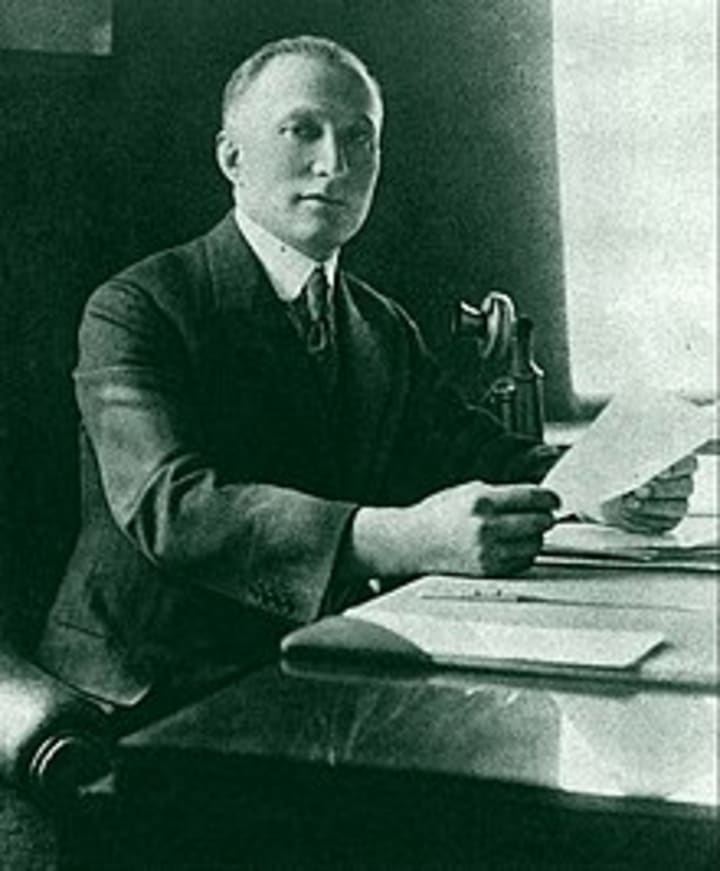
Against this backdrop, Paramount Pictures entered the Wonderland frenzy. The Early '30s had been super hard for the now 20-year-old studio despite having a stable of established stars such as W.C. Fields, Bing Crosby, Gloria Swanson, Cary Grant, Gary Cooper, and Mae West; the Great Depression had taken its toll. Indeed, its founder Adolph Zukor had fired most of the company's managing staff due to its near collapse. Zukor even hired John Hertz, the taxi and rental car magnate, in 1931 to rescue the company from its financial woes. Hertz through in the towel on January 6, 1933, believing the situation untenable, and indeed the company filed for bankruptcy in March of that same year. By April 1933, Zukor himself had lost control of the company to a set of trustees.
To save Paramount, the trustees obtained the rights to the Joseph Mankiewicz and William Manzies' penned screenplay in May 1933. The very same script Walt Disney was attempting to buy for a Mary Pickford-led version of the story. Paramount envisioned the project as a vehicle to take advantage of the current "Alice" excitement and highlight its vast constellation of stars. Hopefully, this would be a blockbuster for them in the Holiday Season and serve as a springboard to emerge from bankruptcy. And so casting began; W.C. Field as Humpty Dumpty, Cary Grant as the Mock Turtle, Gary Cooper as the White knight, Sterling Holloway as the Frog Footman, Richard Arlen as the Cheshire Cat, and Edward Horton as the Mad Hatter, amongst other notables.
Originally coming in at 90 minutes during studio previews, the final version was trimmed to a slim 77 minutes and released on December 22, 1933, to a very cold reception. The film, in the end, was a bomb and didn't rescue Paramount from its financial wows (something Mae West did almost single handily that same year with She Done Him Wrong and I'm No Angel). In large part, the film did poorly because the major stars were virtually unrecognizable in their costumes.
The film itself is a bit of a blend of items from Alice's Adventures in Wonderland and Through the Looking Glass and borrows heavily from
Le Gallienne's stage adaptation. This version starts with Alice and her Aunt in a parlor by the fireplace during a winter storm, and she fantasizes about being able to go through the looking mirror to the room on the other side. Climbing onto the fireplace mantle, she does precisely that, and our journey begins (she only later goes down the Rabbit Hole).
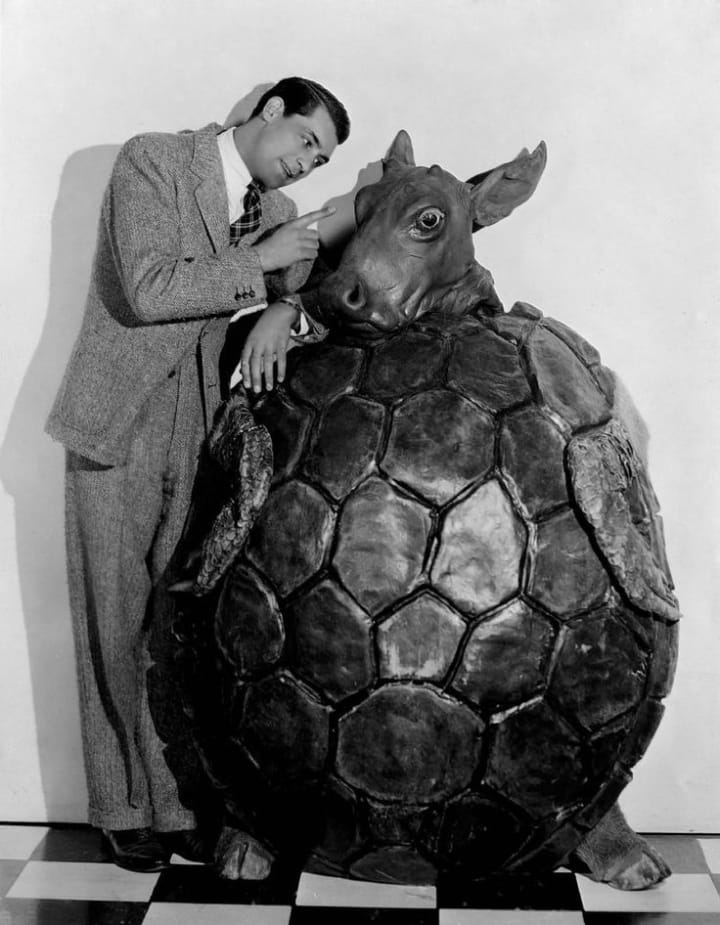
Many of the plot lines are familiar such as the Caterpillar, played by a less than transcendental Ned Sparks, questioning Alice about her identity. Edward Horton, Jackie Searl, and Charlie Ruggles performed the Mad Hatters tea party in a uniquely done fashion. Cary Grant is utterly unrecognizable as the Mock Turtle (A cow in a turtle shell, since mock turtle soup is made with veal) who can't stop crying even while singing. Some of the most memorable sequences are actually from Through the Looking Glass. Tweedle Dee and Tweedle Dum's poem "The Walrus and The Carpenter," with animation provided by Harman-Ising Studio, is particularly notable. Stealing the show, though, is Gary Cooper as the White Knight - repeatedly falling off his horse to great comedic effect.


The hands-down weirdest part of the movie, though, is when the Queen of Hearts, Edna May Olivier, holds the croquet match and the actors are playing with real flamingos (mallets) and hedgehogs (balls). Something that I'm sure wouldn't pass muster with the ASPCA today.
All-in-all though, the movie is a fascinating historical oddity and entertaining, even if the plot is only a strung-together bit of non-sequiturs. As a Fantasy piece of work, several elements hold. There is an adventure/journey at its heart with fantastical elements. The plot lacks a clear antagonist, though, and much as the original books are more of a dreamlike setting than rooted in anything resembling reality. What has always made it fun for adults and children is its multi-layered quality, with hidden jokes for the adults and silliness for the children.
I don't recommend this for your children, mainly because there are better versions, and they will likely find this version dated. Teens and above may be fascinated with the customed attempts at special effects and how well it was done for that era. This movie is a must, though, for Alice fans.
Alice in Wonderland (1933) may be found today on Amazon for rental streaming. This availability is a small treat when you consider it was unavailable anywhere on the market until 2010, when a DVD version was finally released.
Next week we will turn our attention to where Fantasy got its first written start, with the Epic of Gilgamesh from somewhere between 2100-1200 BC.
About the Creator
Keep reading
More stories from Drew Jaehnig and writers in Geeks and other communities.
Not All Who Wander Are Lost
I wanted to start a quest with my readers here. A journey into the Fantasy genre. A trip to explore its origins and evolution and how Fantasy went from a niche genre into a moneymaking juggernaut. Those of us who grew up on Dungeons and Dragons, Tolkien, and the myths and legends of the past were outcasts, nerds, or freaks, know that Fantasy used to be the relatively exclusive domain of recluses and introverts.
By Drew Jaehnig3 years ago in Geeks
Super Saiyan 2 Gohan Transformation: Settling the Score
One scene, but two contrasting philosophies, both shaped the same iconic moment. Let's explore how. You're here because you love Dragon Ball Z's musical score, and you want to hear, see and feel the scene when Gohan's latent potential is finally unleashed in its full glory, but do you know the version you are looking for?
By travus Leroux6 days ago in Geeks


Comments
There are no comments for this story
Be the first to respond and start the conversation.