
Not All Who Wander Are Lost
A Survey of the Fantasy Genre in Film and Literature


I wanted to start a quest with my readers here. A journey into the Fantasy genre. A trip to explore its origins and evolution and how Fantasy went from a niche genre into a moneymaking juggernaut. Those of us who grew up on Dungeons and Dragons, Tolkien, and the myths and legends of the past were outcasts, nerds, or freaks, know that Fantasy used to be the relatively exclusive domain of recluses and introverts.
It is also the domain of an intelligent, literate, and thoughtful fanbase that adores historical legend and the fundamental core concepts of good vs. evil. Indeed, many fully embraced the monomyth concept espoused by Joseph Campbell without knowing it. The idea of "the hero's journey" is a fundamental aspect of storytelling in the Fantasy genre at its core.

Although the Fantasy Genre has always been a mutt genre as defined by today's media. Media companies are attempting to capitalize on the trend and throw all sorts of things into this bucket. The simplest definition I've read is that Fantasy features magical or supernatural elements that "do not exist in the real world." With that definition, Fantasy can come to mean many things and encompass large chunks of Horror and science fiction under its banner. Wikipedia describes it as Speculative, involving "magical elements" and typically set in a fictional universe. Under this definition, Star Wars and Dune would both qualify.
I prefer a more tightly bound definition that evokes our present world and draws on myths already held dear by our cultures. Tending to lean heavily on Fantasy as myth-based, I refer to Tolkien as probably the master template, although this does not exclude other Fantasy based works that are less well-rooted. And by that, I mean works in a similar vein to Alice in Wonderland and Peter Pan. However, classified today as children's stories, they are inherently rich in fantasy elements and contain elements of myth as a basis.
In any event, we can debate what constitutes the genre until the elves come home, but I decided to utilize this definition as the basis for my journey into the realm of Fantasy. I wanted to provide a survey of Fantasy media in film and books to the degree possible, a survey that would likely take years. A study that would also be chronological since Fantasy builds on the works of others before it.
The long-range objective is to provide a sense of history and understanding of these works from a literary and cinematic perspective. This review may also give us a basis to rediscover and understand why we love the genre so much.

So I invite all of you to join me each week as we review motion pictures and literary works and trace the origins of Fantasy to the present day. I will only portend that I will examine some works in film or books, and select works based on the following criteria.
Availability - I want to review the actual work and have that same opportunity availed to everyone else for this journey. So works that are not readily available will likely only be referenced where necessary.
Definition - That it meets my definition of Fantasy, it is not my intent to review Horror or Science Fiction works, although some works may contain elements of the horrific.
So join me each week as we chart this journey through the history of Fantasy. We will start with our first film next week. Going back to the start of talkies in 1927 and sifting through the films available to you, we will begin our journey with Alice in Wonderland from 1933 with Gary Cooper as White Knight, Cary Grant as Mock Turtle, W.C. Fields as Humpty Dumpty, Edward Horton as the Mad Hatter and Sterling Holloway as Frog.
About the Creator
Keep reading
More stories from Drew Jaehnig and writers in Geeks and other communities.
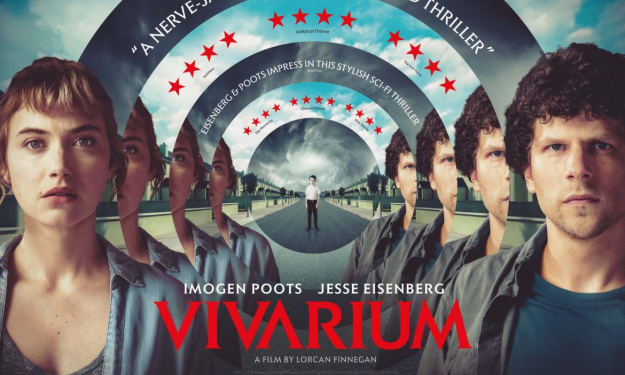
Vivarium
So you’re locked up in your house wondering when the madness outside will end. You’re bored; you have an exaggerated case of cabin fever. Some of you probably have high anxiety about your future, the state of your finances, and the world economy. It’s understandable, and sometimes we need a reminder that it could be worse. I mean, Gemma and Tom would like to leave the house too. Indeed leave their ugly little subdivision, but even that is not possible. They have no games to play, no books to read, no TV to watch and their child is from Hell.
By Drew Jaehnig5 years ago in Geeks
Book Review: "The Substance of Civilisation" by Stephen L. Sass
There are many different substances throughout history that make up the way in which we have lived our lives. Stephen L. Sass goes through the materials which sought to make us humans and shape our meaning with it. From the clay era in which we are shown that even though we are known to use clay, we have no idea what kind of accident brought it about all the way through to the 'silicon' age - the author makes it clear that throughout history we all have one thing in common: we wanted to revolutionise our materials for production. We have always wanted to create something to make our lives easier - and that's what we have been doing since the dawn of humanity.
By Annie Kapur4 days ago in Geeks


Comments
There are no comments for this story
Be the first to respond and start the conversation.