
Inside Llewyn Davis - Ethan Coen, Joel Coen (2013)
Movie Review

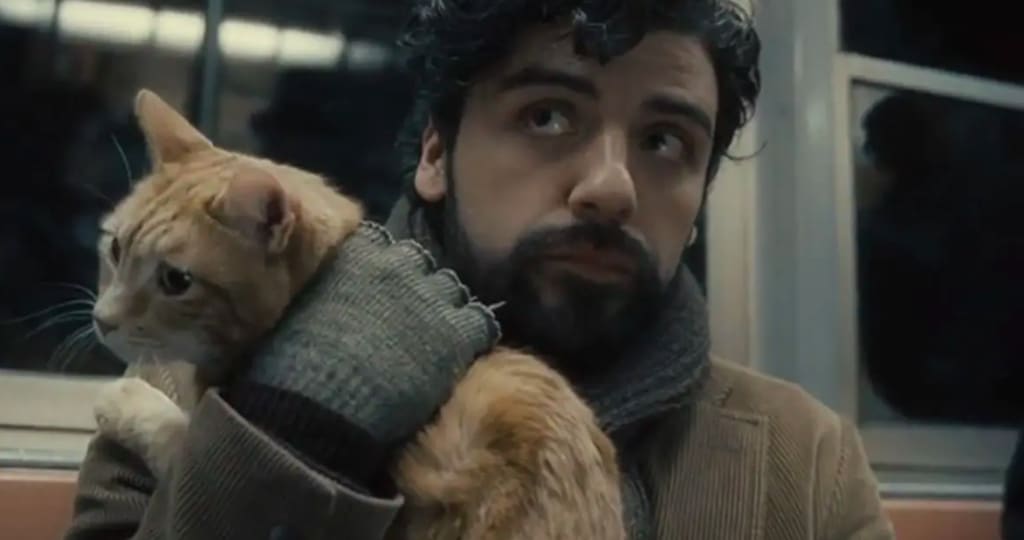
"The Village" is the colloquial name of a neighborhood in western New York, commonly known as "Greenwich Village", with "Greenwich" being the English form of the Dutch word "Groenwijck" (Green District).
Not only for America, but for the whole world, this place is known as the birthplace of the "Beat" movement and later the "counterculture of the 1960s", which evolved into the "pop" style, and then into the "hippie" culture.
"The Village" is therefore a paradise for artists of all kinds, who through gentrification have managed to impose a cultural texture created and adapted to make sense of the changes happening in their living environment. Its proximity to Broadway and the famous 14th Street is not coincidental.
"Greenwich Village" was the location of New York's first prison, "Newgate Prison", and around the same time, it also became the site of the construction of the "Tenth Street Studio Building", where the first architecture school and the first major gallery (exhibition space) of the city were established. Both the former prison, built by a religious man for the purpose of rehabilitation, and the cultural center and generosity of the parks, as well as the modest pretensions, have imbued the settlement with a personality that radiates through tolerance, openness, understanding, and nonconformism. This atmosphere quickly spread throughout the area, with "the Village" functioning as a magnet for all those who wanted to express themselves through artistic messages, regardless of their social class. And because art does not go hand in hand with wealth, it had to be avoided at all costs (many artists voluntarily imposed poverty and minimalist living in order to be part of the spirit of the place).
This is how we come to have here the bohemian lifestyle, whose etymological roots claim the nomadic life of the Roma people (it was believed that they come from "The Kingdom of Bohemia", a province of the Roman Empire, now part of the Czech Republic). Bohemia represents an attitude of the artist who, concerned with his or her purpose, does not want to waste time on social norms and conventions, and who minimizes consumption, the need for money, and extravagance, in favor of values such as freedom and freedom of expression, unrestricted love, and the annulment of any stylistic or organizational constraints.
In the 1960s, in "Greenwich Village", we find predominantly such a landscape, almost, if not at its peak... and today our focus is on the folk phenomenon, also experiencing a rapid resurgence.
"The Village" is the latest production of the Coen brothers, and is considered by critics as their best one. It does not have a plot. It is a week of nightmares, devoid of spectacle, from the life of a singer-songwriter trying to make a name for himself in an overcrowded environment of talent, too scattered in simple existential resolutions, too indifferent to the fate of its occupants... To compensate for the lack, a cat was introduced in the film, somehow connecting the scenes and ensuring continuity.
Yes, it is true that the character behind Llewyn Davis in the film "Inside Llewyn Davis" directed by the Coen brothers is inspired by the life and music of folk artist Dave Van Ronk, also known as "The Mayor of MacDougal Street". However, Llewyn Davis' character is not a direct representation of Van Ronk, but rather a suggestion or generic image of a whole group of artists with dashed dreams and expectations. It takes a good part of the movie until we understand that the connection between the two can work, and it explains, on one hand, the exceptional quality of the music in the soundtrack (by T Bone Burnett), and on the other hand, a post-event upward evolution. But just when we come to terms with this idea, the Coen brothers declare that Dave Van Ronk is just a suggestion for the character of Llewyn Davis, who actually represents the generic image of a whole group of artists with shattered dreams and expectations.
Regarding cinema, even though in all cases we have excellently captured images with high quality, the colors are scarce and on the edge. The entire technical arsenal is used with maximum efficiency to establish the melancholic and depressive mood of the narrative, and the choice to capture all the tracks in direct takes and to let the songs play in their entirety is a wise and essential one for such a film. The options for soft diffuser filters, an accessory that intervenes in almost all frames where folk music is played, are also impressive in composition, serving as a background for this genre of music where poetry and romanticism dominate.
About the Creator
Andreea Sorm
Revolutionary spirit. AI contributor. Badass Engineer. Struggling millennial. Post-modern feminist.
YouTube - Chiarra AI
Keep reading
More stories from Andreea Sorm and writers in Geeks and other communities.
Pandora’s Burden
“My brother warned me to not accept gifts from the one who commissioned you,” said Epimetheus to the woman clad in silvery raiments standing at the entrance to the temple. Her silver tiara and the silver rings on her fingers and toes glinted in the firelight cast by torches set on either side of the doorway. Lingering in the shadows, beyond the reach of the flames as she was, he could not tell what she held in her hands. At first what appeared to be a box was perhaps a funerary urn, or maybe merely an apple.
By J. Otis Haas2 days ago in Fiction


Comments
There are no comments for this story
Be the first to respond and start the conversation.