
The Great Beauty - Paolo Sorrentino (2013)
Movie Review

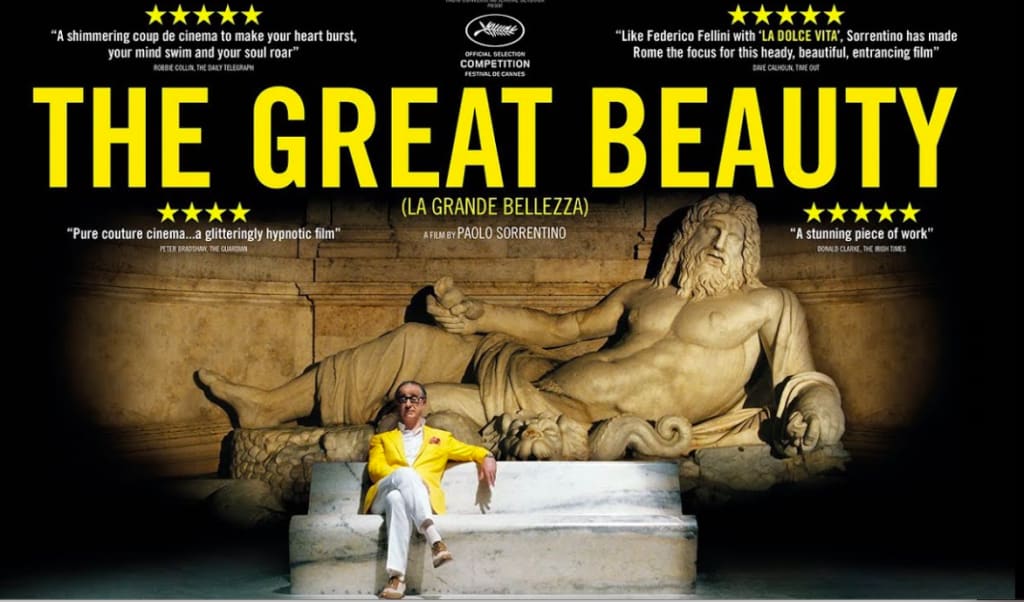
It could be argued that this film could be categorized as a remake, as if it is not a reprise of Federico Fellini's "La Dolce Vita", or a continuation of it, then it is certainly a perfect replica.
Paolo Sorrentino (The Young Pope, The Great Beauty, This Must Be the Place) is a director with a strong involvement in politics, so all of his endeavors are reflexively viewed with specific circumspection, and the eye involuntarily seeks out allusions or coded messages from this realm. This is why almost all of the criticism in Italy associates the production of "The Great Beauty" with interpretations related to the Silvio Berlusconi era. This is also due to the fact that the main character is a frivolous senior who has just turned 65. Indeed, "Il Cavaliere" has significantly influenced the mentality of his contemporaries, swinging public opinion from circumstantial sobriety to debauchery, opulence, and abuse in the name of tolerance. The average Italian, in the twilight of his life, has become receptive and confident that he can have a real chance, regardless of age. Secretly, his envy of Berlusconi has reconciled perfectly with the temptation or pride of following in his footsteps.
To be very objective, however, this film is atypical for Paolo Sorrentino, and while the references to Fellini are evident to everyone, what is not revealed to everyone are the other annotations that cover a much wider range of influences; ones that target authors such as Roberto Rossellini, Vittorio De Sica, and Luchino Visconti, the great masters of Italian neorealism, the only period when Italian cinema shone on the international stage with originality and value.
Nothing much happens in "The Great Beauty"... None of the characters seem to have any real jobs, and Jeb Gambardella's (Toni Servillo) search for answers is often answered before the questions are even asked. Like Marcello, the homologous character from "La Dolce Vita", Jeb is dissatisfied with the outcome of his explorations and the spiritual failure of the extravagant socializing in the elite circle, but for him, all of this leads to a rejuvenation of artistic spirit... That's what it's all about... and the limits of decadence in art, its relationships with avant-garde, levels of consumers and consumerism, and so on...
Leaving politics aside this time, Sorrentino's recipe proposes a construction around a few key scenes, a visually stunning soundtrack (selected according to demands that escape me), and picturesque frames interrupted by the allusive inserts I mentioned before. With some minor stumbles, everything flows quite smoothly, and the clumsiness of certain filming techniques for which I do not have an explanation at this level does not significantly affect the overall realization. With a little more attention, this film could have become a major event in cinema, as the way to replicate a masterpiece through interventions in the behavior and motivations of the characters involved, without altering the message in any way, is an experiment that has never been fully exploited before.
Although condemnable superficiality sometimes hinders the balance between image and music in certain sequences (making it difficult for the audience and distorting the narrative), it remains the essential tool of the adaptation and the element that provides the most consistent support to the great beauty that Jeb identifies in the end as a reconciliation with oneself... as an acceptance of the past, present, and future.
A good film, a beautiful film, and an interesting film, an excellent opportunity to remind ourselves of Cinecitta and the glory of Italian cinema.
The initial title of the film "L'Apparato Umano" was changed during production without any explanation.
The scene projected on the excellent song sung by Else Torp (written by Arvo Part) proposes an axial tracking shot on a park alley that is not deep enough. The usual rule to compensate for this shortcoming is to use a wide lens or double the shot with a zoom. However, none of these techniques are used, although the concept of depth matches perfectly with the chosen piece of music. In other instances, the camera retraces a path it has already taken, or simply pendulum swings. Unless it's an intentional proposal for a new aesthetic, all of these are considered mistakes in film schools.
About the Creator
Andreea Sorm
Revolutionary spirit. AI contributor. Badass Engineer. Struggling millennial. Post-modern feminist.
YouTube - Chiarra AI
Keep reading
More stories from Andreea Sorm and writers in Geeks and other communities.
The Politics of Playing Dress-Up
Well, to start off I'd like to say a happy world book day to all who celebrate. I know I haven't really posted anything on my socials about it but I'm not a jubilant kind of person. I lay low most of the time. Let's start off with a popular anecdote from the vaults...
By Annie Kapur9 days ago in Geeks
Series To Watch
I am certainly no stranger to a tv series and everybody knows that in my life. The amount of time I have spent in my existence watching shows on the television or my computer is honestly embarrassing considering I'm not getting paid for it. Maybe someone should be paying me for it. However, it does mean I get to share it with you, dear people. I will do a list order first, don't worry.
By Lyvia Jack3 days ago in Geeks


Comments
There are no comments for this story
Be the first to respond and start the conversation.