
In Cold Blood by Truman Capote
Why It's a Masterpiece (Week 26)

Serialised in a famed copy of The New Yorker, Truman Capote's novel In Cold Blood was eventually published as a book the following year in 1966 and tells the true story (well, at least a half-true story) of horrific murder.
An entire family was killed by two ex-convicts, Richard Hickock and Perry Smith, during a botched robbery. Truman Capote, along with his close friend Harper Lee, traveled to Kansas shortly after the murders to conduct extensive interviews and gather detailed information about the crime, the community, and the investigation. Their research lasted for six years.
Truman Capote combined factual reporting with narrative techniques typically reserved for fiction, creating a detailed and compelling account of the crime and its aftermath. However, the question of truth is often raised concerning this novel and other nonfiction narratives due to the amount of embellishment which has been done to sell the book as entertainment.
Be that as it may, it became a bestseller and solidified Capote's reputation as a leading literary figure.
Plot
After Richard Hickock and Perry Smith were arrested, tried, and convicted, Capote personally interviewed both men. He found Smith particularly fascinating and depicted him as the more sensitive of the two in the book. The novel was completed only after their execution. The finished book was based off the over 8'000 pages of research that Capote had compiled from before the arrests to after the executions.
It was pioneering the New Journalism style. This involves writing nonfiction in a narrative style as events unfold in real life. Capote exemplified this by simultaneously researching and writing the story as he followed the court trials and interviewed those involved. It was definitely controversial for its time, but the novel has stood the test of time as the first real one of its kind.
Let's take a look at the story behind the murders...
Herbert "Herb" Clutter was a successful farmer in western Kansas, respected by his 18 farmhands for his fair treatment and good wages. He lived with his wife Bonnie, who was reportedly incapacitated by clinical depression, and their two younger children, Nancy (16) and Kenyon (15). Clutter's two older daughters, Eveanna and Beverly, had already moved out and started their adult lives. The portrayal of Bonnie's depression in the book was later disputed by her brother and other family members, who claimed it was not as severe as described.
On November 15, 1959, ex-convicts Richard Hickock and Perry Smith, recently paroled from Kansas State Penitentiary, robbed and murdered Herb, Bonnie, Nancy, and Kenyon Clutter. Hickock was motivated by a former cellmate, Floyd Wells, who falsely claimed that Clutter kept large amounts of cash in a safe. Hickock believed robbing Clutter would be an easy way to get rich and start a new life in Mexico. He involved Smith in the plan. Contrary to their expectations, Herb Clutter had no safe and conducted all his business transactions by check.
Despite finding no safe, Smith, prone to violent outbursts, slit Herb Clutter's throat and shot him in the head. Kenyon, Nancy, and Bonnie Clutter were each murdered with a single shotgun blast to the head. The killers left with a small portable radio, binoculars, and less than $50 in cash. In his oral confession, Smith claimed Hickock killed the two women, but he refused to sign the confession, wanting to take responsibility for all four murders out of sympathy for Hickock's mother. Hickock consistently asserted that Smith committed all four killings.
The trial takes place in Garden City, Kansas, where Hickock and Smith are both found guilty of first-degree murder. Despite their defense attorneys' efforts to argue for leniency based on Smith's mental instability and Hickock's influence over him, both men are sentenced to death. After several years of appeals, Hickock and Smith are executed by hanging on April 14, 1965. It is said that Capote was still researching and interviewing right up until this date.
Into the Book
There are several themes in this book despite it being based on true events. One of the most prominent themes is the nature of human evil and the darkness it can project - puttin very real and innocent people in masses of unknown danger. This is done not only through the story, but Truman Capote's use of language to do with the murders. Capote delves into the psychological depths of Richard Hickock and Perry Smith, exploring what drives individuals to commit heinous crimes.
There are often feelings of desperation and urgency that are committed to the paper, helping the reader not to empathise, but to understand the nature behind the crime. Through detailed character studies, he presents their backgrounds, motives, and mental states, raising questions about inherent evil versus the impact of life circumstances. The question of whether these two murderers were actually simply 'bad eggs' is constant throughout the book - or whether they were simply a product of their own circumstances, having no real agency whatsoever.
Therefore, the book presents Hickock and Smith not merely as cold-blooded killers but as complex individuals with their own vulnerabilities and past traumas. This nuanced portrayal challenges readers to consider the factors that contribute to evil actions and whether such individuals can be purely categorised as evil. A definite moral ambiguity that has made us as people look closer at the judicial process.
You are a man of extreme passion, a hungry man not quite sure where his appetite lies, a deeply frustrated man striving to project his individuality against a backdrop of rigid conformity. You exist in a half-world suspended between two superstructures, one self-expression and the other self-destruction.
- In Cold Blood by Truman Capote
Another theme in the text is the American Dream. As with many of the books around the same twenty to fifty year time period, 'In Cold Blood' details the discontent with the American Dream and the anger presented at its failings. This is done through oppositions: the Clutter family epitomises the American Dream with their prosperous farm, close-knit family, and respected status in the community.
In stark contrast, Hickock and Smith represent the failure to achieve this dream, driven by poverty, broken families, and unfulfilled aspirations. This almost makes the murderers look even worse than they are since we have characters who have nearly achieved it and from so little. It impacts our own judgements.
However, the brutal murder of the Clutters in their home, a symbol of stability and security, shatters the illusion that the American Dream guarantees safety and happiness. The randomness and senselessness of the crime underscore the fragility of the dream and the underlying societal issues. The idea that possibly anything can happen is something that gives great undertones to the novel especially when we reach the chapters regarding the judicial proceedings of the killers.
“Once a thing is set to happen, all you can do is hope it won't. Or will-depending. As long as you live, there’s always something waiting, and even if it’s bad, and you know it's bad, what can you do? You can’t stop living.”
- In Cold Blood by Truman Capote
The final theme that is really important in this novel is regarding the legal system and its conformities. The narrative follows the meticulous investigation by the Kansas Bureau of Investigation, highlighting the determination to bring the killers to justice. This theme examines the complexities and challenges involved in solving a crime and the moral imperatives of law enforcement. These moral imperatives could be seen as being even more important regarding the fact that the Clutter family were the quintessential American family; one that worked and had obedient children - a functioning symbol of the 1950s.
However, it is Truman Capote's presentation of the legal system and its moral implications in capital punishment that really highlights the theme of the legal system in this book. It is the trial and subsequent execution of Hickock and Smith that brings to light the contentious issue of the death penalty. Through the detailed recounting of their trial and appeals, Capote presents differing perspectives on this, questioning its efficacy and morality, and prompting readers to reflect on justice and retribution.
I believe in hanging. Just so long as I'm not the one being hanged.
- In Cold Blood by Truman Capote
Why It's a Masterpiece
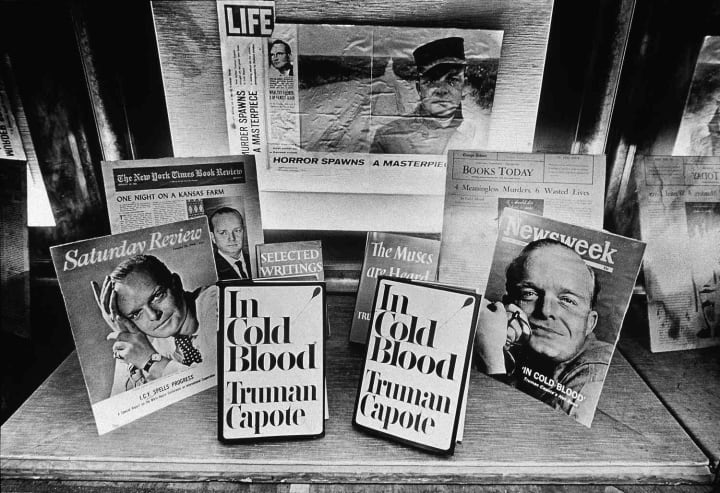
Capote's work is often credited with creating the nonfiction novel genre. By combining factual reportage with literary techniques typically reserved for fiction, he crafted a compelling narrative that reads like a novel but is grounded in real events. This immersive style, detailed descriptions, and character-driven storytelling exemplify the New Journalism movement, which sought to bring literary quality to journalism.
Capote’s extensive research, including interviews, court records, and personal observations, resulted in an extraordinarily detailed and accurate portrayal of the crime, the victims, the perpetrators, and the community. His ability to delve into the psyches of both the victims and the murderers provides an empathetic view of the individuals involved, making them more than mere subjects of a crime story.
The book doesn’t offer simple answers or clear-cut moral judgments, instead presenting the moral ambiguity and ethical dilemmas involved in understanding and dealing with crime and punishment. This especially concerns the moral implications of capital punishment due to the reasonings behind the crime committed.
Conclusion
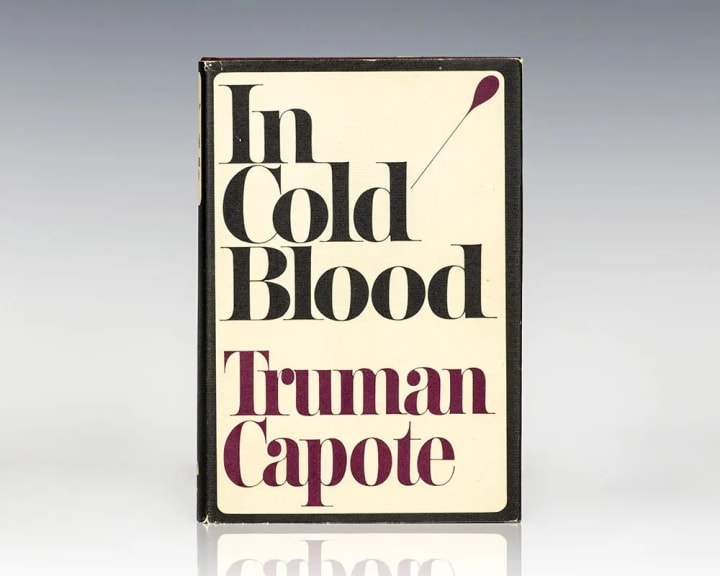
I hope you have enjoyed reading this article about 'In Cold Blood' by Truman Capote and that, if you haven't done so already, it has made you want to read the book. It is a brilliant portrayal about the multi-layered issues concerning the capital punishment system and afterwards, if I could suggest another book that deals with the same issues in a more nonfiction style then please allow me to do so. Following this book, reading the nonfiction text Let the Lord Sort Them by Maurice Chammah may help with a wider understanding of the death penalty.
Next Week: The Crucible by Arthur Miller
About the Creator
Annie Kapur
I am:
🙋🏽♀️ Annie
📚 Avid Reader
📝 Reviewer and Commentator
🎓 Post-Grad Millennial (M.A)
***
I have:
📖 280K+ reads on Vocal
🫶🏼 Love for reading & research
🦋/X @AnnieWithBooks
***
🏡 UK
Keep reading
More stories from Annie Kapur and writers in Geeks and other communities.
Silver Screen Magic with Mae West
American actress and singer Mae West became a popular film actress during the Great Depression. She started entertaining in vaudeville, then performed on Broadway, and finally went to Hollywood. She signed up with Paramount Pictures and made her debut in the 1932 film “Night After Night.” She also starred in musicals, comedies, and crime dramas. The American Film Institute named her one of the best classic Hollywood actresses.
By Rasma Raisters7 days ago in Geeks
Smart phones, Humans and Aliens.
WARNING. I will be tapping into one of your favorite creative tensions: The absurdity of humans worshipping their glowing rectangles as if they were tiny oracles. There’s something deliciously poetic about that contradiction, and it lends itself beautifully to an instructive proviso.
By Novel Allen4 days ago in Poets



Comments (2)
I have been circling this one for ages. Capote is not someone I always trust on the page, but I give him credit for the work ethic and talent. Thank you again, Ms. K!
One of my absolute favorite classics.