
Heart of a Dog by Mikhail Bulgakov
Why It's a Masterpiece (Week 91)

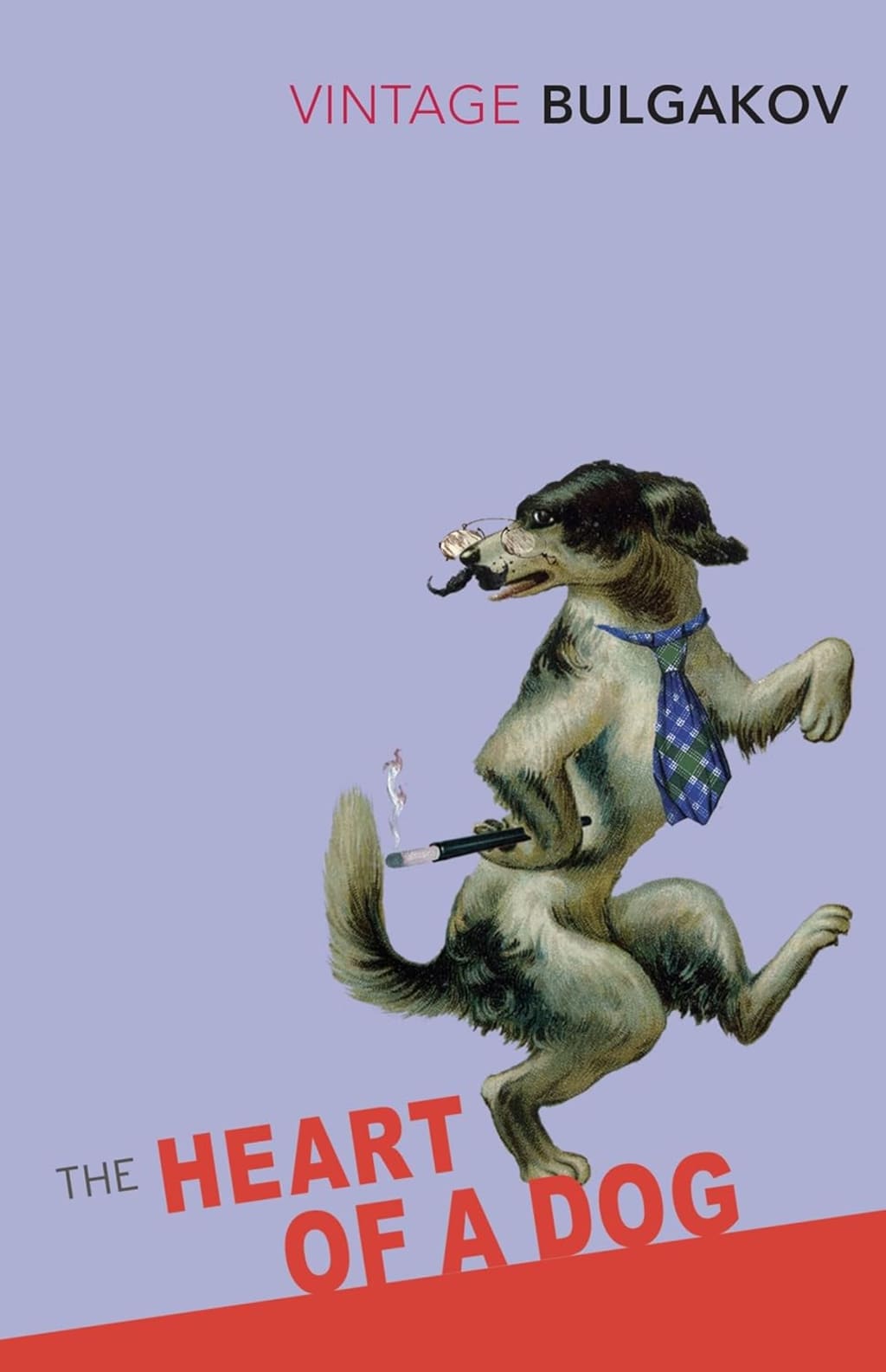
Mikhail Bulgakov’s novella Heart of a Dog (Собачье сердце) was first written in 1925, though it was not officially published in the Soviet Union until 1987, several decades after Bulgakov's death. The work was written during a time of intense political and cultural terror in the Soviet Union, following the Russian Revolution of 1917 and the subsequent rise of Stalin's regime. The novella represents Bulgakov’s true feelings about the Soviet machine, especially in its attitudes toward social engineering, the intelligentsia, and the flawed implementation of Marxism.
It's a satire of the Soviet attempt to create an ideal society, using the transformation of a dog, Sharik, into a human being as a vehicle for this criticism. The plot revolves around Professor Preobrazhensky, a well-respected doctor who, in an attempt to reform society, carries out an experiment on Sharik, turning the dog into a human being by transplanting human organs into him. This experiment is intended to showcase the potential of scientific and social advancement, but instead, it exposes the absurdities and contradictions of the Soviet social order. A sort of absurdist Frankenstein.
Plot
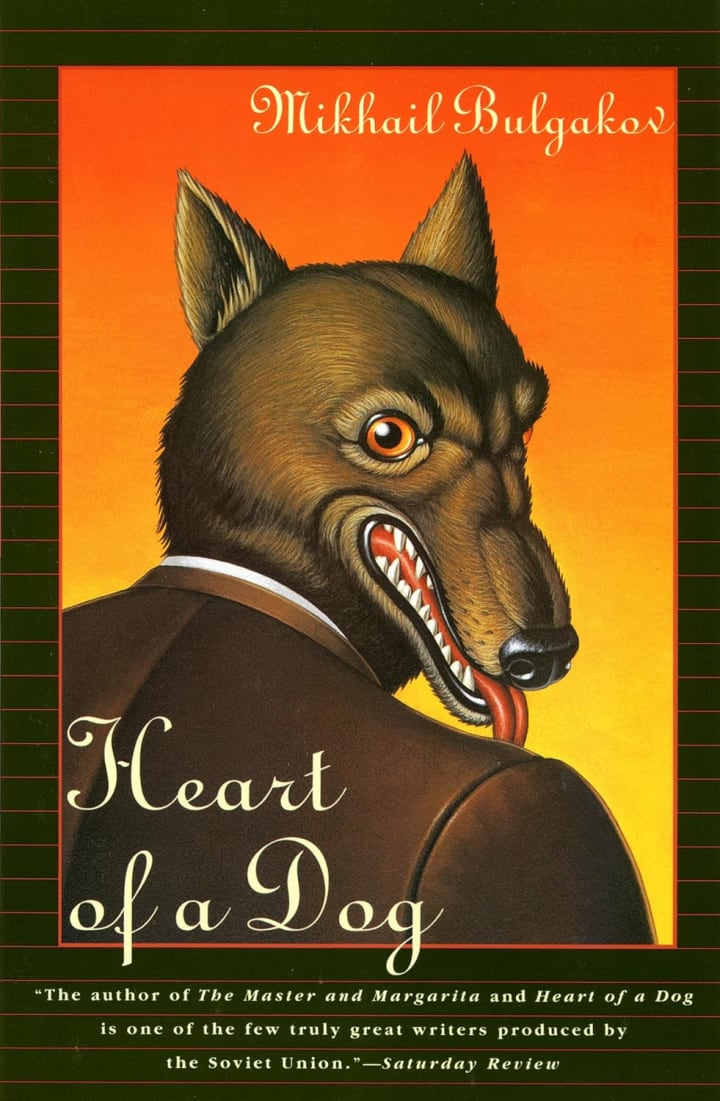
It opens with the introduction of Sharik, a stray dog who lives on the streets of Moscow. Sharik is taken in by Professor Preobrazhensky, a wealthy and well-respected doctor. Preobrazhensky is obsessed with the idea of advancing human science, and he views his scientific work as a means of reshaping society. When Sharik arrives at his clinic, Preobrazhensky sees an opportunity to conduct an experiment that could revolutionize both science and society. Preobrazhensky plans to transplant human organs into Sharik, and the dog is slowly transformed into a human being.
In the early stages of the transformation, Sharik is treated with kindness and compassion. However, as he begins to take on human characteristics, including the ability to speak and think like a man, the experiment begins to unravel. Sharik’s newly acquired human traits are not those of a noble, enlightened individual. Instead, he becomes a reflection of the worst aspects of humanity: greed, crudeness, and ignorance.
Our new dog-man begins to display the behaviour of a proletarian, adopting a vulgar attitude and becoming increasingly rude and disruptive. He no longer behaves like a dog, but neither does he embody the ideals of a cultured and educated human being. Preobrazhensky’s experiment has backfired spectacularly, and the transformation into a man reveals that human nature cannot simply be constructed or engineered.
As Sharik becomes more human, he adopts the name Poligraf Poligrafovich Sharikov, and he begins to assert his new identity. However, the results are disastrous. Sharikov becomes more of a burden than a triumph, and he quickly becomes a symbol of the chaotic and failed attempts to reshape the world through ideological means. His behaviour grows progressively more violent and uncontrollable, and the book ends with the reversal of the transformation, as Preobrazhensky decides to return Sharik to his original dog state. Everything has been for nothing.
Into the Book

The Failures of Social Engineering:
One of the most prominent themes in Heart of a Dog is the failure of social engineering, the idea that society can be perfected or restructured through deliberate, scientific efforts. The book critiques the Soviet regime’s belief in the ability to engineer a new man through ideology and scientific progress. Preobrazhensky’s experiment is a metaphor for the Bolshevik Revolution’s attempts to radically alter society through top-down reforms. His belief in the power of science to perfect humanity reflects the same ideals held by the Soviet regime, which aimed to create a new class of citizens through social and economic experimentation.
However, Bulgakov depicts the absurdity of these efforts by showing that Preobrazhensky’s experiment goes wrong from the start. Rather than creating a more refined and cultured individual, Sharikov’s transformation leads to a grotesque parody of humanity. Instead of embodying the ideals of enlightenment, Sharikov ends up representing crudeness, ignorance, and violence, the very qualities that Soviet officials sought to eliminate through their reforms.
“Nobody should be whipped. Remember that, once and for all. Neither man nor animal can be influenced by anything but suggestion.”
- Heart of a Dog by Mikhail Bulgakov
The Corruption of Intellect:
Bulgakov also targets the corruption of intellectual ideals in Soviet Russia, particularly within the intelligentsia (the educated class that sought to implement the revolutionary vision of the Bolsheviks). Professor Preobrazhensky represents the intellectual elite, and his experiment reflects the hubris of scientists and thinkers who believe they can transcend the limitations of society and nature. Preobrazhensky’s arrogance mirrors the Bolshevik intellectuals, who saw themselves as architects of a new world, capable of shaping human society according to their ideals.
However, as the transformation of Sharik reveals, intellectuals are not immune to the flaws they seek to eradicate in others. Preobrazhensky’s inability to foresee the consequences of his actions reflects the naivety and self-deception of the Soviet intelligentsia, who believed that they could create a perfect society without fully understanding the underlying dynamics of human nature. As Sharikov becomes more vulgar and uncontrollable, Preobrazhensky’s own ideals crumble, and his experiment becomes a cautionary tale about the dangers of: elitism, hubris, and blind faith in scientific progress.
“The whole horror of the situation is that he now has a human heart, not a dog's heart. And about the rottenest heart in all creation!”
- Heart of a Dog by Mikhail Bulgakov
The Limits of Transformation:
Another theme that Bulgakov explores in Heart of a Dog is the nature of human identity and the limits of transformation. The novella raises questions about what it means to be human. Preobrazhensky’s experiment attempts to break down the boundaries between animals and humans, suggesting that humanity is something that can be created or constructed through science. However, Bulgakov critiques this by showing that identity is not simply the sum of biological parts. Sharik’s transformation does not lead to the creation of a noble or enlightened individual; instead, it exposes the gruesome realities of human nature.
The book suggests that human identity is complex and can be shaped by cultural, social, and psychological forces that cannot be reduced to biology alone. Sharikov’s descent into a crude and violent character challenges the idea that humanity can be engineered from the outside. It also raises ethical questions about the power of science and the potential consequences of tampering with nature. In the end, Bulgakov’s message is clear: human identity is a product of much more than just physical transformation. It is hugely dependent on the person's inner-life as well.
“A dog's spirit dies hard.”
- Heart of a Dog by Mikhail Bulgakov
Why It's a Masterpiece
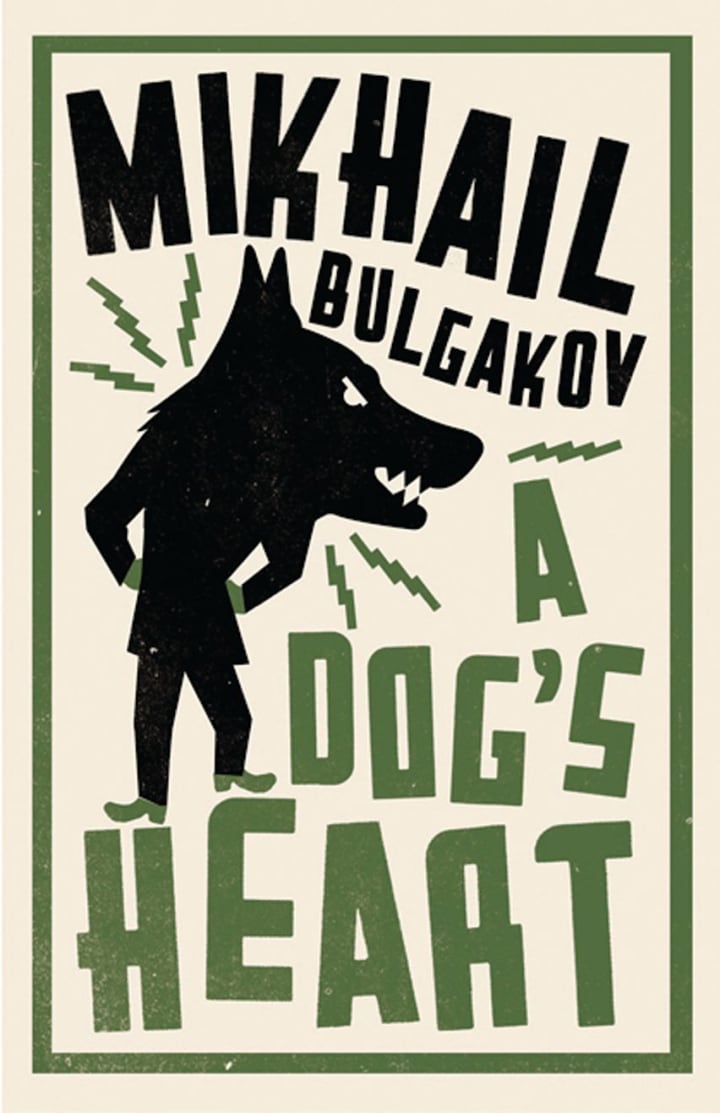
Heart of a Dog is a masterpiece, possibly underrated, of Russian Literature. It blends satire and politics to create something of a philosophical question about humanity at a time when Russia was probably losing their own to ideology and blind faith. The grotesque absurdity of this book is part of what makes it so incredible - it is not just funny but it is deeply critical of a suppressive political system which failed miserably.
There's not only this though. Magical realism and surrealism both play key roles in the book's message about reality. The metaphor of transformation is about the contradictions and unintended consequences of trying reshape society in a particular image - one of rigid frameworks. Intellectuals who believe that they can control the fallout of history are therefore, dead wrong and possibly dangerous.
Conclusion
This book is a critique of the authoritarianism and social engineering that the world did not yet know about when it came to Russia during the Soviet system. The want for a utopia vs. the actions of the those who think they know better than everyone else is a pretty great mixture for failure. There's an irony to this book I've always enjoyed and, if you haven't read it yet I would definitely say pick it up.
Next Week: The Slave by Isaac Bashevis Singer
About the Creator
Annie Kapur
I am:
🙋🏽♀️ Annie
📚 Avid Reader
📝 Reviewer and Commentator
🎓 Post-Grad Millennial (M.A)
***
I have:
📖 280K+ reads on Vocal
🫶🏼 Love for reading & research
🦋/X @AnnieWithBooks
***
🏡 UK
Keep reading
More stories from Annie Kapur and writers in Geeks and other communities.
Book Review: "Sister Carrie" by Theodore Dreiser
Theodor Dreiser is not someone I have explored many times, one or two perhaps and my writings on his book An American Tragedy was well-received. Since then, I have made it my business to read and reread more of his novels, including the often overlooked Sister Carrie. Once I started reading this book I absolutely could not stop. An enthralling story which often shocked me as it was written in a time where perhaps these stories of nonconforming women were still not taken seriously, it is a fantastic narrative even if the main character's morals are shifty at best. Carrie is definitely one of those characters we look forward to learning more about as she experiences more of the world. But, that doesn't mean we like her...
By Annie Kapur2 months ago in Geeks
Marvel Zombie
The last entry into our 2025 superhero projects catalogue is Marvel Zombies. This was a show that was anticipated by absolutely no one and it disappeared from the public consciousness as quickly as it was released. There was nothing special about the project that made it a must see, or a must remember. In fact if anything it's a must forget.
By Alexandrea Callaghan20 days ago in Geeks
Weather Bomb’ on the Way for Sunday Evening / Monday, Warns Environment Canada
Canadians are bracing for a significant weather event this weekend, as Environment Canada has issued urgent warnings about a so-called “weather bomb” expected to hit parts of the country on Sunday evening into Monday. The term, used by meteorologists, refers to a rapidly intensifying storm system that can bring severe winds, heavy precipitation, and dangerous conditions across affected areas. Residents are being advised to stay alert, prepare emergency kits, and follow official guidance to stay safe.
By Fiaz Ahmed 7 days ago in Geeks


Comments (1)
I remember this book. I read it when I was a teenager and first I was like WTF, but by the end I started to like it, especially how he described the changes that happened in the personality as the dog turned into human. Kind of like, you can't escape who you were...