
Golden Stones of Cinema: Harold and Maude
Art of the Highest Commendation, Masterpieces of the Big Screen

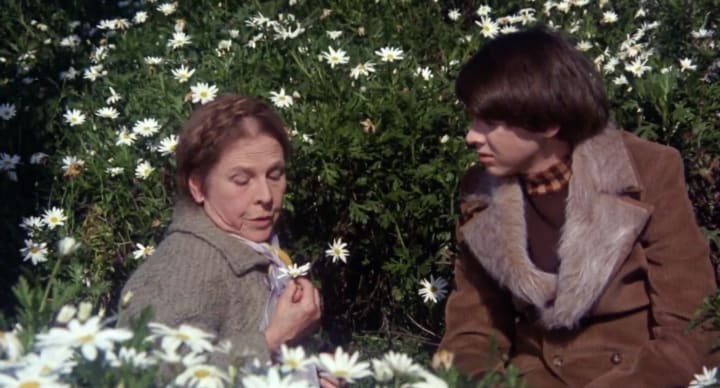
"Tell me, Harold. What do you do for fun? What activity gives you a different sense of enjoyment from the others? What do you find fulfilling? What gives you that special satisfaction?"
"I go to funerals."
Here is of the most bizarre American films to ever be released - a cult film that has not only aged impressively well, but one that would most likely never have been attempted today. Harold and Maude follows a suicidal teenage boy who becomes romantically entangled with an elderly woman nearing her eightieth birthday. If this does not already sound strange enough, what is meant by suicidal teenage boy is this character's unusual ability to actually go through with acts of self-mutilation, suffocation and self-incineration (all depicted on screen) without suffering any apparent consequence of any kind. In one scene, Harold's lacerated body is dispersed all over his mother's bathroom; in the next, Harold seems as healthy as ever (in a death-obsessed pitiful kind of way, of course).
The film begins with a boy named Harold who plans to hang himself as musician Cat Stevens' "Don't Be Shy" gently plays over the opening credits. Once the song is over, the bewildered viewer stares at a teenage boy dangling from his neck as the boy's mother enters the room. We are further left bewildered by the casual indifference exhibited by the mother who exits the room as if she were annoyed by her son's antics. The opening scene leaves the viewer with an accurate representation of what is yet to come. Not only is Harold death-obsessed, but the immortal boy seems to find it amusing (though nobody really pays attention), and scenes are accompanied by the emotional resonance of Cat Stevens. The real question then emerges: How could this film not be utterly tasteless in its context? The answer is Maude, a happy-go-lucky senior citizen who rejuvenates Harold through her optimistic outlook on life. Maude is completely insouciant of the future and helps Harold understand all the marvellous things life has to offer, which is a narrative that could very much have failed due to its strong chance of proving excessively sentimental. However, Hal Ashby (the film's director) truly has a gift for presenting unorthodox storylines in a beautiful way, and none of the wisdom provided by Maude throughout the film ever once feels out of place. Her character's perspective on things becomes all the more potent once is subtly revealed the numbered tattoo on her arm, which has the viewer understand the brutal hardships this woman had gone through at one point in her life.
I was in secondary four when I first came across this film (grade 10 for those who are unfamiliar with the Montreal school system), and my teacher thought it appropriate to have us watch it throughout a special lunch break during which we were fed pizza and fries in class. My classmates and I had just completed Boris Vian's "L'Écume des Jours" (Froth on the Daydream), and our teacher wished for us to make comparisons between the unconventional nature and offbeat contraptions found within both works. As we did not know what to expect of the film, the start of the lunch hour brimmed with frenetic idiocy, and our classroom unsurprisingly turned into a circus, but our wild behaviour was slowly tamed by the pictures on the screen. Many of the boys were so appalled at the growing love story unraveling before them, the movie had to at one point be paused due to a kid, seated next to me, who nearly hurled out his pizza in revulsion at the sight of Harold and Maude being intimate with one another. I, on the other hand, albeit disoriented as well, found myself bizarrely moved by their romance and could not help but admire the couple's outlandish activities. At one point, Harold tells Maude he feels like doing summersaults but does not want to seem stupid to which Maude responds "Harold, everyone has the right to make an ass out of themselves. You just can't let the world judge you too much." While my classmates never attempted rewatching this movie, I got the strange urge to do so a few times in my life when all seemed to hit rock bottom, and each viewing inexplicably brought me peace of mind. Majestic art, in a nutshell.
Three Reasons for Golden Stone Status:
1. The Abnormal Storyline
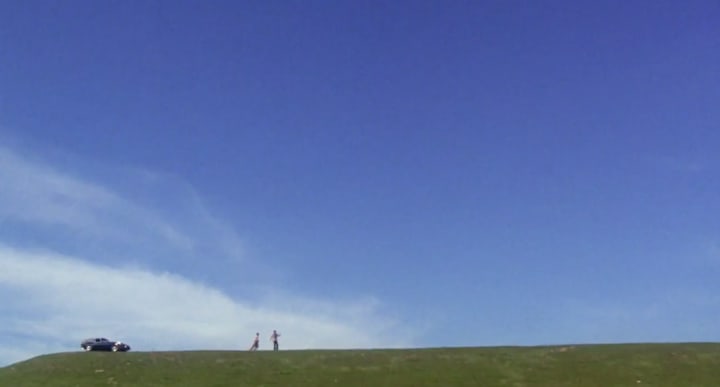
Between making love to a woman who surpasses him in age by sixty years and committing suicide for fun, Harold is far from the viewer's typical protagonist. Maude first meets him at a funeral by offering him some licorice (an act we, as children, are forever told to refuse from a much older stranger), and the two fall in love over the course of a week. SPOILER ALERT (DO NOT READ IF YOU WISH TO WATCH): At the film's conclusion, once Harold finally comes to embrace life, it is Maude who commits suicide as she believes her time has come, which leaves Harold totally miserable and distraught. After she ultimately comes to pass, there is a final clip of Harold, atop a hill, playing the banjo she once gave him, symbolizing Harold's ultimate acceptance of all the beautiful things life has to offer. This whole storyline can get neither stranger nor lovelier for that matter, and there's a reason it turned into a massive cult hit over the years.
2. The Emotional Stabs
The inclusion of Cat Stevens was perhaps the finest creative decision of the film. Between the emotionally inviting "Don't Be Shy", the comforting "Where Do the Children Play?", the heart-rending "Trouble" and the everlasting uplifting "If You Want to Sing Out, Sing Out", there are Maude's affecting quotes on life that prove to be more poignant as the film progresses. At first, the viewer too feels slightly uncomfortable with respect to the entire scenario, but it's like Maude says: "For aesthetic appreciation, always a little time." And by the end of it, we are left feeling that much more appreciative of life (and this, because of a romance that developed between a teenage boy and his eighty-year-old lover).
3. The Magic of Hal Ashby
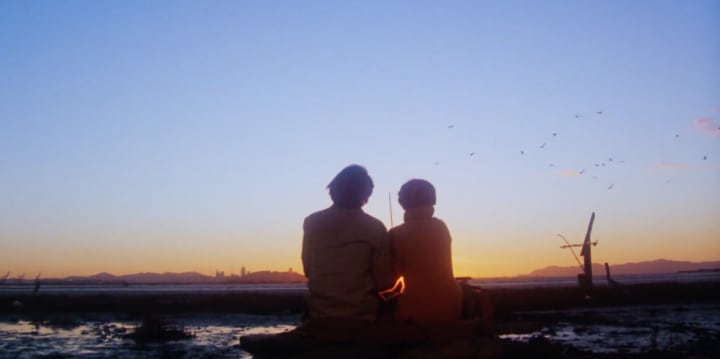
It's also important to note that this film might have proven excessively in bad taste if attempted by any other filmmaker. The subject matter is so grim and evidently does not scream "Box Office Success!", but Hal Ashby made the whole experience feel rather sweet in his own offbeat way. Having viewed his other films as well (Shampoo, Coming Home, Being There, etc.), I can honestly say that Ashby was not of the directors who wished to make movies for just anybody, and he totally owned up to it. This is HIS vision depicted on screen, and he seemed to be of the opinion that if the viewers did not enjoy what they saw, so be it. As I previously mentioned, I don't believe any of his movies (with some obvious expections) would be made by a director today, which is what makes the man so unique. It's unthinkable not to admire the man for this alone, and he seems to successfully convey his idea that even the ugliest of thoughts/things can evoke the most beautiful of feelings if one looks hard enough. I think of Harold and Maude enjoying a sunset in some revolting wasteland; the couple seems to be wonderstruck, as is Ashby, and if the viewers truly pays attention, they are too.
About the Creator
Gabriele Del Busso
Anglo-Italian having grown up within the predominantly French-speaking city of Montreal.
Passion for all forms of art (especially cinema and music).
Short stories usually deal with nostalgia and optimism within a highly pessimistic society.
Keep reading
More stories from Gabriele Del Busso and writers in Geeks and other communities.
The 20 Greatest Best Picture Winners of All-Time
In view of the upcoming 94th Academy Awards, I decided to compile a small list. Having officially watched every single film to take home the prestigious Best Picture award, here is what I deemed were the 20 best to ever win it. (I limited it to presenting my top 20 since to say a word on all 93 films would prove tedious, and I also opted not to include Sunrise: A Song of Two Humans which would assuredly have been in my top 5).
By Gabriele Del Busso4 years ago in Geeks
Silver Screen Magic with Mae West
American actress and singer Mae West became a popular film actress during the Great Depression. She started entertaining in vaudeville, then performed on Broadway, and finally went to Hollywood. She signed up with Paramount Pictures and made her debut in the 1932 film “Night After Night.” She also starred in musicals, comedies, and crime dramas. The American Film Institute named her one of the best classic Hollywood actresses.
By Rasma Raisters6 days ago in Geeks
Book Review: "Everything I Know About Love" by Dolly Alderton
Okay so I'm back to reading some Dolly Alderton. I call these sorts of books my 'treat books' because of their lightness and readibility. At the moment I am sitting up in bed, it's the early morning, I've just finished the book and I am in a lot of physical pain. I haven't been sleeping right, my shoulders are killing me and my legs are entirely in knots. I'm not really sure what to do here because I can't move a lot without being in some kind of pain. Anyways, let's have a look at what Dolly Alderton has to say about love...
By Annie Kapur6 days ago in Geeks


Comments
There are no comments for this story
Be the first to respond and start the conversation.