
Forbidden Colours by Yukio Mishima
Why It's a Masterpiece (Week 60)

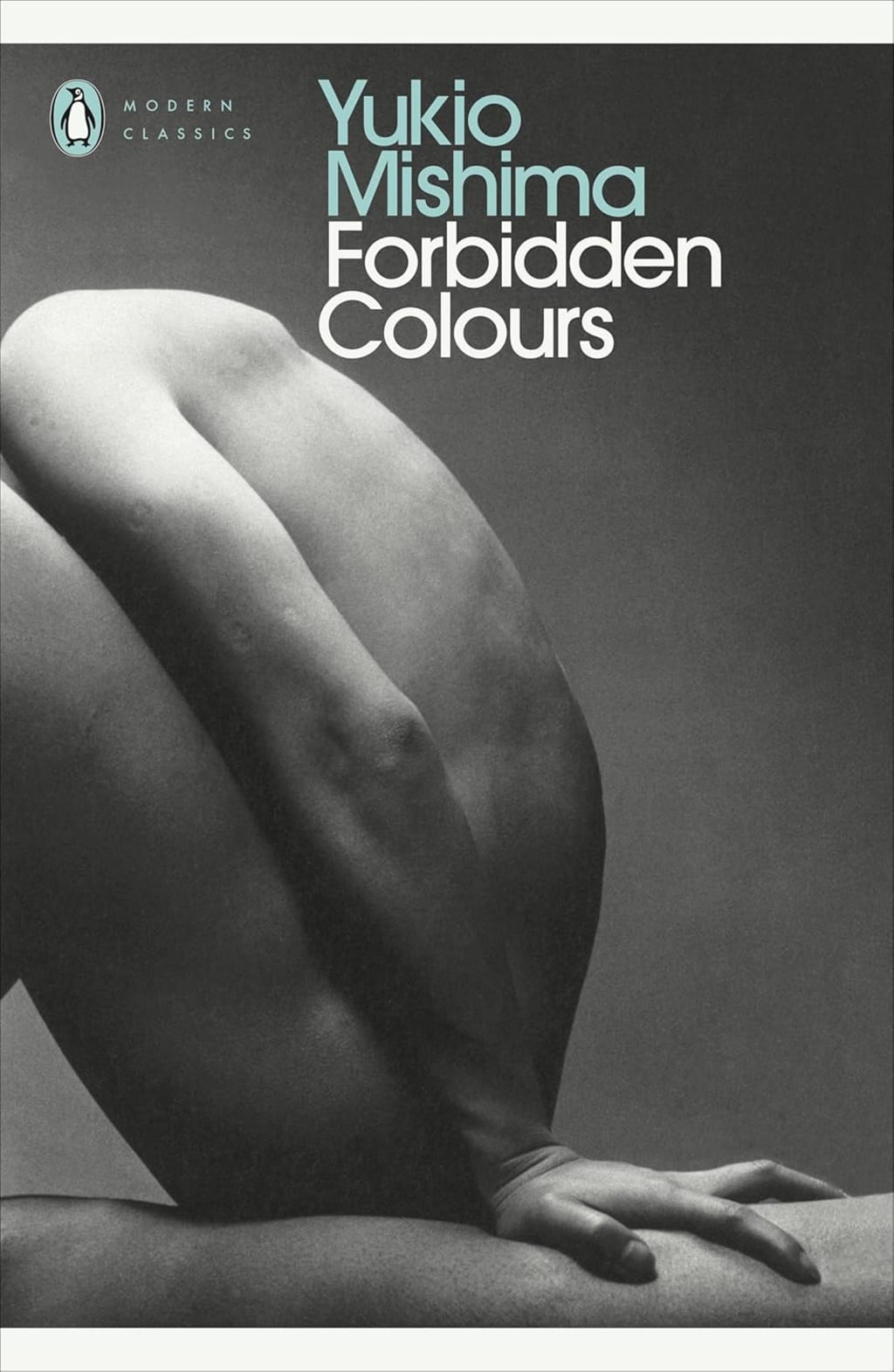
Forbidden Colours (Kinjiki) by Yukio Mishima was first published in serialised form from 1950 to 1951 in the Japanese magazine Gunzo. The completed novel was then released in 1953. Written during a period of intense post-war change in Japan, the novel reflects Mishima's own explorations of sexuality, beauty, and the interplay between social taboos and personal desires. The title itself refers to a concept in Japanese culture; “forbidden colours” connotes homosexuality or love that cannot be openly acknowledged.
The novel was groundbreaking not only for its themes but also for its audacious critique of societal expectations regarding sexuality and morality in post-war Japan. Mishima used bold characters and an intricate narrative structure to delve into taboo topics, shocking some readers yet attracting others to his provocative work.
Although controversial at the time of publication, Forbidden Colours quickly garnered attention, marking it as an essential text in both Japanese literature and LGBTQ+ discourse. It has since been translated into multiple languages, bringing Mishima's vivid, transgressive style to an international audience and solidifying his reputation as one of Japan's most influential modern authors.
Plot

Forbidden Colours tells the story of a young, attractive man named Yuichi Minami, whose life becomes entangled in complex webs of manipulation, desire, and betrayal. The novel opens with Yuichi's encounter with Shunsuke Hinoki, an older and jaded writer, who becomes fascinated with Yuichi's beauty and innocence. Shunsuke, embittered by his own failed love life and longstanding bitterness toward women, hatches a plan to use Yuichi as a pawn in his personal vendetta against women. Although Yuichi is initially presented as a traditional, masculine figure, it soon becomes apparent that he harbours a latent attraction to men, a part of himself he cannot fully accept due to societal pressures and his own internalised shame.
Shunsuke persuades Yuichi to enter a marriage with a young woman named Yasuko, all the while encouraging Yuichi to pursue relationships with men. Shunsuke hopes that Yuichi’s marriage will ultimately lead to heartbreak for Yasuko, fulfilling his twisted quest to avenge his own grievances with women. As Yuichi explores his sexuality, he descends into the clandestine gay nightlife of post-war Japan, an environment Mishima vividly brings to life with his detailed depictions of the social circles and hidden identities within the city’s gay subculture.
As Yuichi's relationships grow increasingly complex, he struggles to reconcile his attraction to men with his obligations as a husband. Shunsuke, meanwhile, becomes increasingly possessive and obsessive, feeding off Yuichi’s beauty and the destructive impact Yuichi’s life choices have on those around him. Their toxic relationship spirals into moral decay, pulling everyone involved into deeper levels of emotional and psychological conflict.
Over time, Yuichi's destructive tendencies manifest in cruelty toward his partners, especially Yasuko. Caught between conflicting identities and societal expectations, he grows more alienated, eventually reaching a point where he feels disconnected from both himself and the people around him. This internal struggle brings the novel to a tragic conclusion, with Yuichi's inability to resolve his desires and identity leading to a hollow, destructive existence that leaves him emotionally and spiritually drained. Mishima crafts a complex narrative on the destructive potential of repressed desire and the psychological harm inflicted by living under societal expectations, ultimately portraying a protagonist torn apart by the forbidden nature of his own identity.
Into the Book

One of the central themes of Forbidden Colours is repression, both internal and societal, and how it shapes individual identity and desire. Yuichi Minami’s sexuality becomes a point of intense personal and social conflict. Living in post-war Japan, where traditional family values and heteronormative expectations dominated, Yuichi feels trapped in a role that he cannot fully inhabit. He is drawn to the underground gay scene yet compelled to hide this part of himself, leading to a conflict between personal desires and societal norms.
Mishima illustrates the anguish Yuichi experiences as he struggles to reconcile his true self with the outward life society demands of him. His repression transforms into resentment, alienation, and eventually cruelty, showing how repression can deform a person’s sense of self and morality. The theme captures the pain and alienation of living inauthentically, a sentiment that resonates in broader discussions of LGBTQ+ experiences and the impact of social taboos.
“Everybody's the same. People are all the same. But it’s the prerogative of youth to think it’s not so.”
- Forbidden Colours by Yukio Mishima
Beauty, often idealised, takes on a sinister edge in the novel where it becomes both a curse and a weapon. Yuichi’s physical beauty draws Shunsuke’s attention and serves as the foundation for Shunsuke’s manipulation. Mishima explores the destructive nature of beauty as both an object of desire and a source of obsession. Shunsuke’s fascination with Yuichi’s beauty drives him to exploit Yuichi for his vendetta against women, which spirals into a toxic form of control.
Mishima’s focus on beauty highlights its double-edged quality: it captivates but also consumes. For Yuichi, his beauty becomes a prison, trapping him in a cycle of expectations and manipulations that leave him increasingly hollow. The relationship between Shunsuke and Yuichi, built on the latter’s beauty, underscores how obsession can erode both the possessor and the object of desire, reducing both to mere shells of themselves. This theme challenges readers to consider the corrupting potential of beauty when idolised to an extreme.
“When we plot the happiness of another, we unconsciously impute to the other person what is in another form the dream in which our own happiness is fulfilled. Thus by not thinking of our own happiness we make it possible for ourselves to become egotistic.”
- Forbidden Colours by Yukio Mishima
Forbidden Colours also examines how identity, particularly when constrained by external forces, can lead to moral decay. Yuichi’s marriage and double life illustrate the struggle to establish a coherent self-identity amid conflicting expectations. Manipulated by Shunsuke and forced into a heteronormative marriage, Yuichi’s sense of self splinters, leading him down a path of deceit, cruelty, and ultimately, nihilism.
Mishima presents Yuichi as a tragic figure whose fractured identity leads him to exploit others, including Yasuko and his male lovers. Shunsuke’s influence further erodes Yuichi’s moral compass, blurring the line between right and wrong as he becomes enmeshed in a web of lies and betrayal. Mishima’s exploration of identity as both fluid and fragile reflects the deep complexities of selfhood, especially within restrictive social frameworks. This theme connects to Mishima’s larger philosophical interests in existentialism and the search for meaning, portraying the tragic consequences of a self divided between true desires and imposed identities.
“A work of art is by no means the property of its creator.”
- Forbidden Colours by Yukio Mishima
Why It's a Masterpiece

Forbidden Colours is hailed as a masterpiece for its fearless exploration of taboo subjects, psychological depth, and vivid portrayal of post-war Japan’s societal constraints. Mishima’s work delves deeply into themes of identity, repression, and the dark allure of beauty, all within a unique and transgressive narrative. He boldly addressed homosexuality, a topic rarely depicted so openly in Japanese literature of the time, bringing hidden lives and forbidden loves into sharp focus. The novel’s complex character dynamics, particularly the manipulative relationship between Shunsuke and Yuichi, allow Mishima to dissect human motivations and the consequences of living inauthentically, adding layers of tragedy to the narrative.
Conclusion

I hope that because of this article you have chosen to pick up a Mishima novel. If you do not know where to start then I definitely recommend Forbidden Colours because of its brutal depths and difference from any Japanese modernist novel you will ever read. Thanks for reading and on to next week!
Next Week: Equus by Peter Shaffer
About the Creator
Annie Kapur
I am:
🙋🏽♀️ Annie
📚 Avid Reader
📝 Reviewer and Commentator
🎓 Post-Grad Millennial (M.A)
***
I have:
📖 280K+ reads on Vocal
🫶🏼 Love for reading & research
🦋/X @AnnieWithBooks
***
🏡 UK
Keep reading
More stories from Annie Kapur and writers in Geeks and other communities.
Book Review: "The Complete Short Stories" by Muriel Spark
I've read some Muriel Spark in my time. It's usually been The Driver's Seat and The Prime of Miss Jean Brodie. But, honestly I've been looking more into her work and someone suggested I read her short stories. I had been meaning to for a while but to be honest, the more I read the summary of the collection the less interested I became. And this is a lesson in why even if you read the summary, you should still be interested in finding your own perspective on the book. I actually quite enjoyed it. So, let's have a look at what was going on in there...
By Annie Kapur9 months ago in Geeks
Marvel Zombie
The last entry into our 2025 superhero projects catalogue is Marvel Zombies. This was a show that was anticipated by absolutely no one and it disappeared from the public consciousness as quickly as it was released. There was nothing special about the project that made it a must see, or a must remember. In fact if anything it's a must forget.
By Alexandrea Callaghan17 days ago in Geeks
Best VPN for Peacock TV
Peacock TV is NBCUniversal's, a subscription streaming service offering movies, TV shows (including NBC/Bravo hits, Originals, Universal films), live sports (like Premier League, WWE), news, and 24/7 channels, with both ad-supported (Premium) and ad-free (Premium Plus) options available for streaming on various devices.
By David Cook6 days ago in Geeks


Comments (3)
You should have seen the looks I got when I mentioned I had read him. My Japanese students thought he was too extreme...and that was in Tokyo! But I'm glad you pointed out this one. He still speaks to many issues in society we would like to ignore.
Very interesting article that you have written Japanese novel, and good luck
Very beautiful