
Craftsman vs Bosch Batteries: Which Delivers Better Runtime?
This comparison focuses on the Craftsman batteries, including the popular Craftsman 19.2 volt battery, and the range of Bosch batteries, explaining their performance, runtime, and compatibility in real-world use.
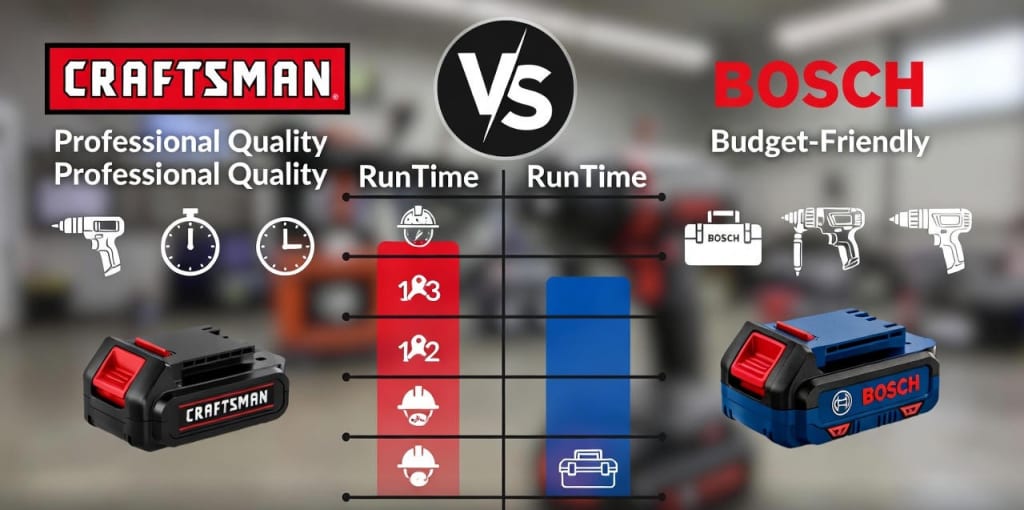
When you depend on cordless tools, battery life becomes a major factor in your daily workflow. Craftsman and Bosch both make reliable power tools and battery systems, but the runtime and performance vary depending on the tool type and how you use it. This comparison focuses on the Craftsman batteries, including the popular Craftsman 19.2 volt battery, and the range of Bosch batteries, explaining their performance, runtime, and compatibility in real-world use.
Overview of Craftsman Batteries
Craftsman has been a go-to brand for home users and professionals who value durability and convenience. Their batteries come in different voltages and capacities, but the Craftsman 19.2 volt battery remains one of the most recognized models. It supports older Craftsman cordless tools that are still widely used in workshops.
These batteries usually come in Nickel-Cadmium (NiCd) or Lithium-ion (Li-ion) types. Li-ion batteries are lighter and hold a longer charge, while NiCd batteries are bulkier but more affordable. Craftsman’s newer V20 and V60 systems rely on lithium-ion cells, giving better energy density and faster charging times.
The 19.2V battery, still popular today, delivers decent runtime for most household and light workshop tasks. It powers drills, saws, sanders, and impact wrenches efficiently, especially when paired with newer chargers.
Overview of Bosch Batteries
Bosch tools are known for their solid construction and precision engineering. Their Bosch batteries are built for consistent output, especially for demanding tasks. Bosch primarily uses advanced lithium-ion technology with intelligent power management. Their battery packs include built-in protection against overheating and overloading.
Bosch batteries are available in multiple voltages, mainly 12V and 18V. The 18V line competes directly with Craftsman’s V20 system. Bosch uses a compact design, so the batteries fit well into tools without adding much weight.
Bosch also focuses on “CoolPack” technology that prevents cells from heating up during heavy use. This technology helps maintain longer battery life and consistent runtime.
Runtime Comparison
When it comes to runtime, the difference depends on the voltage, amp-hour (Ah) rating, and how you use your tool. Craftsman’s 19.2V battery generally delivers about 1.5Ah to 4.0Ah, depending on the model. The higher the amp-hour rating, the longer the battery runs.
Bosch’s 18V lithium-ion batteries typically range from 2.0Ah to 8.0Ah. The larger capacity versions are built for professionals who need extended runtime during long tasks.
In a general comparison:
A Craftsman 19.2V 4.0Ah battery usually powers a drill for about 40 to 50 minutes of continuous use.
A Bosch 18V 4.0Ah battery often lasts a bit longer, providing around 60 minutes under similar conditions.
Bosch has the advantage in runtime due to its modern cell technology and smart power management. Craftsman batteries still hold up well for medium-duty work but may need more frequent recharges in professional settings.
Charging Time
Charging time affects productivity when you work through multiple tools in a day. Craftsman chargers are simple and dependable, with most batteries taking between 45 minutes to 90 minutes to reach a full charge.
Bosch chargers are typically faster. The company’s fast-charging models can recharge a 4.0Ah battery in under 45 minutes. Bosch also includes temperature sensors that adjust charging speed to protect the cells.
For someone who needs quick battery turnaround, Bosch offers a slight edge. However, for home use or light-duty work, Craftsman’s charging time is still reasonable.
Compatibility
Compatibility plays a big role in battery selection. Craftsman’s 19.2V battery works with a wide range of tools in the same voltage line. That includes older drills, saws, and flashlights that many users still keep in service.
Bosch batteries follow a similar platform concept. Their 18V batteries fit all Bosch Professional 18V tools. That cross-compatibility is convenient for users who own multiple Bosch power tools.
Both brands offer backward compatibility, but Craftsman’s older models might require adapters for newer chargers. Bosch’s compatibility system feels more streamlined across generations, which can be useful for professionals managing mixed tool sets.
Durability and Build
Both Craftsman and Bosch build their batteries to handle daily use. Craftsman batteries have a sturdy plastic shell that resists drops and wear. The 19.2V batteries are heavier, which adds some protection but can feel bulky on smaller tools.
Bosch batteries are compact and lightweight. Their “CoolPack” design uses better heat dissipation materials, helping the pack last longer. Bosch also uses quality cells that maintain performance after many recharge cycles.
In general, Bosch batteries handle heavy-duty applications with less heat buildup. Craftsman batteries are tough but better suited for moderate workloads.
Cost and Value
Cost is a major factor for most users. Craftsman batteries are often more affordable than Bosch batteries. A Craftsman 19.2 volt battery replacement usually costs less than a Bosch 18V 4.0Ah pack.
Bosch batteries cost more because of their technology and higher capacity options. For professionals who use tools daily, the longer runtime and fast charging justify the extra price. For casual or weekend users, Craftsman batteries deliver dependable performance at a lower cost.
Real-World Use Cases
If you use tools for basic home repairs, Craftsman batteries are reliable and budget-friendly. The 19.2V battery powers most hand tools easily. You can handle jobs like drilling, assembling furniture, or cutting wood without worrying about frequent recharging.
For workshop or jobsite work, Bosch batteries give longer runtime and better thermal management. They suit continuous drilling, cutting, or grinding tasks where tool downtime costs time. Bosch’s consistent output also supports high-torque tools better.
Many users choose Bosch for professional construction or maintenance work, while Craftsman batteries are preferred for home improvement, garages, or small shops.
Maintenance Tips for Longer Battery Life
To keep your Craftsman or Bosch batteries lasting longer:
Avoid leaving batteries on the charger after they reach full charge.
Store them in a cool, dry place.
Use the battery regularly to keep cells active.
Clean battery terminals with a dry cloth before connecting.
Avoid full discharges; recharge before the battery drains completely.
Both brands design their lithium-ion packs for hundreds of charge cycles, but good care helps maintain capacity over time.
Final Verdict
Both Craftsman batteries and Bosch batteries deliver solid performance, but their strengths differ. Craftsman offers affordable and dependable options for casual use and home projects. Bosch provides longer runtime, faster charging, and better temperature control for professionals.
If you already use Craftsman 19.2 volt batteries, you can keep using them with confidence. They remain a cost-effective option for most DIY tasks. If your work demands more runtime and heavy tool usage, Bosch batteries offer better consistency and lifespan.
Both brands have earned their reputation for reliability, so your choice depends on how and where you use your tools. For everyday users, Craftsman batteries are a solid pick. For all-day workers, Bosch batteries are worth the investment.
About the Creator
Silver Screen Magic with Mae West
American actress and singer Mae West became a popular film actress during the Great Depression. She started entertaining in vaudeville, then performed on Broadway, and finally went to Hollywood. She signed up with Paramount Pictures and made her debut in the 1932 film “Night After Night.” She also starred in musicals, comedies, and crime dramas. The American Film Institute named her one of the best classic Hollywood actresses.
By Rasma Raisters9 days ago in Geeks
Venus Williams
Venus Williams is more than a tennis champion. She is a symbol of strength, resilience, and evolution in modern sports. From her explosive entrance into professional tennis in the late 1990s to her continued influence decades later, Venus has shaped the game in ways that go far beyond trophies and rankings. Born on June 17, 1980, in Lynwood, California, Venus Ebony Starr Williams was raised with a vision. Her father, Richard Williams, believed his daughters could change tennis, and history proved him right. With a powerful serve, aggressive baseline play, and unmatched athleticism, Venus introduced a new style that challenged traditional expectations of women’s tennis. Redefining Women’s Tennis When Venus Williams turned professional, women’s tennis was already competitive, but her physical presence and confidence brought something different. Standing tall at six feet one inch, she combined speed with strength in a way rarely seen before. Her serve became one of the most feared weapons on tour, and her fearless approach inspired a generation of players to play bold, attacking tennis. Venus won seven Grand Slam singles titles, including five Wimbledon championships, where her grass-court dominance was especially evident. Beyond singles, she also excelled in doubles, winning multiple Grand Slam titles alongside her sister Serena Williams. Their partnership remains one of the most successful in tennis history. Yet her impact was never limited to match results. Fighting for Equality One of Venus Williams’ most important contributions came off the court. Early in her career, she recognized the inequality in prize money between men and women, especially at Wimbledon. Rather than staying silent, Venus used her platform to advocate for equal pay. Her efforts played a crucial role in Wimbledon announcing equal prize money for men and women in 2007. This decision marked a turning point in sports equality, and Venus became widely respected as a leader who stood up not just for herself, but for all female athletes. This advocacy helped redefine what it means to be a professional athlete—someone who competes fiercely while also challenging unfair systems. Longevity and Mental Strength In an era where many players retire in their early thirties, Venus Williams’ longevity stands out. Despite injuries and being diagnosed with Sjögren’s syndrome, an autoimmune disease that causes fatigue and joint pain, she continued to compete at the highest level. Her ability to adapt, manage her health, and stay competitive reflects her mental strength. Venus never rushed to prove anything. Instead, she focused on progress, self-care, and passion for the sport. This mindset resonates with younger players navigating the pressures of modern professional tennis. A Bridge Between Generations Today’s tennis landscape features a mix of seasoned champions and rising stars. Players like Olga Danilović, a talented Serbian tennis player known for her aggressive style and left-handed power, represent the new generation stepping onto the global stage. The presence of athletes like Venus Williams creates an important bridge between eras. While Venus built her legacy in a different time, her influence is visible in how younger players train, compete, and express themselves. Discussions comparing veterans and newcomers, such as conversations around Olga Danilovic and established champions, highlight how the sport continues to evolve. Rather than seeing generational shifts as competition, Venus has always embraced change. Her career shows that tennis is not just about age, but about adaptability and mindset. Beyond Tennis Outside the court, Venus Williams is an entrepreneur, fashion designer, and advocate for healthy living. She founded EleVen, a fashion-forward athletic wear brand that reflects her bold personality. She also promotes wellness, interior design, and balanced living, showing that athletes can thrive in multiple spaces. Her life after peak competition is not defined by retirement but by reinvention. An Enduring Legacy Venus Williams’ story is not just about wins and losses. It is about changing perceptions, opening doors, and staying true to oneself through every phase of life. She showed the world that power and grace can coexist, that advocacy matters, and that persistence often defines greatness more than talent alone. As tennis continues to welcome new stars like Olga Danilović, the foundation laid by legends like Venus remains essential. Her legacy lives on in every powerful serve, every confident young athlete, and every step taken toward equality in sports. Venus Williams didn’t just play the game. She transformed it.
By Saboor Brohi 5 days ago in Geeks


Comments
There are no comments for this story
Be the first to respond and start the conversation.