

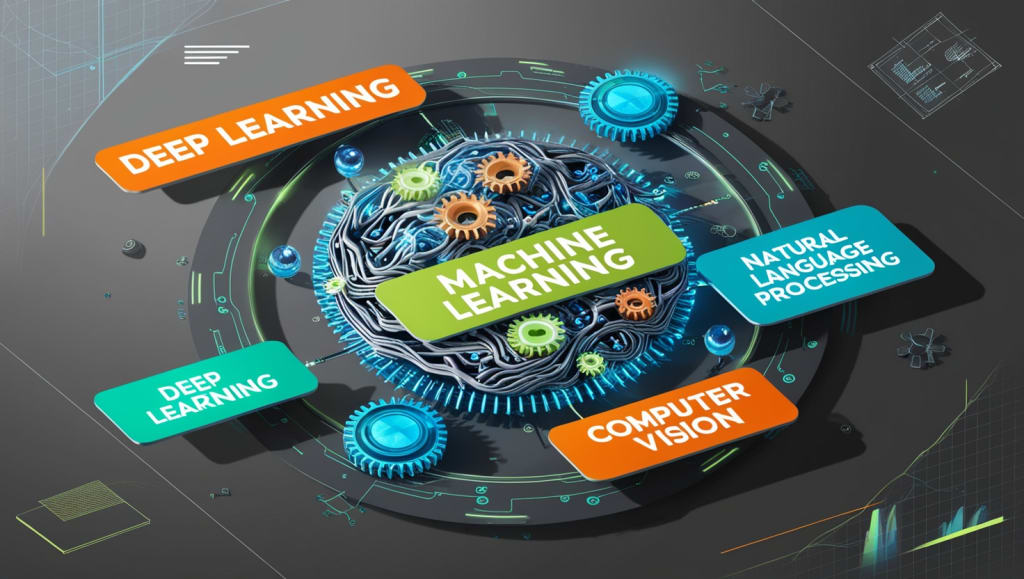
Key Concepts for Machine Learning Interviews
1. Supervised Learning: Understand the basics of supervised learning, where models are trained on labeled data. Key algorithms include Linear Regression, Logistic Regression, Support Vector Machines (SVMs), k-Nearest Neighbors (k-NN), Decision Trees, and Random Forests.
2. Unsupervised Learning: Learn unsupervised learning techniques that work with unlabeled data. Familiarize yourself with algorithms like k-Means Clustering, Hierarchical Clustering, Principal Component Analysis (PCA), and t-SNE.
3. Model Evaluation Metrics: Know how to evaluate models using metrics such as accuracy, precision, recall, F1 score, ROC-AUC, mean squared error (MSE), and R-squared. Understand when to use each metric based on the problem at hand.
4. Overfitting and Underfitting: Grasp the concepts of overfitting and underfitting, and know how to address them through techniques like cross-validation, regularization (L1, L2), and pruning in decision trees.
5. Feature Engineering: Master the art of creating new features from raw data to improve model performance. Techniques include one-hot encoding, feature scaling, polynomial features, and feature selection methods like Recursive Feature Elimination (RFE).
6. Hyperparameter Tuning: Learn how to optimize model performance by tuning hyperparameters using techniques like Grid Search, Random Search, and Bayesian Optimization.
7. Ensemble Methods: Understand ensemble learning techniques that combine multiple models to improve accuracy. Key methods include Bagging (e.g., Random Forests), Boosting (e.g., AdaBoost, XGBoost, Gradient Boosting), and Stacking.
8. Neural Networks and Deep Learning: Get familiar with the basics of neural networks, including activation functions, backpropagation, and gradient descent. Learn about deep learning architectures like Convolutional Neural Networks (CNNs) for image data and Recurrent Neural Networks (RNNs) for sequential data.
9. Natural Language Processing (NLP): Understand key NLP techniques such as tokenization, stemming, and lemmatization, as well as advanced topics like word embeddings (e.g., Word2Vec, GloVe), transformers (e.g., BERT, GPT), and sentiment analysis.
10. Dimensionality Reduction: Learn how to reduce the number of features in a dataset while preserving as much information as possible. Techniques include PCA, Singular Value Decomposition (SVD), and Feature Importance methods.
11. Reinforcement Learning: Gain a basic understanding of reinforcement learning, where agents learn to make decisions by receiving rewards or penalties. Familiarize yourself with concepts like Markov Decision Processes (MDPs), Q-learning, and policy gradients.
12. Big Data and Scalable Machine Learning: Learn how to handle large datasets and scale machine learning algorithms using tools like Apache Spark, Hadoop, and distributed frameworks for training models on big data.
13. Model Deployment and Monitoring: Understand how to deploy machine learning models into production environments and monitor their performance over time. Familiarize yourself with tools and platforms like TensorFlow Serving, AWS SageMaker, Docker, and Flask for model deployment.
14. Ethics in Machine Learning: Be aware of the ethical implications of machine learning, including issues related to bias, fairness, transparency, and accountability. Understand the importance of creating models that are not only accurate but also ethically sound.
15. Bayesian Inference: Learn about Bayesian methods in machine learning, which involve updating the probability of a hypothesis as more evidence becomes available. Key concepts include Bayes’ theorem, prior and posterior distributions, and Bayesian networks.
𝐒𝐢𝐦𝐩𝐥𝐞 𝐆𝐮𝐢𝐝𝐞 𝐭𝐨 𝐋𝐞𝐚𝐫𝐧 𝐌𝐚𝐜𝐡𝐢𝐧𝐞 𝐋𝐞𝐚𝐫𝐧𝐢𝐧𝐠 𝐟𝐨𝐫 𝐃𝐚𝐭𝐚 𝐀𝐧𝐚𝐥𝐲𝐭𝐢𝐜𝐬 😃
🙄 𝐖𝐡𝐚𝐭 𝐢𝐬 𝐌𝐚𝐜𝐡𝐢𝐧𝐞 𝐋𝐞𝐚𝐫𝐧𝐢𝐧𝐠?
Imagine you're teaching a child to recognize fruits. You show them an apple, tell them it’s an apple, and next time they know it. That’s what Machine Learning does! But instead of a child, it’s a computer, and instead of fruits, it learns from data.
Machine Learning is about teaching computers to learn from past data so they can make smart decisions or predictions on their own, improving over time without needing new instructions.
🤔 𝐖𝐡𝐲 𝐢𝐬 𝐌𝐚𝐜𝐡𝐢𝐧𝐞 𝐋𝐞𝐚𝐫𝐧𝐢𝐧𝐠 𝐈𝐦𝐩𝐨𝐫𝐭𝐚𝐧𝐭 𝐟𝐨𝐫 𝐃𝐚𝐭𝐚 𝐀𝐧𝐚𝐥𝐲𝐭𝐢𝐜𝐬?
Machine Learning makes data analytics super powerful. Instead of just looking at past data, it can help predict future trends, find patterns we didn’t notice, and make decisions that help businesses grow!
😮 𝐇𝐨𝐰 𝐭𝐨 𝐋𝐞𝐚𝐫𝐧 𝐌𝐚𝐜𝐡𝐢𝐧𝐞 𝐋𝐞𝐚𝐫𝐧𝐢𝐧𝐠 𝐟𝐨𝐫 𝐃𝐚𝐭𝐚 𝐀𝐧𝐚𝐥𝐲𝐭𝐢𝐜𝐬?
✅ 𝐋𝐞𝐚𝐫𝐧 𝐏𝐲𝐭𝐡𝐨𝐧: Python is the most commonly used language in ML. Start by getting comfortable with basic Python, then move on to ML-specific libraries like:
𝐩𝐚𝐧𝐝𝐚𝐬: For data manipulation.
𝐍𝐮𝐦𝐏𝐲: For numerical calculations.
𝐬𝐜𝐢𝐤𝐢𝐭-𝐥𝐞𝐚𝐫𝐧: For implementing basic ML algorithms.
✅ 𝐔𝐧𝐝𝐞𝐫𝐬𝐭𝐚𝐧𝐝 𝐭𝐡𝐞 𝐁𝐚𝐬𝐢𝐜𝐬 𝐨𝐟 𝐒𝐭𝐚𝐭𝐢𝐬𝐭𝐢𝐜𝐬: ML relies heavily on concepts like probability, distributions, and hypothesis testing. Understanding basic statistics will help you grasp how models work.
✅ 𝐏𝐫𝐚𝐜𝐭𝐢𝐜𝐞 𝐨𝐧 𝐑𝐞𝐚𝐥 𝐃𝐚𝐭𝐚𝐬𝐞𝐭𝐬: Platforms like Kaggle offer datasets and ML competitions. Start by analyzing small datasets to understand how machine learning models make predictions.
✅ 𝐋𝐞𝐚𝐫𝐧 𝐕𝐢𝐬𝐮𝐚𝐥𝐢𝐳𝐚𝐭𝐢𝐨𝐧: Use tools like Matplotlib or Seaborn to visualize data. This will help you understand patterns in the data and how machine learning models interpret them.
✅ 𝐖𝐨𝐫𝐤 𝐨𝐧 𝐒𝐢𝐦𝐩𝐥𝐞 𝐏𝐫𝐨𝐣𝐞𝐜𝐭𝐬: Start with basic ML projects such as:
-Predicting house prices.
-Classifying emails as spam or not spam.
-Clustering customers based on their purchasing habits.ML Interview Question :
What is the "dying ReLU" problem, and how can you address it in neural networks?
The dying ReLU problem occurs when neurons in a neural network become inactive and stop updating their weights during training. This happens because the ReLU activation function outputs zero for any negative input. Once a neuron consistently outputs zero, its gradient becomes zero, and it no longer contributes to learning.
How to address the dying ReLU problem:
1. Leaky ReLU: Allows a small negative slope to keep neurons active for negative inputs.
2. Parametric ReLU (PReLU): Learns the slope for negative values during training, giving more flexibility.
3. ELU (Exponential Linear Unit): Outputs small negative values to prevent neurons from dying.
4. He Initialization: Proper weight initialization helps avoid large negative values in early layers.
5. Smaller Learning Rates: Reducing the learning rate prevents large weight updates that could push neurons into inactivity.
Machine Learning (ML) is the backbone of data science interviews, and the right preparation can be the difference between rejection and landing your dream role.
✅ Start with the Basics
Make sure you know your classifications, regressions, and clustering algorithms inside out. Focus on core ones like Linear Regression, Decision Trees, Random Forest, and K-Means.
✅ Understand the Intuition Behind Each Model
Interviewers will ask you to explain why you’re choosing a specific model. It's not enough to just implement; knowing the pros, cons, and use cases of algorithms like SVMs, KNN, and Naive Bayes is crucial.
✅ Hands-on Practice with Real Data
Practice makes perfect. Use Kaggle or UCI datasets to simulate real-world problems. Know how to handle missing data, outliers, and perform feature engineering to improve model accuracy.
✅ Explain Your Workflow Clearly
Interviewers love structured problem solvers. Always structure your responses around data preprocessing, model training, evaluation, and interpretation. Make sure you understand cross-validation and model tuning techniques like GridSearchCV.
✅ Know Evaluation Metrics
Accuracy is just the beginning. Be well-versed with evaluation metrics like F1 score, precision, recall, ROC curves, and AUC. For regressions, dive into RMSE, MSE, and R².
✅ Tuning and Optimization
Hyperparameter tuning is key to improving model performance. Make sure you know the ins and outs of techniques like Random Search and Grid Search.
📍My Tips:
1. Prepare to explain ML concepts in simple terms, interviewers want to see if you can simplify complexity.
2. Practice explaining ML workflows as if you're presenting to a non-technical audience, this can really set you apart in interviews.
About the Creator
Bahati Mulishi
Practical advice on remote work, IT careers, and professional skills to help you stay work-ready anywhere in the world.
Keep reading
More stories from Bahati Mulishi and writers in Geeks and other communities.




Comments
There are no comments for this story
Be the first to respond and start the conversation.