
"Complete Letters" by Pliny the Younger
First Impressions (Pt.20)

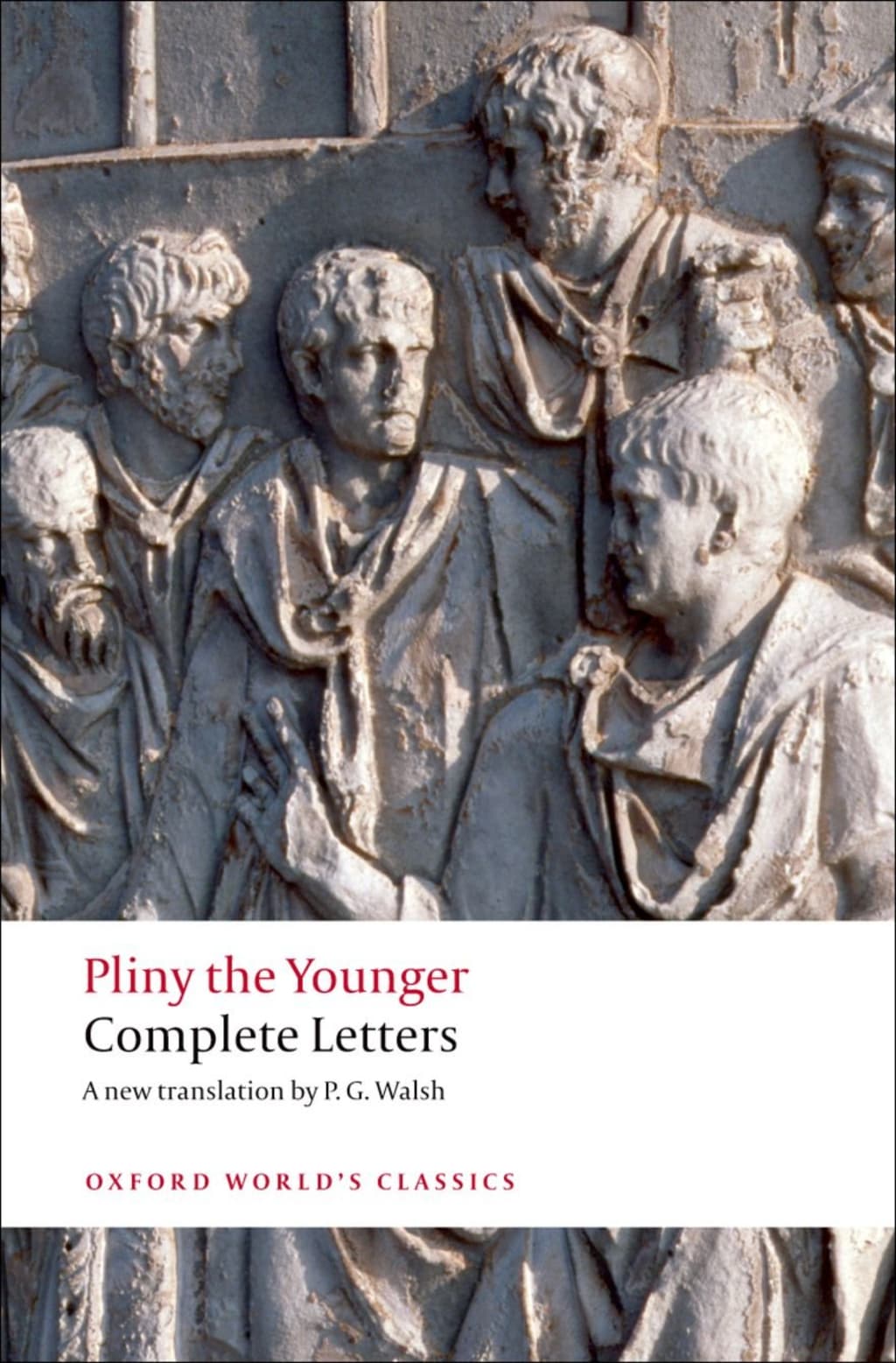
Pliny the Younger’s letters represent the way in which Roman everyday life is understood by the various correspondents and depends on the fact that the correspondents may be in a similar situation and social class as himself. These letters often concern different aspects of the human experience including: living arrangements, valuing and selling houses, family and friendships, funerals and the grieving process, inheritance and family connections, life and philosophies, morals and ethics and finally, the way in which learning and knowledge impact the lifestyle one will live. Pliny the Younger though, also goes through his own profession in which he details the requirements for good oration and the way in which he scripts his narratives.
He covers a wide array of topics about particular cases and makes sure that the correspondent understands the atmosphere of the letter whether Pliny is confident about his speech, in trouble about his scripting or, rare as it is, anxious about the reception of his narratives. Pliny the Younger was a lawyer and so, often concerns his writing with laws and systems of the Roman Senate, Governing body, Middle class and those who are related to him, such as his uncle Pliny the Elder who apparently died in the eruption of Mount Vesuvius near Pompeii. Pliny the Younger, though he is a man of letters and therefore of rational mind, also concerns himself with the extremities of human emotion, detailing the often irrationality he suffers in his anxiety of the speech he is to give over whether it is good enough, the grief over a friend’s death who still had unfinished business which Pliny himself now feels urged to complete for the sake of closure and even, the way in which slave owners abuse their slaves. Pliny feels the most anger towards the abuse of slaves and often cites the viciousness of the slaves in retaliation as an act of virtue on their part, stating it was only moments away anyway and that the abuse was simply a threshold that the dead man had to break in order to be allowed to die. Be that as it may, the death is often violent and graphic in description and understandably, as Pliny is a lawyer and deals with facts, he would not want facts and evidence left out.
The most profound thing about this book though is the letter in which Pliny the Younger writes about how strange it is that Romans feels the need to record and detail their lives as if they are very important to someone. This is almost a narrative breaking a wall and so, in a reading of this, it would often make the modern reader laugh at the prospect of Pliny the Younger not knowing exactly how important he actually is in our learning of the Roman lifestyle, legal system and correspondents of the middle class. He is ultimately one of the most important people next to his uncle, Pliny the Elder, the historian Tacitus and the grand orator, Cicero.
It is clear that Pliny the Younger is well aware that he requires to note things down in detail as to not make the mistake of misleading his correspondence, but some of these letters are in so much detail that it only proves how intelligent and articulate Pliny the Younger actually was, even when he was not actually directly discussing the law and legal system or any of his cases in detail, but simply talking about buying his new home and the details of what it looked like with every room in a precise appreciation from the bedroom and baths, to the kitchen garden and the plants. Both reason and passion are adapted by Pliny the Younger and show his wide knowledge and his ability to profess fact and create fantastical images at the same time. One is an aspect of his occupation as a lawyer and the other is a requirement of his occupation as an orator. It is quite extraordinary to read this in knowing that Pliny the Younger was ultimately to be respected as one of the greats of his day later on in the timeline of history - he just did not know it yet.
When Pliny the Younger first discusses accounting for each day in Rome, he writes about correspondences containing every last detail of the day and he also writes about the way in which Romans find the accounts of their day important when someone asks. An allusion to his historical background in factual study, Pliny the Younger argues that this is important however it still baffles and confuses him. Though it is important to preserve factual evidence, he finds little use in detailing every last minute, stating that he is often concerned about the topics of letters, writings and the presentation of the Roman everyday lifestyle to others:
“It is remarkable how we account, or seem to account, for each individual day in Rome, but not for a number of days combined. If you were to pose anyone with the question “What did you do today?”, the answer would be “I attended an investiture of the adult toga” or “I was present at a betrothal or wedding” or “one person asked me to witness his will, a second to plead for him in court and a third to act as assessor for him on the Bench.” These duties seem necessary on the day you perform them, but once you reflect that you have spent every day doing the same things, they seem pointless, and much more so when you retire from Rome, for it is then that you recollect: “How many days I have wasted on what tedious pursuits!”” (p.11)
Even though Pliny the Younger may call these things he does day in, day out, ‘tedious pursuits’, he is often very vocal about his emotions during the oration part of his occupation. His descriptions of orations are packed full of extreme emotion, passion and irrationality, but also serve a purpose. They are not simply there to provide entertainment, but they are there in order to teach the correspondent about something that could have happened if it had not been for the oration of Pliny the Younger and normally, the ‘something’ is negative. Thus, Pliny the Younger has stopped something from going horribly wrong and almost gives himself credit through his passion for his work:
“Somehow or other I composed my mind, gathered my thoughts and began to speak. My anxiety was counterbalanced by the approval of my listeners. I spoke for almost five hours, for four further water-clocks were added to the twelve of the largest size already allowed to me. Thus the very factors that seemed forbidding and hostile before I spoke turned out to be to my advantage once I began.”(p.40)
To conclude, Pliny the Younger definitely covers a wide array of topics when corresponding to his friends and family concerning life and work in Rome. In order to make sense of him, we travel through numerous different situations that include everything from Pliny the Younger viewing and purchasing his new home to him writing about his uncle, Pliny the Elder’s, works and even to the point where he discusses how he scripts his orations. His coverage of life in Rome seems to be more and more about how Romans respect their legal system, how they follow a certain lifestyle (especially if they are of a particular class) and how they eventually retire from Rome. It is a book that collects Pliny the Younger’s letters and makes an unstructured by intimate autobiography out of them.
Citation:
Pliny, G (2009). The Complete Letters. UK: Oxford World's Classics.
About the Creator
Annie Kapur
I am:
🙋🏽♀️ Annie
📚 Avid Reader
📝 Reviewer and Commentator
🎓 Post-Grad Millennial (M.A)
***
I have:
📖 280K+ reads on Vocal
🫶🏼 Love for reading & research
🦋/X @AnnieWithBooks
***
🏡 UK
Keep reading
More stories from Annie Kapur and writers in Geeks and other communities.
"On the Road" by Jack Kerouac
I first read this book when I was fourteen years’ old and I’m not going to lie to you, the very first time I read it - I didn’t actually enjoy it all that much. The reason was because it was written in a style that I was entirely used to and so, I didn’t end up understanding the entire drift of the novel. Instead, I put it aside for a while, hoping that someday I would figure it all out. And that’s exactly what happened. When I was sixteen years’ old, I saw the novel “On the Road” in a bookshop in my hometown and I was immediately taken back to those memories of trying to get into it at fourteen and failing miserably. The reason these memories were so pressed into my mind was because of the fact that it was just after my fourteenth birthday and I had a science test the day after completing the book. The copy in the shop window was absolutely beautiful and I went to buy it. Instead of just having the book, it had some explanatory essays I made use of as well and so, when I ended up re-reading it (well, I’ll call it reading for the first time, because it was the first time I understood it), I read the essays as well and referred to all this extra material for guidance. It slowly became one of my favourite books to re-read after that.
By Annie Kapur5 years ago in Geeks
Silver Screen Magic with Mae West
American actress and singer Mae West became a popular film actress during the Great Depression. She started entertaining in vaudeville, then performed on Broadway, and finally went to Hollywood. She signed up with Paramount Pictures and made her debut in the 1932 film “Night After Night.” She also starred in musicals, comedies, and crime dramas. The American Film Institute named her one of the best classic Hollywood actresses.
By Rasma Raisters7 days ago in Geeks


Comments
There are no comments for this story
Be the first to respond and start the conversation.