
Classic Movie Review: 'Manhunter' - The Underrated Gem by Michael Mann
A Deep Dive into the Stylish and Haunting Thriller

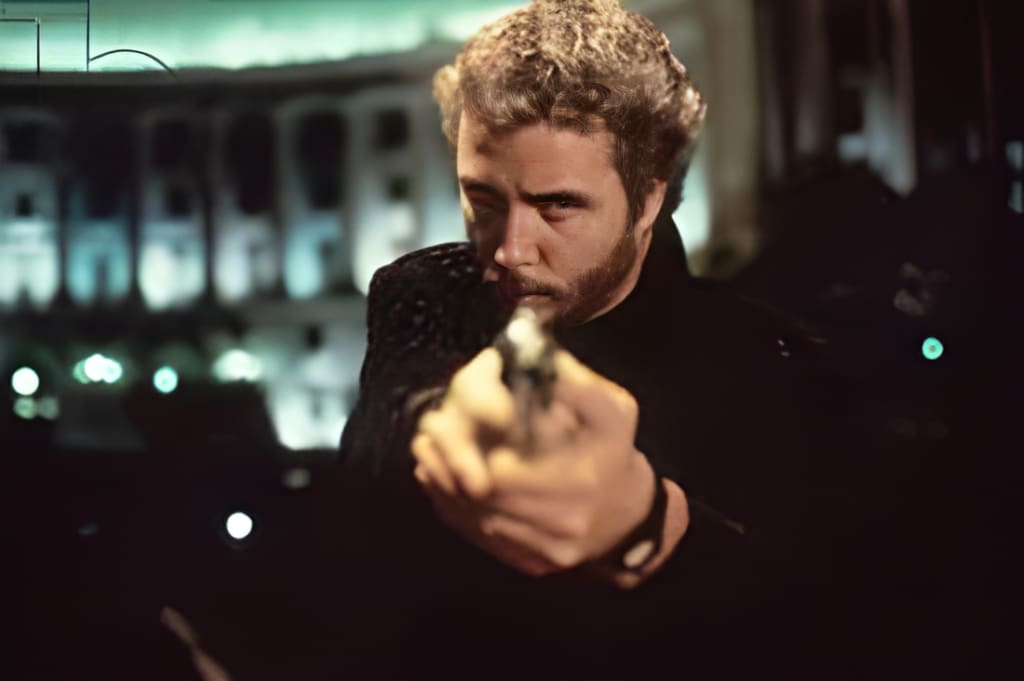
Manhunter, released in 1986
Michael Mann is the director.
Composed by Michael Mann
starring Dennis Farina, Brian Cox, Kim Greist, Joan Allen, and William Peterson
Date of Release: August 15, 1986
Printed on July 16, 2024
The opening shots of Michael Mann's Manhunter are exquisite in their visual simplicity. Our scene opens with a flashlight descending a set of steps. Everything is dark except for the flashlight. At this point, it may be an investigator or a house intruder. Little ones tend to play recklessly, and that's why toys are scattered all over the staircase. Every visible indication of living in an average American household is there. We reach the top of the steps as the person with the flashlight makes their way up, light spilling across more symbols of life. The illumination flickers into what seems to be an empty child's room.
After taking a few more steps, we find ourselves in a bedroom where we see our first human traces. For an instant, it's unclear whether the guy and lady in bed are dead or alive. The lady eventually moves to indicate that she is alive, and the spotlight starts to stay on her. The beam is still fixed on the lady, and it's obvious that she's waking up. With her slumber still lingering in her consciousness, she eventually starts to wake up. Just as she is ready to respond to seeing a stranger holding a flashlight, the opening title of the movie Manhunter appears.
This flashlight-wielding individual is obviously going to pull out a horrifying murder. It adds to the growing suspense and anxiety when Michael Mann plays with us with a symbol as basic as a flashlight, giving us hope that maybe we are approaching an inquiry rather than an invasion. An awful crime is going to be committed, as suggested by the frightening way the flashlight catches and clings on to the lady in bed. Even with Mann's straightforward directing and stunning visual narrative, the character is still simply a man with a lantern and some visual background. That is the language of movies.
Following Manhunter, Michael Mann's approach will be more flamboyant and less understated in the years to come. Not any less polished or skillful, but in some ways more ostentatious and contemporary due to a larger budget, more famous people, and higher aspirations. The blockbuster period of Michael Mann is not one of my favorites. The dynamic, exaggerated style of Heat, for example, is not my favorite. Though I really think Michael Mann's Blackhat is among the worst blockbuster efforts of this relatively new century, I still have respect for him. I'm certain that Mann will never stop doing what he accomplished in Manhunter—that is, shocking me with his uncomplicated, unambiguous command of the cinematic language.
One should not undervalue Manhunter's elegance. Manhunter is an incredibly beautiful movie, and the pace that director Michael Mann sets in the opening sequences starring Kim Greist as Molly Graham, Dennis Farina as Jack Crawford, and William Peterson as Will Graham contributes to that elegance by blending in perfectly with cinematographer Dante Spinotti's exquisitely warm visual palette. In particular, Spinotti stands out for his delicate and delicate use of the color blue. Blue is often connected to extreme cold. Spinotti captures blue as cozy and personal. It's a nuanced distinction that takes into account the story's setting as well.
The film's soundtrack, which is ascribed to Red and Michael Rubini, further emphasizes how tastefully the narrative is told. Jack Crawford has extended an invitation to Will Graham to resume his work as a serial killer profiler. Graham is taking the offer. Subtle dialogue has shown that Will Graham's previous experience as a profiler left scars—the type you can't see but know are there—which explains why Will's wife, Molly, is afraid. Molly worries a lot because Will wants to revisit these old wounds. We see the fine line between closeness and sex as they recline in bed, bathed in a stunning, warm blue that mixes the splendor of the ocean with the brilliance of the moonlight.
Intimacy is gentle and elegant where sex is aggressive and sweaty. This is an intimate scene. Will is attempting, but failing, to calm Molly's nerves. Molly is trying to seem brave for Will, but it's obvious that she's nervous and worried when the camera catches her face while he's not looking. This is emphasized with a musical composition that builds in tempo and intensity in a subtle and gradual manner. This iconic synthesizer music from the 1980s starts off slowly but builds in tension as Mann's camera gradually pans in on Molly's worried face, serving as a visual cue that something is going to happen in the picture. This fits with the story's tension as it prepares to move into Will's investigation's action.
After fewer than ten minutes of Manhunter, we already have all the information we need. A family is being destroyed by a serial murderer. This hasn't been explained to us via awkward speech; instead, it's been suggested visually. For example, the flashlight light shining on a victim and two pictures of a family visually represent the lady from the previous scene and her family, which was hinted at in the opening scene. Will Graham's unwillingness to take on an assignment from his previous employer, Jack Crawford, indicates to us that he is troubled by his past. And we know that Will Graham will continue to take on this job in spite of his wife Molly's dismay, who worries that he would bring his past with him into this new case.
Manhunter's first ten minutes need to be taught in film school. Manhunter's first moments are really clever while being so basic. I can't even begin to critique a single frame of it—I can only exclaim how amazing it is. Every aspect of filmmaking, including acting, photography, editing, and score, is predetermined. There are developing themes and motifs. Mann has laid the table wonderfully. From here, Mann is able to either meet or exceed our expectations in order to suit the narrative he is presenting. As someone who watches more movies than anybody, I can promise you that not all directors are thus effective, efficient, and creative all at once. If you believe this to be the case, you are mistaken.
The latest edition of the I Hate Critics Movie Review Podcast features the classic Manhunter. Manhunter and the recently released horror film Longlegs, which stars Maika Monroe as an FBI agent pursuing a serial murderer portrayed by Nicolas Cage, have been matched by my co-host Jeff Lassiter and myself. Although they are two very different films, they are both fascinated with death, devastation, and the triumph of good over the most heinous evil. Whenever you listen to podcasts, tune in to the I Hate Critics Movie Review Podcast.
About the Creator
Keep reading
More stories from oussama arrafia and writers in Geeks and other communities.
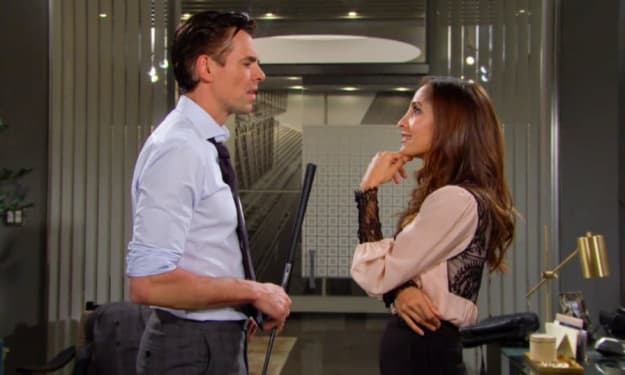
Fans are Hopeful While Billy and Lily Supporters Are Outraged on ‘The Young and the Restless’
Billy and Victoria on The Young and the Restless seemed to be soul mates at one time. Fans of Villy were ecstatic when Phyllis was seeing her brother-in-law since it seemed like their favorite pair was falling in love again. When Billy Abbott, the gum-chewing, hallucinating guy, appeared and started hanging around with Amanda, everything changed. Although Jason Thompson's persona was unpopular at the time, he has since evolved. Jill encouraged Cane Ashby's ex-wife to collaborate with her son and founded Chancecom. These days, the two are profitable for the firm and in love.
By oussama arrafia2 years ago in Geeks
Silver Screen Magic with Mae West
American actress and singer Mae West became a popular film actress during the Great Depression. She started entertaining in vaudeville, then performed on Broadway, and finally went to Hollywood. She signed up with Paramount Pictures and made her debut in the 1932 film “Night After Night.” She also starred in musicals, comedies, and crime dramas. The American Film Institute named her one of the best classic Hollywood actresses.
By Rasma Raisters5 days ago in Geeks
Ludacris and Nelly draw backlash over bookings at MAGA-coded music festival
Ludacris and Nelly headlining a mostly right-wing event is good for them. It’s also great for the genre of hip hop. The two rap veterans have showcased their talents on other stages. Why can’t they perform for mostly MAGA folks and grab that bag?
By Skyler Saunders4 days ago in Beat



Comments
There are no comments for this story
Be the first to respond and start the conversation.