
Book Review: "You're Not Listening" by Kate Murphy
3/5 - there's lots of good points, but not a lot of data to back them up...

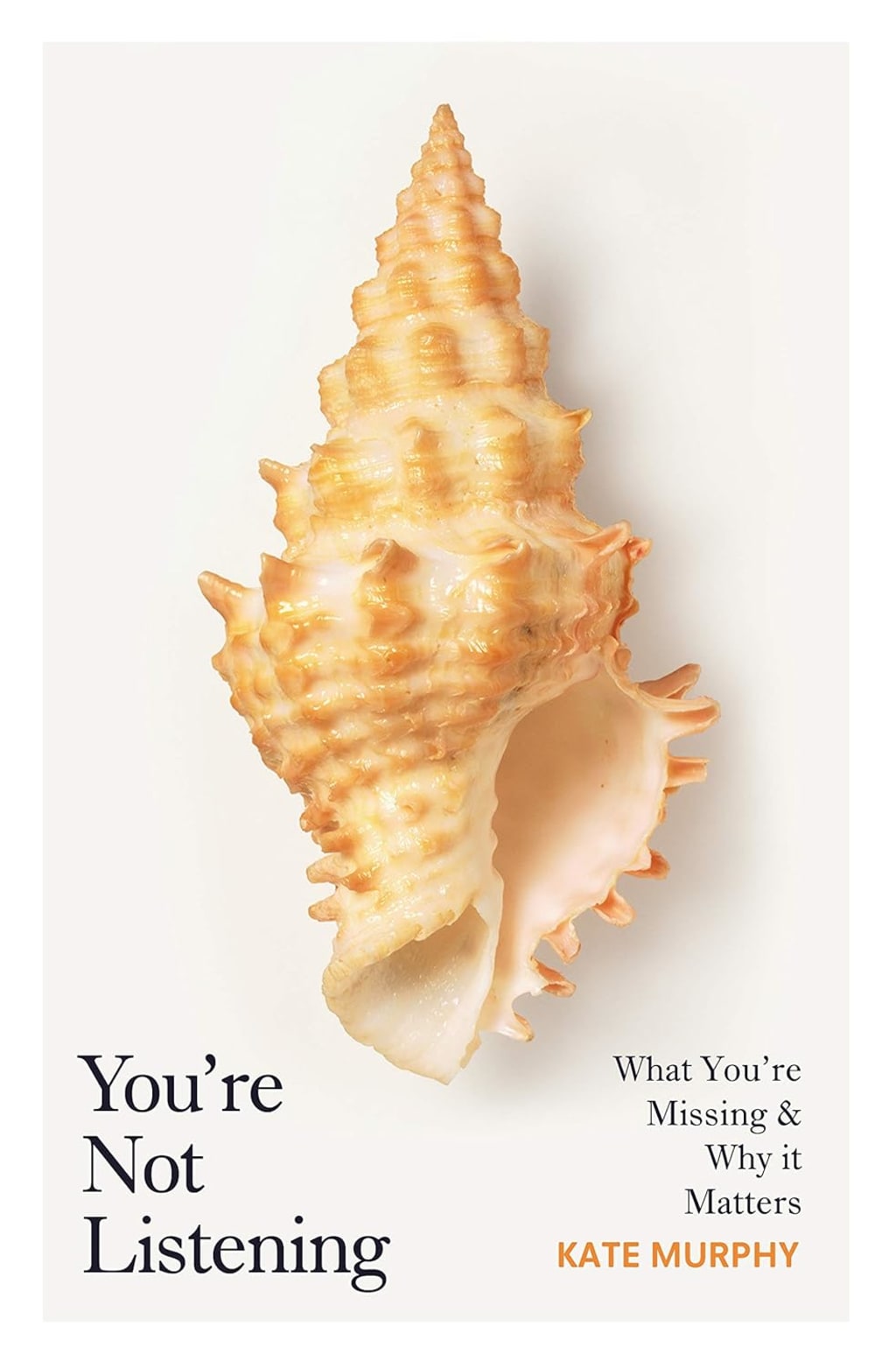
Full Title = You're Not Listening: What You're Missing and Why It Matters by Kate Murphy
I chose to read this after seeing it on the list of Penguin Nonfiction I was browsing through one day (yes, I like to scroll through the Penguin Nonfiction books). After a while of the scrolling and going back and forth saying to myself 'no, I don't want to read this one...' I ended up reading it. To be honest, it was rather here and there - neither amazing nor awful. It was one of those middle of the road books where the problem again, as we have seen with some of our more recent nonfiction...is data.
Murphy argues that listening goes far beyond simply being quiet while someone else speaks. Good listeners actively participate in the conversation by showing genuine curiosity and asking insightful, clarifying questions that allow the speaker to delve deeper. This active approach to listening requires patience and the discipline to resist interrupting or steering the conversation, allowing the speaker to feel truly heard. She highlights that active listening also involves reading non-verbal cues, such as tone of voice and body language, to fully understand the speaker’s message.
I think we can all say that we know this one. However, I also think that this part has too many pages in the book dedicated to it. I mean, the audience reading this book would be those already interested in the subject so I don't think the author needs to patronise them. Though I like how it has been explained, I'm not sure I agree with the ratio it takes up in the book.
The author explains that people often unconsciously filter information through their own biases and beliefs, only "hearing" what aligns with their own worldview. This selective hearing can hinder honest communication and prevent listeners from being open to new ideas. For instance, if someone has a preconceived notion about a topic, they might ignore aspects of what the speaker is saying that challenge their beliefs. She encourages listeners to stay open and temporarily set aside their opinions, which allows for a fuller understanding of the speaker's perspective and a more authentic exchange of ideas.
This is a part I think is pretty good and it is interesting as well. There's a lot of research into this and the way we listen to people...or rather hear them and what we hear. The author stating that we need to put our own beliefs aside in order to listen to the other person is probably more important than ever in our divisive world. It's quite telling actually about why she has chosen to include this analysis in the book.
The author also highlights a common listening pitfall known as "conversational narcissism," where people subtly or overtly turn conversations back to themselves, redirecting the topic to their own experiences, opinions, or achievements. This behaviour, often motivated by a desire for validation, can make the other person feel undervalued and unheard. She then suggests that instead of responding with personal anecdotes, a better approach is to ask follow-up questions or acknowledge the speaker’s experiences. For instance, instead of saying, “That happened to me, too,” a good listener might ask, “How did you feel when that happened?”
I honestly hate it when people do this. The whole 'that happened to me as well...' or 'I feel the same way because...' You're either listening to the other person or you're just waiting for your turn to talk. It's not fair on the person talking for someone to hog it up with their desire to tell their own story because they don't want to listen. It's a weird self-obsession and I simply don't like it. Though, I like that it has been highlighted. Even though the data is a bit here and there.
The author then explains that silence, while often uncomfortable, plays a vital role in meaningful listening. She notes that allowing silence in conversations gives people time to reflect and consider their thoughts, often leading them to share more significant, personal insights. Many listeners are uncomfortable with silence, rushing to fill pauses, but She argues that letting silence sit for a few seconds can lead to deeper understanding and greater emotional openness. Silence can also help the listener process and reflect on what the speaker has shared, rather than planning their next response immediately.
The data for this section annoyed me because it came from artsy idiots doing some stupid vanity project instead of actual scientific studies and it especially annoyed me because it makes a good point - though it cannot be verified in the book. Silence is a great thing to practice even if you cannot feel as though you can do it. In our modern society, silence is basically nowhere and I cannot say I'm too good at it either. This doesn't mean just not talking, it also means no distractions. It's like a meditation.
This moves us on to the next point which also has very little research to back it up even though it makes a good point. The author highlights how distractions, especially from smartphones and other digital devices, impede effective listening. She points out that multitasking or allowing distractions during conversations communicates a lack of interest and respect, making others feel dismissed. By silencing devices and removing potential distractions, listeners can offer their full attention, creating an environment that fosters trust and engagement. She stresses that when listeners are truly present, they are more likely to pick up on subtle cues and better understand the speaker's emotions, enhancing the quality of the interaction.
All in all, we can see that listening can clearly be improved even though it will be difficult to do so if you're not a good listener already. We need to learn how to listen to each other for conversational purposes but also in order to gain connection again. I understand it yes, and I want to be a better listener if I can (though out of work I'm not much of a talker), but I'm not sure I'd like to be that close to anyone like that.
About the Creator
Annie Kapur
I am:
🙋🏽♀️ Annie
📚 Avid Reader
📝 Reviewer and Commentator
🎓 Post-Grad Millennial (M.A)
***
I have:
📖 300K+ reads on Vocal
🫶🏼 Love for reading & research
🦋/X @AnnieWithBooks
***
🏡 UK
Keep reading
More stories from Annie Kapur and writers in Geeks and other communities.
Book Review: "Exam Nation" by Sammy Wright
A lot of people have told me that this is one of the primary books on 21st century post-COVID secondary education to read and so, I had a go at reading it. I'm not going to lie to you - it is rather a mixed bag. Some of it is pretty well researched and other parts are anecdotal bulls*** that doesn't apply to anywhere else except for his small context. There are also oddities in the arguments he makes.
By Annie Kapurabout a year ago in Geeks
Aima Baig Turns 31 With a Note on Grief, Gratitude and Growing Up in the Spotlight
Pakistani singer Aima Baig turned 31 on March 10, 2026, and marked the milestone with a heartfelt and unusually candid message about her journey in the public eye — touching on grief, gratitude and the complexities of adulthood under constant scrutiny. The post offered fans a glimpse into the personal thoughts of one of Pakistan’s most prominent musical voices as she navigates both professional success and personal challenges. � images.dawn.com Baig’s Instagram carousel celebrated her birthday with intimate snapshots rather than the polished, glossy images often associated with celebrity social media. Among the images were casual selfies, a cake‑cutting moment with friends and colleagues at work, and a light‑hearted father–daughter scene capturing her dad playfully rolling his eyes at her self‑care purchases. The relaxed nature of the photos suggested a desire to share authenticity rather than spectacle. In an accompanying caption, Baig reflected on both difficult and meaningful aspects of her life. She spoke openly about dealing with grief — a rare admission from a public figure who often maintains a composed, star‑quality persona. She acknowledged losses and emotional weight she has carried, saying that even amid her career successes, moments of sorrow have shaped her understanding of life and personal resilience. These reflections resonated with many of her followers, who praised her vulnerability and emotional honesty in an era where celebrity images are often meticulously curated. At the same time, Baig expressed deep gratitude for the people who have supported her, from family and close friends to her fans around the world. She thanked those who “showed up in quiet ways” — friends who hosted cake‑surprise gatherings during her busy work schedule, and loved ones who stood by her through challenges. Her message emphasized that gratitude and connection often matter more than fame or achievement. Baig’s note also hinted at the sometimes heavy burden of living in the spotlight. She wrote about the constant public gaze and how it can amplify both praise and criticism. Though she did not mention specific incidents, the sentiment reflected a broader experience faced by many celebrities — where every personal choice or emotional expression becomes subject to public debate. Her comments illustrated how navigating fame can be both energizing and exhausting. Aima Baig first rose to prominence in Pakistan’s entertainment scene in the mid‑2010s, earning acclaim for her powerful vocals and distinct style. Born in Rahim Yar Khan in 1995, she studied at the University of Lahore before launching a successful music career that would see her contribute to film soundtracks and television programs, as well as high‑profile performances on platforms like Coke Studio Pakistan. Over the years, she has been recognized with multiple awards, including Lux Style Awards and a Tamgha‑e‑Fakhre‑Imtiaz for her contributions to the arts. Her birthday post was striking not just for its warmth, but also for its emotional depth — a rare moment of unguarded self‑expression from a performer whose life has often been dissected by tabloids and social media commentators. In recent years, Baig has been at the center of public attention not only for her music but also her personal life, including her relationships and public image, which have frequently inspired online discussion. Despite this, she has continued to build her artistic career, increasingly seen as a voice of her generation. Fans and commentators alike responded with messages of support, celebrating her honesty and maturity. Many praised her for acknowledging both light and darkness in her personal journey — recognizing that embracing life fully sometimes means confronting uncomfortable truths about loss and growth. As Baig embarks on her 31st year, her message of grief intertwined with gratitude suggests a reflective and grounded perspective — one that acknowledges the challenges of life in the public sphere while appreciating the relationships and experiences that sustain her. In a world where celebrity narratives are often manufactured, her willingness to speak candidly about her inner life marks a meaningful connection with audiences who see not just a performer, but a person growing, learning and evolving with every year.
By Fiaz Ahmed 3 days ago in Geeks




Comments
There are no comments for this story
Be the first to respond and start the conversation.