
Book Review: "Wake Up" by Jack Kerouac
3/5 - ...perhaps not his best work...

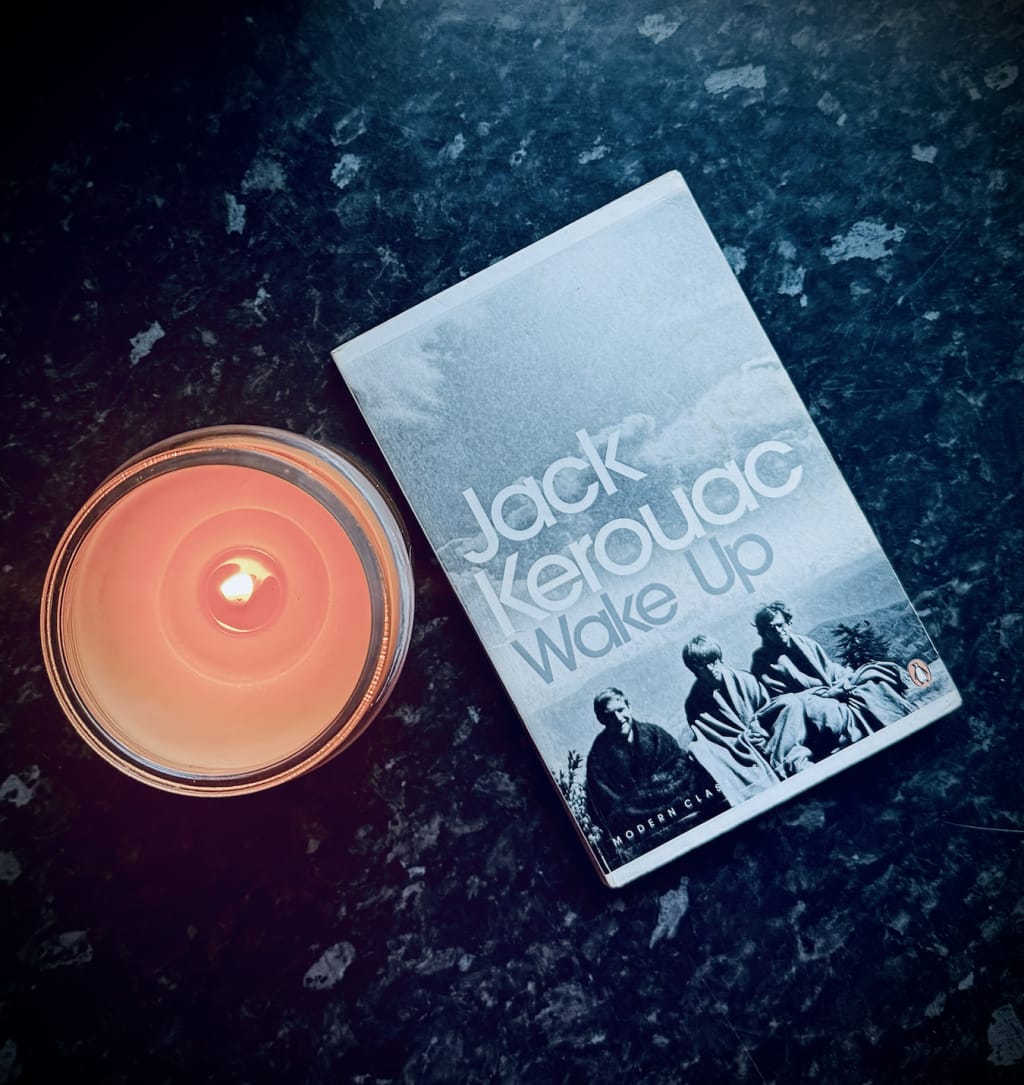
Jack Kerouac was definitely a prolific writer and there was so much released after his death that was never actually intended to be released ever. When I first read The Sea is My Brother, I couldn't help but think about whether Kerouac would have ever released this thing had he lived a little longer. I came to the conclusion that he would've probably done a Bob Dylan-esque 'Bootleg' situation and released them as writings from the past himself. When it comes to Wake Up though, I feel like it reads a bit like something Kerouac was working on but never really saw a future in. It's a bit overly simple and not quite exactly what I was hoping for out of him.
The story begins in the kingdom of Kapilavastu, where Queen Maya dreams of a white elephant entering her side which is a sign that she will give birth to a divine being. Her son, Siddhartha, is born miraculously from her side, bathed in light and already radiating wisdom. Kerouac recounts this with both wonder and irreverence, emphasising the sense of cosmic destiny surrounding the child. The infant’s birth is marked by prophecies: that he will either become a great king or renounce the world to save humankind. Yes, you've read that correctly. I don't think that this story was made to be written by Kerouac and it also doesn't make for a very interesting story either. The problem with this narrative is that two-sided problem in which the story is tired and boring and the writer seems to be aloof and disconnected. Though it is supposed to seem 'magical', it comes off as basic and a bit underworked like a bread that hasn't risen.
The next section of the book is about Siddhartha’s youth which is a life of gardens, music, and luxury, the author injects the scenes with his own disillusioned tone about Western materialism. The prince, restless and introspective, begins to feel that his existence is hollow. Kerouac’s narration often slips into Buddhist philosophical commentary: that ignorance and attachment, no matter how gilded, are still forms of suffering. This part is written far better than the beginning, but it also seems to be not very polished. There's something that feels a bit juvenile about it. It's not unpolished like On the Road and it's not purposefully underdone like Maggie Cassidy. It feels randomised and, if I'm going to be honest, a bit crap even though the ideas were clearly there.
Tormented by the suffering he has seen, Siddhartha decides to renounce his princely life. He sneaks away from the palace at night, removing his jewels and cutting off his hair as symbols of his detachment. Kerouac writes this scene with the rhythm and melancholy of a jazz solo which is unironically the sound of a soul breaking free. This renunciation, he suggests, is the moment when Siddhartha truly “wakes up,” though his enlightenment is still to come. I'm not going to lie, when I was reading about this book over the internet after reading the book, I saw that many people were calling this the most poetic passage in the text but I honestly wasn't feeling it. Again, the mixture between Kerouac's own thoughts and the story makes it just feel so disconnected and even though I usually love how he blends different ideas together, once more it feels underdone.
Siddhartha sits beneath the Bodhi tree, vowing not to rise until he attains enlightenment. The demons of Mara tempt and torment him with fear, desire, and doubt. Kerouac’s prose becomes and echo of his Beat style as a mix of ecstatic mysticism and modern slang (“he saw through the whole hustle of existence”). Finally, at dawn, Siddhartha achieves awakening, understanding the Four Noble Truths and the Eightfold Path. I would say that this part of the book, the second half, gets better. It seems like Kerouac definitely finds his own way through the text at this point and it doesn't read as rough and tumble as the first half. It definitely reads more like a man who has found his groove. As we continue towards the end, we get a more balanced Kerouac - one we are more used to.
All in all, this is not really Kerouac's best book and probably isn't even in the top five books I've read by him. But, if you like the works of Kerouac then I would not tell you to skip this one over. It is important to see how he formulates a biography even if it is a bit here and there.
About the Creator
Annie Kapur
I am:
🙋🏽♀️ Annie
📚 Avid Reader
📝 Reviewer and Commentator
🎓 Post-Grad Millennial (M.A)
***
I have:
📖 280K+ reads on Vocal
🫶🏼 Love for reading & research
🦋/X @AnnieWithBooks
***
🏡 UK
Keep reading
More stories from Annie Kapur and writers in Geeks and other communities.
Marvel Zombie
The last entry into our 2025 superhero projects catalogue is Marvel Zombies. This was a show that was anticipated by absolutely no one and it disappeared from the public consciousness as quickly as it was released. There was nothing special about the project that made it a must see, or a must remember. In fact if anything it's a must forget.
By Alexandrea Callaghan20 days ago in Geeks
People We Meet on Vacation Movie
Some love stories arrive with fireworks. Others arrive quietly, like a familiar song playing in the background of your life. People We Meet on Vacation belongs firmly in the second category. As the highly anticipated film adaptation of Emily Henry’s bestselling novel moves closer to the screen, audiences are preparing for a story that doesn’t rely on dramatic twists or sweeping declarations, but instead finds its power in shared moments, missed chances, and the slow realization that love has been there all along.
By David Cook2 days ago in Geeks




Comments (1)
Oooo, bread that hasn't risen, that's a clever analogy. Loved your review!