
Book Review: "The Twilight World" by Werner Herzog
4/5 - an extraordinary philosophy on human endurance...


“Most details are factually correct; some are not. What was important to the author was something other than accuracy, some essence he thought he glimpsed when he encountered the protagonist of this story.”
Werner Herzog is a fantastic director of some increasingly incredible documentary and feature films. Though I have some weirdly choice words about his adaptation of F.W Murnau's Nosferatu, I do think that Herzog is quite possibly one of the greatest documentary directors in human history. He has an eye for storytelling realities that no other director has grasped and his intense realism in his feature films reflects this brilliantly.
“Onoda’s war is of no meaning for the cosmos, for history, for the course of the war. Onoda’s war is formed from the union of an imaginary nothing and a dream, but Onoda’s war, sired by nothing, is nevertheless overwhelming, an event extorted from history.”
It seems a bit strange given that the subject of this book has apparently written his own autobiography (one of which I have only heard about and regrettably not yet read). Though I regard Werner Herzog's ability to tell a realistic story in a incredibly philosophical way as something of a talent in him. It is done in this book however, to varying degrees of success with some of the philosophical writing sounding like incoherent ramblings on a subject that is somewhat a little disjointed. It is, on the other hand, forgiven given that the book is actually a really good and interesting read to introduce you to the character and that I am sure that what I view as an incoherent rambling may actually hold some meaning to Herzog that I am not learned enough to understand the true meaning behind. That was really my only criticism of the book.

The beginning is quite odd but I understand it. It starts off with that quotation that opens this review and we are told that this may not be 100% accurate but is based on human essence. This means that the act of writing a short biography of the person is actually very different to them writing an autobiography - they themselves would not be able to see the same essence that another sees when looking at them and listening to them. Thus, as we move through the book what we are witnessing is not actually someone's life and work but rather their life and work as seen by other people. This is especially thought-provoking when the person who is seeing it is Werner Herzog, mystical director of the hyper-realistic world. His added commentaries of philosophy, repeated phrases and human experiences make the whole thing feel like one of his films.
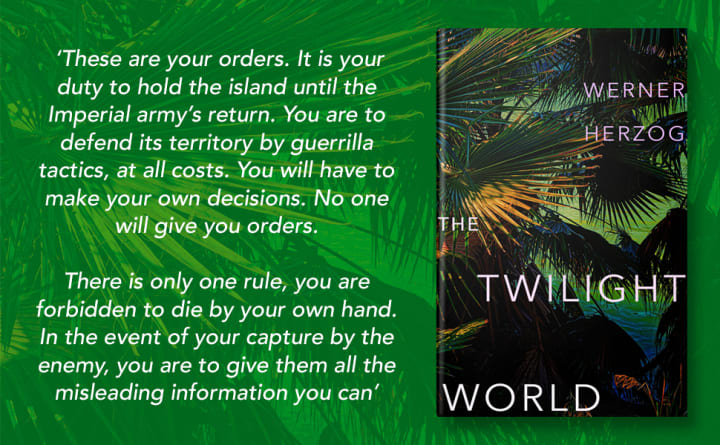
I love the way Werner Herzog uses language to express parts of the human experience that not everybody has had. It does not feel overdressed or verbose but instead is poetic, quite blunt and is made to get the reader thinking about morals, ethics and emotions involved in how the subject has thought it out. The subject of this book stood guard after the Second World War for so long out of moral obligation and servitude. But Werner Herzog also explores the realistic side of making that decision, having that obligation for so long and how intensely it has been thought about reflects many of the themes in the filmmaker's features as well as the character of the book - doing the reader a double service in understanding by the author and the subject.
Onoda's "war" is separate to the Second World War, as is suggested by Werner Herzog. This war of the subject is entirely internal and within their own ethical perimeters. There is something not heroic, but individual in the choice that is made and Herzog explores that very act of free will and whether it is really free will or influence decision. It becomes a really big deal for a book that is barely 150 pages long.
All in all, I thought that this book maybe was not his best work given the difficulty in understanding the philosophical side that I had, but in its writing it has some very key and underlying points that can get any reader of any understanding thinking about our own realities, whether they are individual or universal. Our own internal wars and struggles are part and parcel of existence and all existence must have an act of suffering to be called existence at all.
About the Creator
Annie Kapur
I am:
🙋🏽♀️ Annie
📚 Avid Reader
📝 Reviewer and Commentator
🎓 Post-Grad Millennial (M.A)
***
I have:
📖 280K+ reads on Vocal
🫶🏼 Love for reading & research
🦋/X @AnnieWithBooks
***
🏡 UK
Keep reading
More stories from Annie Kapur and writers in Geeks and other communities.
Book Review: "Any Human Heart" by William Boyd
“The pleasures of my life here are simple – simple, inexpensive and democratic. A warm hill of Marmande tomatoes on a roadside vendor’s stall. A cold beer on a pavement table of the Café de France – Marie Thérèse inside making me a sandwich au camembert. Munching the knob of a fresh baguette as I wander back from Sainte-Sabine. The farinaceous smell of the white dust raised by a breeze from the driveway. A cuckoo sounding the perfectly silent woods beyond the meadow. A huge grey, cerise, pink, orange and washed-out blue of a sunset seen from my rear terrace. The drilling of the cicadas at noon – the soft dialing-tone of the crickets at dusk slowly gathers. A good book, a hammock and a cold, beaded bottle of blanc sec. A rough red wine and steak frites. The cool, dark, shuttered silence of my bedroom – and, as I go to sleep, the prospect that all this will be available to me again, unchanged, tomorrow.”
By Annie Kapur2 years ago in Geeks
10 Times Rotten Tomatoes And I Disagreed
***Disclaimer*** I will be ranking these movies in the following manner: The greater the divide between Rotten Tomatoes and I, the higher up on the list (and I am referring to the critic's score, not the audience score). I will also show Rotten Tomatoes' score on each one in addition to my score. I am curious to know what everyone thinks, please let me know in the comments below!
By Madison "Maddy" Newtonabout 19 hours ago in Geeks
An Inside Look at Emily Ratajkowski’s Natural Diamond Reset Rings
Emily Ratajkowski is turning a new chapter in her life story and taking a moment to celebrate herself with a natural diamond self-gifting moment. In a photo posted on Instagram, Emrata showed off her “Divorce Rings”– two natural diamond stunners featuring a 3+ carat, akimbo-set pear-shaped natural diamond and another 3+ carat princess cut diamond flanked by two trapezoid cut natural diamonds, designed by Alison Chemla of Alison Lou.
By Dena Falken Esq3 days ago in Geeks




Comments
There are no comments for this story
Be the first to respond and start the conversation.