
Book Review: "The Road Less Travelled" by M. Scott Peck
3/5 - a great reading experience which shows us how important but deeply flawed psychotherapy is...

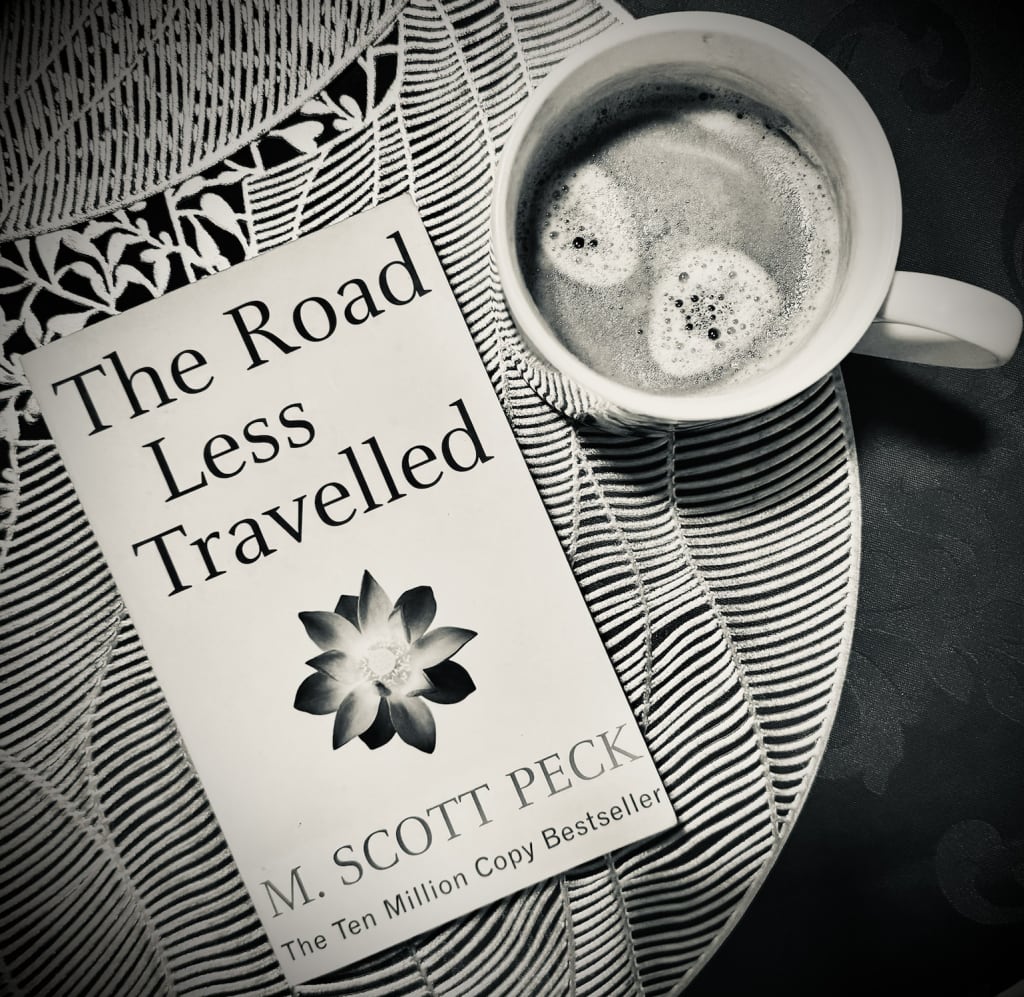
This book sort of details the same ideas The Marshmallow Test states but with a spiritual flair to it. Whenever someone mentions the 'human spirit' I usually ask for a definition as you'll probably see in that, they can't actually define what it is. With all the 'spiritual' stuff and the illogical thinking which roots itself in clearly, some sort of religious lexicon, I definitely went into the book telling myself I probably wouldn't be agreeing with many of the points put forward and thus, was cynical about the 'spirit' perspective that the book was pushing. However, it did make some interesting arguments regarding everything from delayed gratification to how incredibly important parenting is.
The writer tells us that we need to accept that life is difficult and once we accept that, life becomes easier. Yes, we are going to start off with a complete contradiction and on top of that - we are going to be taken through anecdotes relative to (possibly fictional) people who don't have any real world problems by a psychotherapist who clearly has some religious leanings. Don't get me wrong, there are some good points - but you really do have to look for them.
One of the points that the writer covers is the idea of delayed gratification. As a psychotherapist, the writer often adds in the stories of people he treats without giving away any confidential information about them. One of them is a woman who can't seem to get anything done at work and so, the psychotheraphist states that she should do the more difficult and tedious parts of her work first, so that the rest of the day she can have to do the more fun aspects of it. A delayed gratification perspective made her life better yes, but I would say that the writer also acknowledges that the woman had a great amount of willpower to do so. Grown adults who have serious problems with delayed gratification have been seen to have issues with crime and addiction, they aren't the white collar 'I don't actually have any problems' types. So I would like to say that on the whole, this anecdote tells us nothing important.
But, the writer does talk about the importance of parenting shaping the individual as they grow up. Parents who are uncaring produce children who seek validation, parents who are overly protective produce children who believe that the only function of the world is to kill them and finally, parents who are not disciplined in themselves produce children without discipline. We could make the assumption that it is all imitation but it's not quite that simple. Many children grow up to be in some ways, their parents - but many of them also grow up to be a product of their parents belief systems. Many parents, even those who are more well to-do, tend to have a fault with their parenting in which they will say something like 'believe what I believe or I won't love you anymore'. In this state, the author states, love becomes conditional and so, the learnt security from 6 months old the child has towards the parent becomes unstable. This can have catastrophic consequences later on in life.
I agree with the whole notion that parenting basically shapes the identity of the child in question. But I think that school does the same thing since the child, after the age of six, will spend the majority of the next decade or so of their lives there.
When it comes to love, the author makes the distinction between self-discipline and falling in love. The writer makes the argument that 'falling in love' is actually just the collapsing of boundaries and ego rather than actually being in love with the object of your sexual affection. This I agree with because there must be a biological explanation for why people randomly fall in love with each other. I mean, I haven't experienced this phenomenon but it basically changes the person's personality towards everything. Calling it a collapse of boundaries is probably the closest I can come to an actual explanation as to why this would happen. It puts the person experiencing those feelings though, in a very dangerous position as their inhibitions are lowered. It would definitely be something to avoid in the evolutionary way of thinking since it opens people up to predators.
The author also analyses the nature of dependent love and how it isn't love at all. Dependent love shows up as a complete dependency on someone else, being interested only in your own happiness and growth rather than the happiness and growth of the couple, and on top of this, making sure that the other person doesn't have access to certain aspects of life that would make them quite capable of moving on to someone else (or at least, moving away from the dependent person). Arguably, this can be seen as an act of coercive control and is probably more perpetrated by men - keeping women trapped in unpaid labour is a pretty good way to lock her out of financial freedoms and the ability to leave. But, the very nature of unpaid labour means that he is constantly looked after whilst her growth has been stifled. The author looks at the reversal as well, the way in which people take care of pets is similar to the idea of war brides, as soon as communication of ideas, opinions and the self is able - the figure of affection will be cast out. The whole point of this is to make sure the object of affection is completely dependent on the individual. It is quite shocking and if I wasn't put off by the idea of love before - I definitely am now.
As we move through the section on love though, we get a much more mystical view of it. Gone are the logical arguments which structure the feeling of romantic love as a fatal flaw in human development (which I wholeheartedly support the claim of), but we now have 'love as a mystery' and how we can never really know why we love. I think this is wholeheartedly wrong and possibly even damaging. Here's the explanation and you can actually research this: familial love is probably the only biologically correct form of love (which is why it is so painful when familial bonds break), romantic love is a myth that people believe in order to get to familial love (i.e having children) and is an inherent flaw in themselves as most of it is about making themselves feel better. And finally, sexual love is criminally more skewed towards being committed to by people who lack having something better to do (i.e gardening, reading etc). Love is not mysterious. It's only mysterious if you're an idiot.
The next sections deal with religion and the way in which religion can foster and hinder personal growth. I'm going to be perfectly honest with you, my eyes opened when I left religion and I stopped believing that I was someone special and worthy - instead, I saw the reality: in the grand scheme of things I don't matter. And, to be perfectly honest, it was much more freeing than being tied to the responsibilities by which I would be held accountable by a person who didn't exist. I understand how religion does help people, so I'm not completely Hitchens-ed out in thinking religious people are idiots. I don't. I understand that for some people, it is helpful - like a child who has an imaginary friend (and please, don't take that as infantilisation - there is psychologically a lot of advantages to children having imaginary friends. It is a brilliant builder of empathy, understanding and imagination). But I disagree that religion is an avenue for personal growth.
Correctly so, the author identifies that the main downfall of people who are religious is that they cannot explain a rational reason for their worldview that does not involve teachings that they have accumulated from religion. This is usually unmoving. The issue lies with learning. Learning can only be done when we distrust what we believe and go searching out new avenues of explanation and evidence for something else. This cannot be done in the realms of religious doctrine. Therefore, though religion might be helpful psychologically, it doesn't foster personal growth.
The author asks some interesting questions, giving us some case studies of how religion is both a help and a hinderance - which is surprising since the writer has currently written about both love and the human spirit without being able to define either (even in the section of the second chapter entitled 'Love Defined'). I think for this author to state that religion isn't a helpful avenue to personal growth whilst also using phrases like 'human spirit' and 'soul' in order to describe psychotherapy's concentrations is something of a contradiction. He never actually defines any of these abstract concepts with an underlined definition but instead leaves the reader to think they are something mystical and unable to be rationalised. For someone who then makes the argument that God has a bad track-record with patients of psychotherapy, this seems deeply disingenuous.
Anyways, you've probably grown tired of my back and forths with this book and so I will leave you with a thought, something that I took away from this book regarding one of its biggest concepts: say there 'is' a human 'spirit', how would you define your own and what does it consist of? Is everyone's spirit different or do we all have the same one? If everyone has the same spirit does that mean that you and I have something in common with the soul of a violent criminal, rapist or murderer? Must we accept these arbitrary skirtings around abstract concepts if we are to try and understand the why, or should which ditch the bullshit and rely on science for an explanation?
About the Creator
Annie Kapur
I am:
🙋🏽♀️ Annie
📚 Avid Reader
📝 Reviewer and Commentator
🎓 Post-Grad Millennial (M.A)
***
I have:
📖 280K+ reads on Vocal
🫶🏼 Love for reading & research
🦋/X @AnnieWithBooks
***
🏡 UK
Keep reading
More stories from Annie Kapur and writers in Geeks and other communities.
The Ballad of Peckham Rye by Muriel Spark
A dark-comic novel which is often regarded as 'sharp', The Ballad of Peckham Rye (1960) displays all of the notes regularly associated with the author Muriel Spark. Set in post-war London, the novel follows the arrival of Dougal Douglas, an enigmatic and manipulative Scottish outsider who disrupts the mundane lives of the working-class community in Peckham. The layered narrative, the explorations of human weakness and the wit are all part and parcel of what makes the novel what it is.
By Annie Kapur8 days ago in Geeks
Nancy Guthrie: Is a miracle still possible after close to two weeks?
Close to two weeks since Nancy Guthrie's abduction As of February 12, 2026, Nancy Guthrie remains classified as missing for 12 days, but there is no official confirmation that she is deceased. Blood matching Guthrie’s DNA was found on her front porch, indicating she likely suffered an injury during the abduction.
By Cheryl E Preston2 days ago in Geeks




Comments
There are no comments for this story
Be the first to respond and start the conversation.