
Book Review: "The Peloponnesian War" by Thucydides
4/5 - a fast-paced account of a turbulent war...


“I think the two things most opposed to good counsel are haste and passion; haste usaully goes hand in hand with folly, passion with coarseness and narrowness of mind.”
Though not much is known about his actual life, The Peloponnesian War seems to give us some details of his existence and military career. Likely born around the year 460BCE, Thucydides' life is shrouded in history and comes at a turbulent political time. It was likely that he was born into a wealthy family and, according to his own records, he was an Athenian.
Holding the position of general in the Peloponnesian War, he was an avid member of the political scene in his hometown and worked his way into the rankings. Unfortunately, for failing to prevent the capture of a prominent Athenian sector named Amphipolis, he spent an exile period in Thrace and observed the war rather than fighting in it for this time. He conducted a lot of research during this exile as well, visiting people and speaking with them about what they had witnessed of the war. Ultimately, this would help him write his history of the situation.
Known for his empirical research and attention to critical detail, Thucydides' method of writing history is often revered by those who have read this book as it provides a more analytical and less passionate account of the events that unfolded. Unfortunately, the narrative itself ends abruptly in 411BCE but the reason behind that is unknown. Some researchers believe that Thucydides probably died before he could finish writing. However, his legacy as a critical writer of history still stands the test of time.
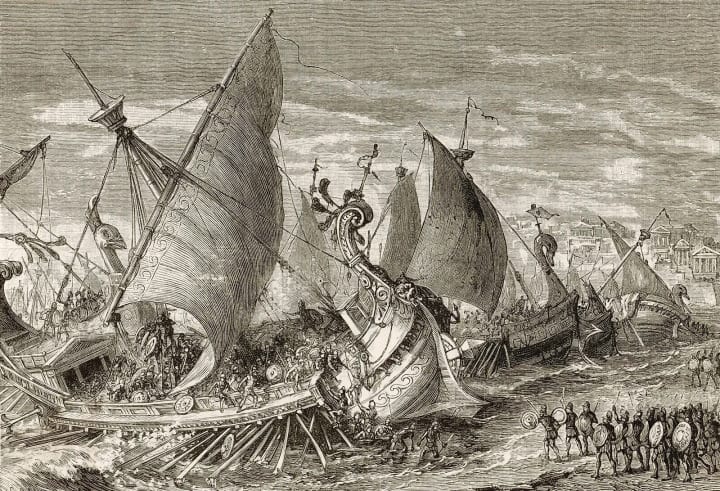
For those of you who are stuck on what the Peloponnesian War actually was, here is a brief account of what happened in the most succint way I can think of. In 431 to 404BCE, Athens and Sparta were going head to head in a war and this led to blockades by the Athenians and a very short period of peace time in 421BCE. Unfortauntely, the Sicilian Expedition of 415BCE did not go well for Athens as they tried to launch some sort of military campaign there to gain influence. This included things like the invasion of Syracuse and it ended horribly. Spart was recieving support from the superpower Persian Empire which, when Athens and Sparta resumed their main war, led to the complete decimation of Athens. Athens fell and was forced to surrender to Sparta. It reshaped the entire political landscape of Ancient Greece.
"The Athenians were first to abandon their weapons and relax their lifestyle into something more luxurious."
Thucydides' book gives a great account of these moments of history in which he states that the different states should work on bettering their own homes before dealing with the politics of others. He details the causes of the war being between the old powers which already had a lot of influence and the threatening new powers which wanted to gain influence (also referred nicely to as the Thucydidian Trap). Thucydides goes on to discuss the importance of maintaining ethics and morality when dealing in politics, making sure that security and power at home are the first things they must do.

However, when the state's self-interest is involved then political morality should be abandoned for the security of the state and its wellbeing. This weirdly balanced viewpoint is something we do not normally encounter in political writings, but I think because of the dispassionate way it has been discussed, it does make the book itself difficult to read.
In the understanding of the dynamics of conflict, Thucydides places himself as a figure we look up to. I can honestly say that reading about conflicts involving Ancient Greece is a great thing to do. But also, after reading The Iliad it makes it boring to read anything that is not as passionate. Be that as it may, if we take away the dispassionate writing, we are left with a pretty difficult book to grasp and follow. Though it is well written, I do not think my personal expertise are suited to this account that has been written. Though I know what the war was, I do not feel like I have been involved in a book, instead I feel like I have been lectured on the importance of realpolitik.
About the Creator
Annie Kapur
I am:
🙋🏽♀️ Annie
📚 Avid Reader
📝 Reviewer and Commentator
🎓 Post-Grad Millennial (M.A)
***
I have:
📖 280K+ reads on Vocal
🫶🏼 Love for reading & research
🦋/X @AnnieWithBooks
***
🏡 UK
Keep reading
More stories from Annie Kapur and writers in Geeks and other communities.
My Top 5 'Black Mirror' Episodes
It has taken a lot of convincing to get me to watch the hit Netflix TV Show Black Mirror which was first released in 2011 on Channel 4. Taken to Netflix by Season 3, Black Mirror flourished its way to an audience of 11.6 Million viewers during the sixth season. I will not lie to you when I say that the majority of the episodes in my opinion, are some of the most boring and banal things I have ever seen on television. However, the cultural impact of the show upon others cannot be denied or understated.
By Annie Kapur2 years ago in Geeks
Silver Screen Magic with Mae West
American actress and singer Mae West became a popular film actress during the Great Depression. She started entertaining in vaudeville, then performed on Broadway, and finally went to Hollywood. She signed up with Paramount Pictures and made her debut in the 1932 film “Night After Night.” She also starred in musicals, comedies, and crime dramas. The American Film Institute named her one of the best classic Hollywood actresses.
By Rasma Raisters9 days ago in Geeks
Sania Mirza flags structural gaps in Indian Women’s tennis at Australian Open
New Delhi, Jan 16: India U19 pacer Henil Patel credited former South Africa pacer Dale Steyn as his inspiration behind his match-winning performance against the USA at the ICC Under-19 Men’s Cricket World Cup.
By Dena Falken Esq5 days ago in Geeks
Smart phones, Humans and Aliens.
WARNING. I will be tapping into one of your favorite creative tensions: The absurdity of humans worshipping their glowing rectangles as if they were tiny oracles. There’s something deliciously poetic about that contradiction, and it lends itself beautifully to an instructive proviso.
By Novel Allen6 days ago in Poets


Comments
There are no comments for this story
Be the first to respond and start the conversation.