
Book Review: "The Knot of Vipers" by François Mauriac
5/5 - psychologically transformative...Mauriac writes a novel of hopelessness and hope in a family where hatred 'seems' to rule the day...

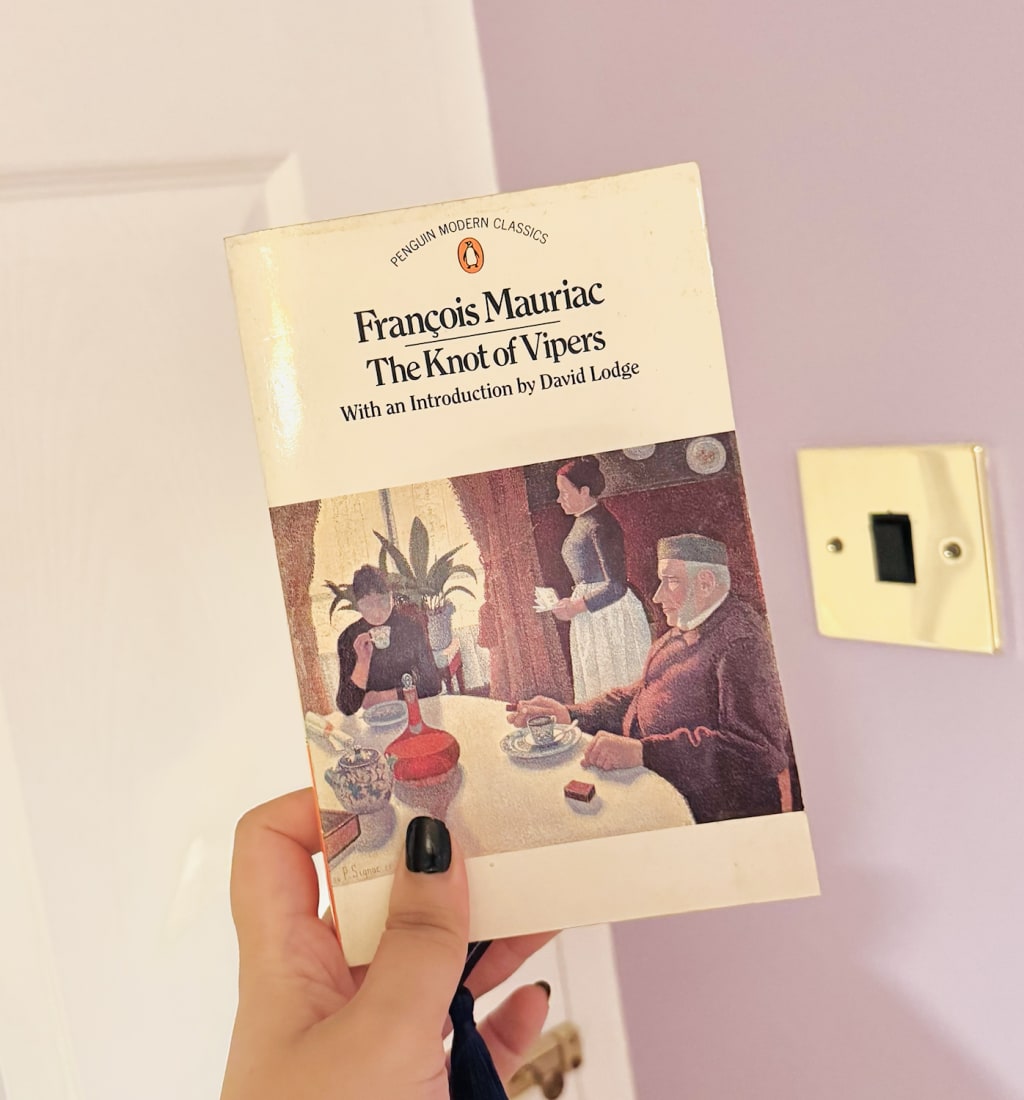
I'm not going to lie, more than often it is a title that draws me to a book and this one was quite intriguing because it didn't give anything away. The only thing I could figure out is that it wasn't going to be a romantic comedy or something along those lines. The Knot of Vipers is François Mauriac's novel written in the style of a confession, about a family falling apart and the members like 'vipers'. They deceive, they are poison to each other, they are hypocritical and selfish. All I can say is that this psychologically twisted novel was not quite what I was expecting but it was amazing nevertheless.
Louis is an elderly, wealthy lawyer who has grown cold and isolated. On top of this he is consumed by hatred. He begins a confessional letter by addressing his wife, Isa, explaining that he is writing in order to expose his inner life and the truth behind the decades of resentment that have poisoned their marriage. Louis definitely draws in the reader by using this strange shrouded secrecy to begin with and slowly revealing his mental state. I like the way it's written to some degree because it's quite clever - it can be seen that this is the way someone would speak in a confessional. At first they are unsure about themselves and then, once they start speaking, they feel more confident about their words (this is definitely revealed in the tone of the latter parts of the book).
Louis recounts how, as a young man, he married Isa out of genuine affection, but the relationship quickly deteriorated. Isa’s family looked down on him as socially inferior, and he became convinced that his wife never truly loved him. Her affection for their children only deepened his sense of exclusion. As Louis’s emotional life decays, he channels all his energy into work and the accumulation of wealth. This is a common trope of the age - work and work and work so that you don't have to feel anymore. But then again, it is also ahead of its time in the sense that this is what people are encouraged to do today. There's a phrase which states that if you 'throw yourself into your work' you will forget about trauma and yet, there are numerous people who have suffered greatly, even to the point of suicide, from taking this advice. It is definitely portraying itself as a universally psychologically relevant novel to the reader.

Louis’s bitterness infects his relationship with his children. He feels they are ungrateful and materialistic, waiting for his death to claim his fortune. The truth is, their emotional distance is largely a reaction to his own cruelty and coldness. Louis's own hatred seems to blind him to the fact that his children are giving him what he is giving them. It is one of the many blind-spots our character suffers with (not to mention the whole 'work yourself to death' ideology he adopts). Once we readers start to see that his hatred only begets hatred, we start to question the accuracy of the portraits of these people he paints with his words. He becomes a shifty, unreliable narrator when it comes to impressing upon us, people from his life - especially his children.
Near the end of his life, Louis experiences moments that challenge his bitterness. A letter, a confession, and memories of his past begin to awaken regret. He discovers signs of genuine affection and faith in those he despised. As we near this point, we see him soften to people like his granddaughter, who becomes a symbol of innocence and hope. This is quite important because she is a young girl and is basically the exact opposite character to himself. Could this mean that his eventual death will signal a new era for the family? There are many questions the reader could ask about this deliberate juxtaposition of character.
The novel's ending reveals little about the coming age but it does make some amount of sense to those of us who have followed Louis' inner turmoil all this time through the inheritance stage. He begins to reflect on the knot of vipers every now and again, much to the interest of the reader who is praying that he sees himself for who he truly is and changes his ways before it is too late. I won't tell you how it ends exactly but I think it will leave you with one big question - the rest is rather ambiguous about the thoughts of our protagonist.
About the Creator
Annie Kapur
I am:
🙋🏽♀️ Annie
📚 Avid Reader
📝 Reviewer and Commentator
🎓 Post-Grad Millennial (M.A)
***
I have:
📖 280K+ reads on Vocal
🫶🏼 Love for reading & research
🦋/X @AnnieWithBooks
***
🏡 UK
Keep reading
More stories from Annie Kapur and writers in Geeks and other communities.
Book Review: "Ageless" by Andrew Steele
Who loves cheap books they can read on their phone? I do. This book wasn't too expensive when I found it and well, I'm not going to lie when I say I'm not overtly interested in biology. HOWEVER, I am also aware that this book is an important read and so, I wanted to get in there. What happens when we have to confront ageing and all of the horrors that come with it? Well, if you're like me you normally turn to the fact that you don't feel like you're too old but you also have to admit that there are things you simply can't do anymore - things you used to do about ten or fifteen years' ago. Andrew Steele gets into the argument about why we should treat this concept, where our bodies work against us, rather than just looking at diseases we can see straight away. How do we cure ageing? Oh, and why should we?
By Annie Kapur2 months ago in Geeks
Silver Screen Magic with Mae West
American actress and singer Mae West became a popular film actress during the Great Depression. She started entertaining in vaudeville, then performed on Broadway, and finally went to Hollywood. She signed up with Paramount Pictures and made her debut in the 1932 film “Night After Night.” She also starred in musicals, comedies, and crime dramas. The American Film Institute named her one of the best classic Hollywood actresses.
By Rasma Raisters6 days ago in Geeks
Grant Gustin's Chances Of Returning As The DC Universe's Flash Have Just Increased After New Update
The Flash has yet to be cast for the new DC Universe, and after a new update, the rumors of Grant Gustin's return as Barry Allen in the new franchise have gained strength once again. Gustin made history by playing Barry for The Flash's nine seasons. The actor also starred in multiple Arrowverse crossovers, becoming one of the franchise's fan-favorites.
By Dena Falken Esq4 days ago in Geeks
Ludacris and Nelly draw backlash over bookings at MAGA-coded music festival
Ludacris and Nelly headlining a mostly right-wing event is good for them. It’s also great for the genre of hip hop. The two rap veterans have showcased their talents on other stages. Why can’t they perform for mostly MAGA folks and grab that bag?
By Skyler Saunders4 days ago in Beat


Comments (1)
Hmmm, I do feel sorry for Louis. Loved your review!