
Book Review: "The Infernal Riddle of Thomas Peach" by Jas Treadwell
3/5 - a great idea with a narrative problem...

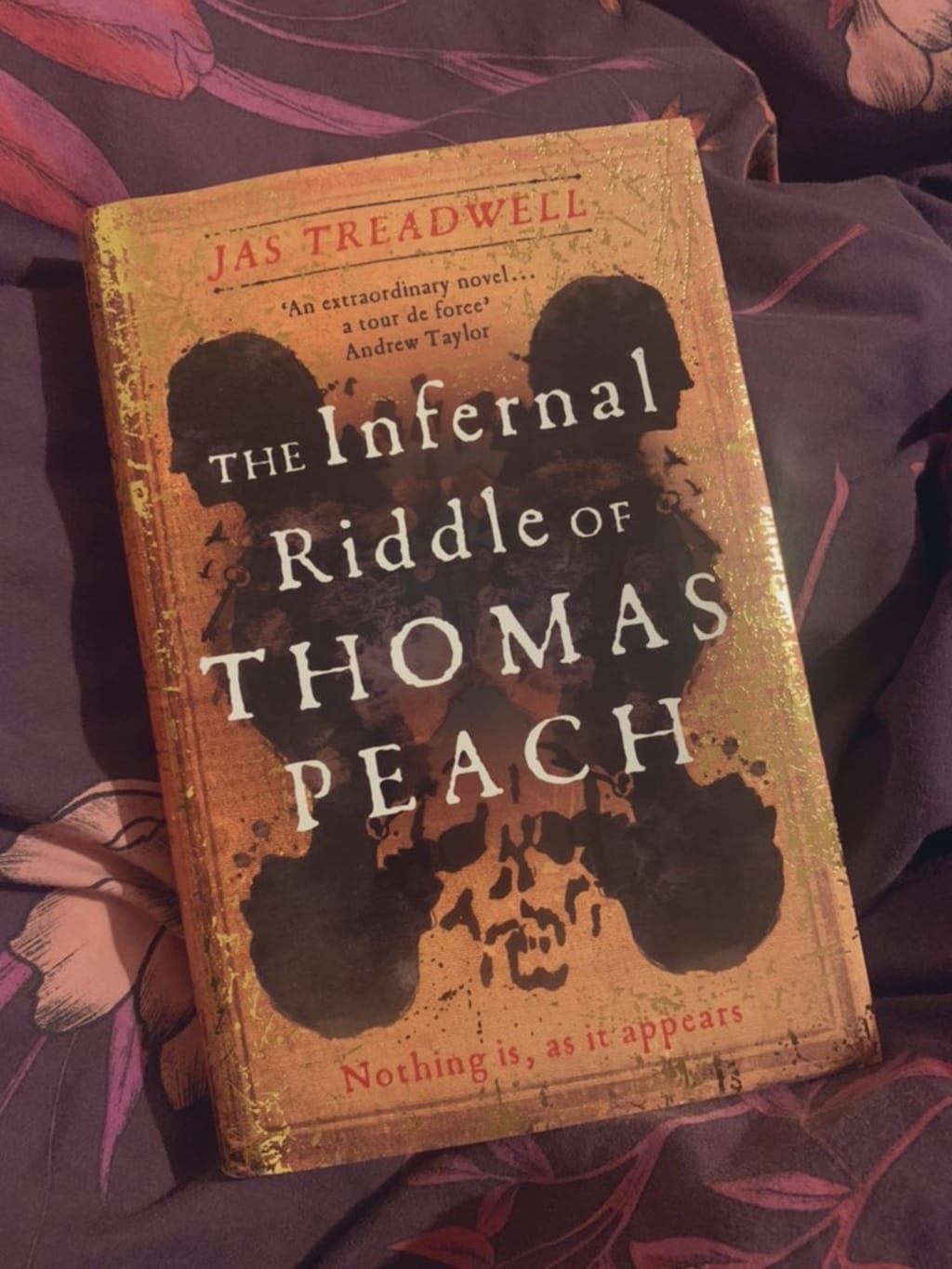
There is something in Victorian and Georgian literature that keeps the audience coming back over and over again. From Mary Shelley's Frankenstein all the way to Bram Stoker's Dracula - the literature of these eras includes theories about science vs. the personality, monstrosity, secrecy and sensationalism. I myself have always been fascinated by how secrecy works in these era as my favourite novel of all time, The Picture of Dorian Gray depends on it for survival. Secrecy and sensationalism are possibly best put forward in the books by Mary Elizabeth Braddon. Her books Lady Audley's Secret and Vixen being the most prominent for the themes.
But from the secret surrounding a twisted doctor in Dr. Jekyll and Mr. Hyde to a sound and fury of a monster in Frankenstein, from the attic-based secrets of The Picture of Dorian Gray and Charlotte Bronte's Jane Eyre to the previous workers in The Turn of the Screw - I think it is safe to say that for over one or two hundred years, we as readers have enjoyed secrecy and more importantly, how this secrecy can destroy every part of our being. The theme of secrecy and sensationalism is definitely true for this Georgian/Victorian based gothic story entitled: The Infernal Riddle of Thomas Peach.
The entire aspect of Victorian and Georgian English secrecy and sensationalism are well-explored through the character development of Thomas Peach. The more we learn about him, the less we trust him. The more we learn about the gossip surrounding him, the less we trust him. This is a definite plus for the novel and I think, if it was written slightly differently, it would have been a higher marker in my books. Let's though, have a look at why it faltered...
Thomas Peach is a topic of gossip around Georgian England. Filled with archaic language, it really does put you in the moment of the novel. The atmosphere is just right for establishing this whimsical gothic, the only thing that lets it down is that it is very difficult to really sink your teeth into. Gothic novels normally have a very simple narrative style to them, allowing the reader to get lost in the prose. Unfortunately for The Infernal Riddle of Thomas Peach - the narrative style can get too much from time to time. But, that being said - that does not mean it is in any way 'bad' - it just simply is not a style I am used to when it comes to the gothic.
Nobody knows whether his 'wife' really exists when he exits the scene to go and live with her, tend to her and care for her through illness. She has never been seen, never leaves the house and is not known through society like he is, though they are married. Sometimes I do think about this. What I think about is that when Thomas and his wife would have been first married and he, a wealthy man, she would have been known in society for the fact that she is marrying a rich man. This is the purpose of the female socialite. The recluseness in the novel may be given to illness, but that doesn't explain why nobody knows who she is and has not even seen her. Even if the marriage was a small-time affair, there must be someone who knows who she is. I found this idea a bit unbelievable given the circumstances of Thomas Peach himself.
Talking more about the narrative, I felt like the whimsical nature was a tad bit overdone. The whole aspect of the 'riddle' is all well and good, but the narration by this third person is sometimes too full of words, almost sounding more resonant of a circus show than a gothic novel. Aspects of the narration seem to have required further editing and on the whole, it was pretty well done - but it doesn't allow you, as I say again, to get completely lost in the prose. The reader remains at the surface, which makes for an underwhelming read at most.
In conclusion, though I enjoyed the idea of this book, it could have been better executed in a darker, more twisted gothic sense rather than overtly trying to be something it is not. The sad thing is that as I have said, you cannot lose yourself in the prose and ideas of the novel, and yet I think that the very loss of self was what the author was trying to create.
About the Creator
Annie Kapur
I am:
🙋🏽♀️ Annie
📚 Avid Reader
📝 Reviewer and Commentator
🎓 Post-Grad Millennial (M.A)
***
I have:
📖 280K+ reads on Vocal
🫶🏼 Love for reading & research
🦋/X @AnnieWithBooks
***
🏡 UK
Keep reading
More stories from Annie Kapur and writers in Geeks and other communities.
Book Review: "The Hiding Place" by Amanda Mason
Ghost stories are always good this time of year. From the start of October all the way through to just after New Years' - ghost stories really do get under your skin when the weather is colder. I like to re-read books like The Haunting of Hill House and The Turn of the Screw to definitely get me in the mood for Halloween and then, the cold and strange aura of Christmas. When we talk about the 'ghost story' most of us think of the Victorian Era and yet, books such as The Haunting of Hill House (which indeed, is missing some physicality when it comes to ghosts, but is a haunting nonetheless), Peter Straub's Ghost Story, and Susan Hill's chilling Christmas Eve which starts The Woman in Black - are all written in the modern era.
By Annie Kapur4 years ago in Geeks
Silver Screen Magic with Mae West
American actress and singer Mae West became a popular film actress during the Great Depression. She started entertaining in vaudeville, then performed on Broadway, and finally went to Hollywood. She signed up with Paramount Pictures and made her debut in the 1932 film “Night After Night.” She also starred in musicals, comedies, and crime dramas. The American Film Institute named her one of the best classic Hollywood actresses.
By Rasma Raisters5 days ago in Geeks




Comments
There are no comments for this story
Be the first to respond and start the conversation.