
Book Review: "The Hunter and the Whale" by Laurens Van Der Post
5/5 - fantastic, deep and philosophical - complete with immersive sensory descriptions

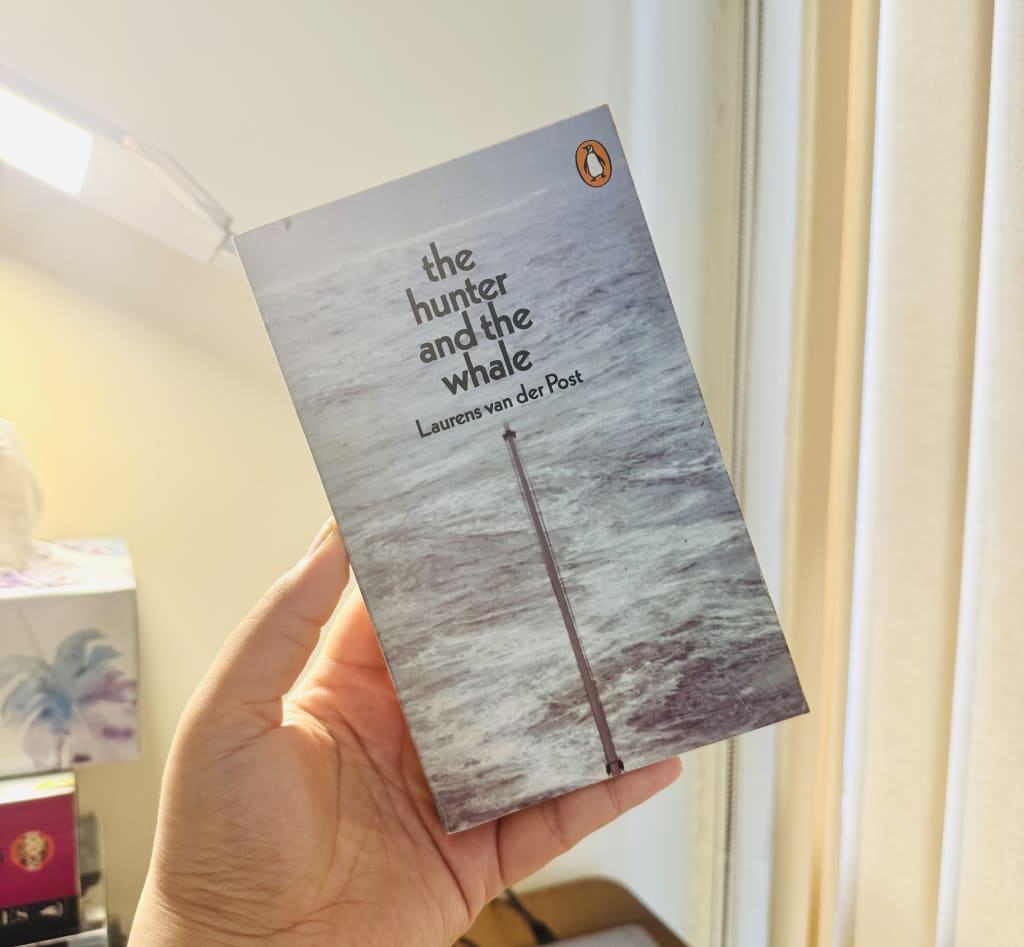
You are perhaps bored of reading about me going through old Penguin books and reading them but, perhaps you will indulge me on the reason why. Well, it's the Christmas Season which means my money is depleting quite quickly. This means that maybe I cannot afford to buy too many books at the moment and most of the ones I am buying are discounted on Kindle or they are used books from other sites. But these books that I am eating through at the moment are the orange Penguin Books I found in my mother's house and so, they don't cost me a thing. I was simply allowed to pick up whatever I wanted and take it with me. For this, I am grateful. This book is called The Hunter and the Whale and prepare yourself for some beautiful writing.
The novel centres on the character of Jakob van der Merwe, a South African of Dutch descent, whose life is steeped in the traditions and lore of the sea. Jakob is the captain of a whaling ship, a position that embodies his mastery of both man and nature. His stern yet introspective personality reflects a man deeply committed to the craft of whaling, which he sees not merely as a profession but as an ancient and noble pursuit. Jakob’s connection to the sea is almost mystical, and he carries with him the weight of ancestral traditions, deeply embedded in the rituals and ethics of the hunt. There's something deeply descriptive and atmosphere about this opening which also opens the ethical arguments made throughout the course of the book. The introspection is beautiful and filled with moral philosophies. It seems almost Kierkegaardian at times.

As the narrative unfolds, Jakob’s ship sets out on a whaling voyage, and the crew becomes a microcosm of broader human tensions. The men aboard the ship represent a variety of backgrounds, beliefs, and ambitions, creating a microcosm of human society. Among them is Johnny, a young crew member who serves as a counterpoint to Jakob’s worldview. Johnny is eager, impressionable, and deeply curious about the natural world, embodying a new perspective on humanity’s place in nature. This deep curiosity of the natural world opens up the themes of ecology and environment which also litter the novel's philosophies. It is wonderful to delve into and immerse yourself in.
The central conflict of the novel emerges as Jakob grapples with the changing perceptions of whaling in a world increasingly aware of the destruction it entails. The majestic whale, both prey and symbol, becomes a powerful presence in the story. For Jakob, the whale is more than a creature to be hunted; it is a representation of the sublime forces of nature, a being that commands both reverence and fear. The act of hunting the whale is depicted with a sense of ritualistic gravity, blending the practicalities of the chase with philosophical and spiritual overtones. The destructive qualities of whaling have this impression on the mentalities of the main characters and this is what makes the changing introspections really compelling and deeply moving. The characters are in deep emotionally strife and even though not a lot takes place in these times - we get to see inside the mind and have our own judgements.
As the voyage progresses, the physical and emotional challenges of the hunt expose deep fractures within the crew and within Jakob himself. The brutality of whaling becomes increasingly difficult to reconcile with the reverence Jakob feels for the sea and its creatures. His reflections grow more profound, questioning the morality of taking life and the implications of humanity’s dominion over nature. Jakob’s internal conflict is mirrored by the growing unease among his crew, who begin to question their purpose and the toll of their actions. This is a familiar question that happens in Moby-Dick and that is probably why we are so drawn to it. We know it is wrong to go whaling, but we have to wait for the characters to do through their emotional turmoil and have that moment of realisation.
All in all, Laurens van der Post’s writing is infused with a deep respect for both nature and the human spirit. The narrative blends lyrical descriptions of the sea and its creatures with philosophical musings on the nature of existence. The novel’s setting, rich with the sensory details of the ocean and the traditions of whaling, serves as both a physical and metaphorical landscape for Jakob’s journey of self-discovery. I absolutely adored it.
About the Creator
Annie Kapur
I am:
🙋🏽♀️ Annie
📚 Avid Reader
📝 Reviewer and Commentator
🎓 Post-Grad Millennial (M.A)
***
I have:
📖 280K+ reads on Vocal
🫶🏼 Love for reading & research
🦋/X @AnnieWithBooks
***
🏡 UK
Reader insights
Nice work
Very well written. Keep up the good work!
Top insights
Eye opening
Niche topic & fresh perspectives
Heartfelt and relatable
The story invoked strong personal emotions
Keep reading
More stories from Annie Kapur and writers in Geeks and other communities.
The Rachels - 2025
Much to my surprise, I have kept a list of the films I‘ve seen this year. I daresay it isn’t complete. There will be films that snuck in on a late night in front of the TV that I would’ve forgotten to note. Or others, that I went to watch at the cinema, but then had a red wine and promptly forgotten about. But it’s not a bad approximation of the films I’ve seen this year. In total, there are 53 films listed, so an average of one a week and one for good luck.
By Rachel Robbins26 days ago in Geeks
Kartik Aaryan suffers first major setback after minor dating controversy
Kartik Aaryan recently suffered first major setback after getting caught in a controversy of dating a minor. It all started when the 35-year-old actor’s newly released film, Tu Meri Main Tera Main Tera Tu Meri, became a box office bomb.
By Dena Falken Esq5 days ago in Geeks


Comments
There are no comments for this story
Be the first to respond and start the conversation.