
Book Review: "The Genius of Shakespeare" by Jonathan Bate
5/5 - after many reads, I still have a soft spot for this book...

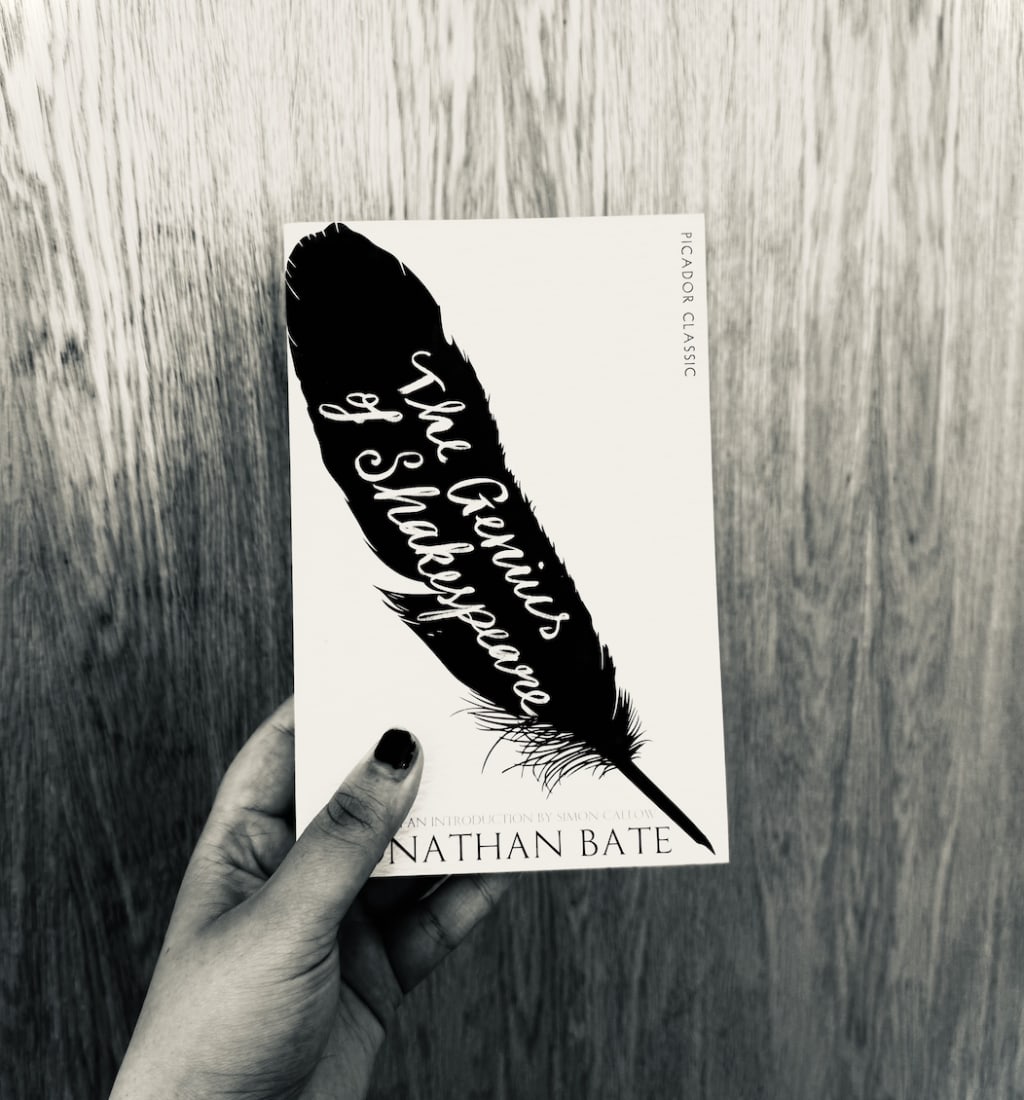
I have had this book for years. It's true that when your mental health is bad, you should read Shakespeare or at least, something about him. It's March 2025 and I'm going full circle back to books I've read in the past. The last time I read this book was perhaps a few weeks before writing this review but, I have read it many times over the course of my degree and that was nearly ten years' ago now. If you think 'I can't read Shakespeare Literary Theory because I didn't do a literature degree' I want you to eject that thought from your mind because there is absolutely no reason you can't do it. It's like I always say, even if you read a paragraph a day and you finish the book in ten or fifteen years - you still read it. So if you want to read it, go ahead. There's no competition and you have your entire life to do it. That time will be wisely spent! Now on to the review...
Jonathan Bate begins by exploring the concept of Shakespeare’s “genius” and how it has been understood over time. He argues that while Shakespeare is widely regarded as the greatest writer in the English language, this reputation is not simply due to innate brilliance but also to his adaptability, deep understanding of human nature, and skillful use of language. Bate challenges the idea of genius as a purely mystical or intellectual quality and instead presents Shakespeare’s success as a result of his responsiveness to his audience, his mastery of dramatic form, and his ability to synthesise different influences into something original and enduring. I like this because of Jonathan Bate's ability to rationalise Shakespeare's intelligence. Shakespeare, I believe, was intelligent because of his amazing perspective on human nature. This is why his plays often feel very real even though they can have these storylines that make people realise how ridiculous they are. Take Twelfth Night for example. There's so much to analyse but there are also these smaller sub-plots which make us as humans look fragile and ridiculous. But we still empathise with it because we accept that we are humans.
Bate discusses how Shakespeare built upon classical and contemporary sources, rather than writing in isolation. He highlights how the playwright borrowed freely from Roman literature, particularly Ovid and Seneca, as well as from English and European history, mythology, and popular culture. Shakespeare’s originality, Bate argues, lay not in inventing entirely new plots but in his ability to transform existing material into something richer, more psychologically complex, and more theatrically compelling. The book positions Shakespeare as both a literary artist and a practical playwright, conscious of what would captivate an audience. I think people who say 'Shakespeare stole x,y or z storylines' are very strange because it was never a secret that Shakespeare used other stories to base his plays upon. I'm not sure what point they are trying to prove - or maybe they just thought it was a secret. This is why it's always a good idea to read upon the subject. It's not only not a secret, it is something that we Shakespeare fans love him for.
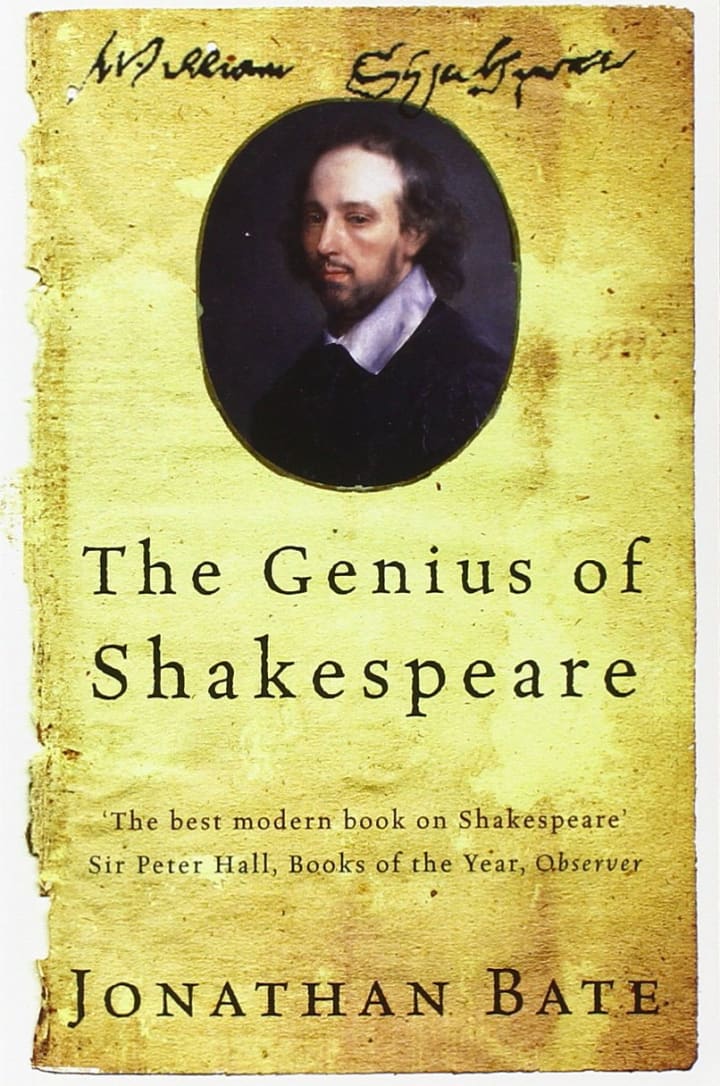
A major theme in The Genius of Shakespeare is the playwright’s unparalleled insight into human psychology. Bate argues that Shakespeare’s characters are so compelling because they embody contradictions and inner conflicts that make them feel real. Unlike earlier playwrights, who often relied on stock characters or moral archetypes, Shakespeare gave his characters depth, nuance, and the capacity for self-reflection. He explores how figures like Hamlet, Macbeth, and Lear express complex emotions and existential dilemmas that remain relevant across centuries. This, Bate suggests, is one of the reasons why Shakespeare’s work continues to resonate with audiences today. I love the existential dread presented in Shakespeare's plays. It is something I teach a lot when I teach Macbeth. The speech Macbeth makes after he discovers his wife has died is a fantastic meta-narrative of how people live their lives on a stage. Then we have the 'play's the thing' from Hamlet and of course As You Like It has 'all the world's a stage'. Shakespeare literally uses language of the stage to present the existential dread and limitations of life that characters experience.
A crucial argument in the book is that Shakespeare’s plays were written primarily for performance, not for private reading. Bate explores how the physicality of the theatre, the expectations of Elizabethan audiences, and the constraints of the stage influenced Shakespeare’s dramatic choices. He also discusses how different directors and actors have reinterpreted Shakespeare over the centuries, ensuring his continued relevance. The book highlights that while Shakespeare’s works are often studied as literature, they only reach their full potential when performed, with actors bringing new dimensions to his language and characters. This is something that I have thought about every single day. Each time I teach Shakespeare I always get worried about the fact that they are teaching it wrong at school and perhaps that is the reason many students don't actually like learning Shakespearean plays.
All in all, this book gives us a lot to think about when it comes to who Shakespeare was, the way he wrote his plays and the way we understand his plays today. It is a great analysis of all the different turns we can see when we think of why we continue to be mystified by his incredible perspectives on the human condition.
About the Creator
Annie Kapur
I am:
🙋🏽♀️ Annie
📚 Avid Reader
📝 Reviewer and Commentator
🎓 Post-Grad Millennial (M.A)
***
I have:
📖 280K+ reads on Vocal
🫶🏼 Love for reading & research
🦋/X @AnnieWithBooks
***
🏡 UK
Keep reading
More stories from Annie Kapur and writers in Geeks and other communities.
Book Review: "Bat Eater" by Kylie Lee Baker
This book has been quite literally everywhere. I've seen it on Amazon, on social media and even in real life. I've wanted to read it for a while but obviously, had to wait for it to become a price I could afford. Finally, it came down to something reasonable and I got it on my Kindle. Not able to sleep, I stayed up to read this book and honestly it was hilarious, underlined with deep social commentary and I think I saw a lot of myself in the young Cora at the beginning of the book. I would highly recommend everyone who wants a huge ride through the pandemic in a whole different way to read this book. It is fantastic.
By Annie Kapur9 months ago in Geeks
Silver Screen Magic with Mae West
American actress and singer Mae West became a popular film actress during the Great Depression. She started entertaining in vaudeville, then performed on Broadway, and finally went to Hollywood. She signed up with Paramount Pictures and made her debut in the 1932 film “Night After Night.” She also starred in musicals, comedies, and crime dramas. The American Film Institute named her one of the best classic Hollywood actresses.
By Rasma Raisters6 days ago in Geeks
The Devil's Cut
“Comrade, finally you’re awake.” The voice was smooth, sensual. A flickering incandescent bar was all that lit the white, sterile room. All Vladimir remembered was everything going black. He tried to move his arms and found them strapped to the gurney.
By Matthew J. Fromm6 days ago in Fiction


Comments
There are no comments for this story
Be the first to respond and start the conversation.