
Book Review: "The Florentines" by Paul Strathern
5/5 - a fantastic account of the best Florentines...

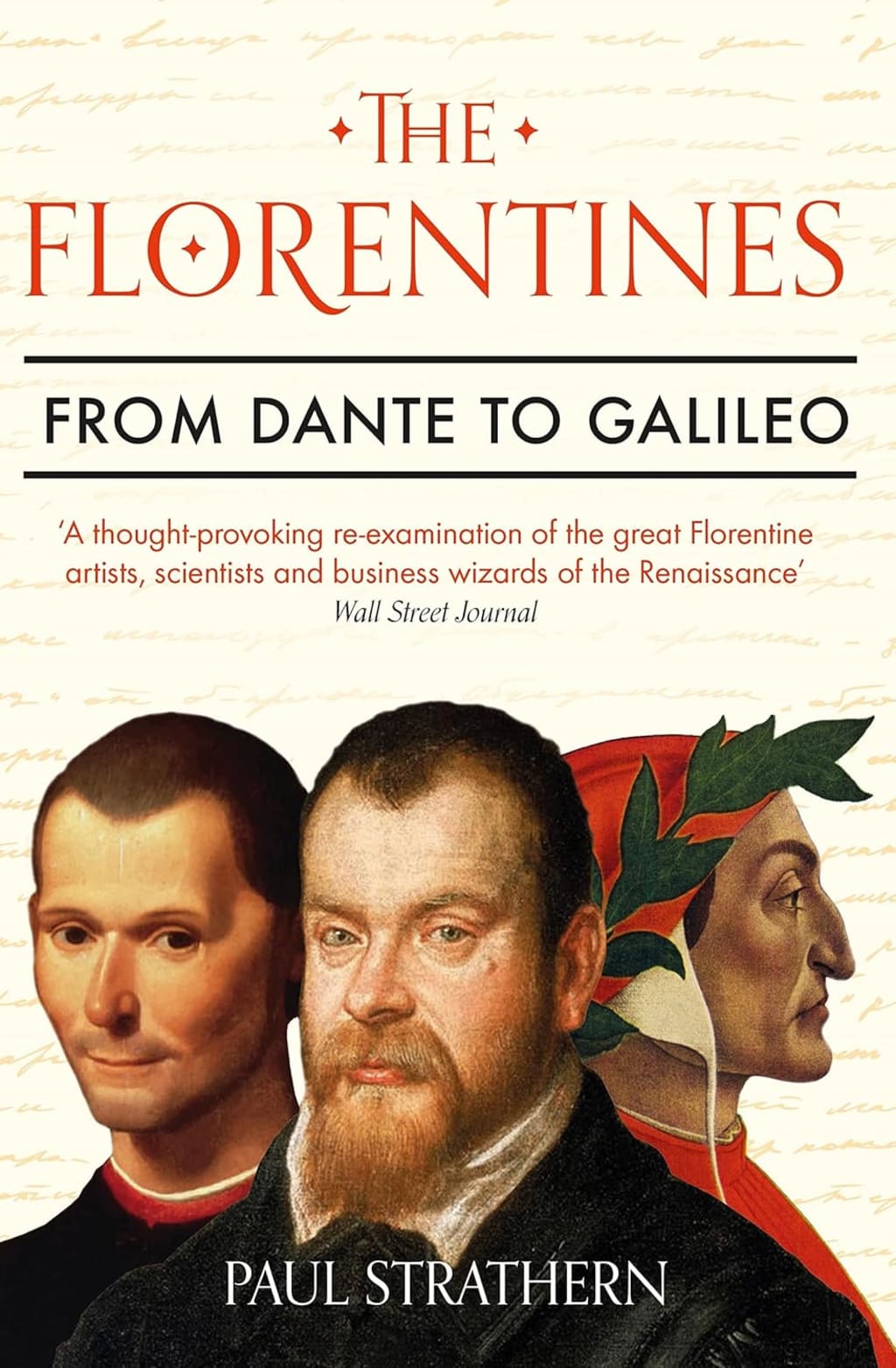
Full Title: The Florentines: From Dante to Galileo by Paul Strathern
After reading the wonderful book The Grammar of Angels, I wanted something else rather Renaissance as well. Fun fact here: when I was in university, I read quite a few books to do with the artist Caravaggio, such as the biography by Andrew Graham Dixon, and a book called M by Peter Robb. I'd also read quite a bit about Raphael for no reason whatsoever but here we are today. The Grammar of Angels quite surpasses all the books I've just written about and this one I'm about to review, however I never would have found this read if it were not for Edward Wilson-Lee's brilliant guidance into the Renaissance.
It's no doubt that Florence was basically the centre of the world during the Renaissance and the Late Middle Ages. We have got the fact that it was prosperous, the geography was just right and the religious and cultural bounds were expanding. We get some analysis of the banking systems, the way in which politics promoted ideas and discussion and the fact that the geography meant Italy was uniquely placed by the Middle East, Africa and Europe in order to receive all of this unique information. Honestly, I've read about the Renaissance for a while and this is still fun for me.
One of the first people he goes through is Dante and it looks at his decision to write the Divine Comedy in Italian dialect (Tuscan) rather than in Latin. This choice not only made literature more accessible but also laid the foundation for the Italian language and the author covers both of these sides in his writing. The author delves into the political exile of Dante, looking at not only his life but how after his death, Ravenna chose not to return his bones due to the mistakes Florence had already made. It is clear that the exile of Dante is a dark stain on Florence's history and when we look at the futher chapters considering Boccaccio and Petrarch we see that these men learnt from their master, Dante - and though Petrarch was also exiled, also taught themselves to live outside the lines. This is what made them great.
On my undergraduate degree, I wrote my dissertation about Dante, Boccaccio, Petrarch and Chaucer and so, I already knew my fair share when coming to this book. I would say you don't have to read the works by these people before coming to the book, but perhaps have a good idea of what you are about to lead yourself to. It is not only a story of exile, but these were the original political dissidents. They wanted nothing more than to see Florence prosper and they were punished because of it. Boccaccio may have run from the plague, but Petrarch and Dante didn't do anything really wrong - they just didn't want their city falling into the wrong hands.
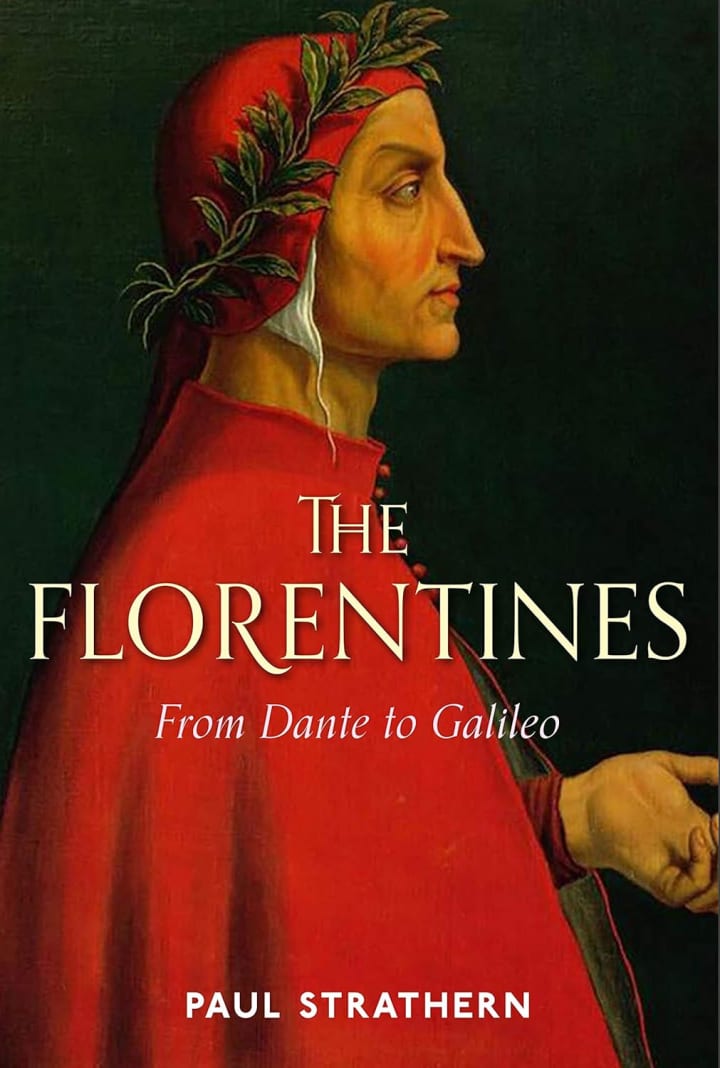
Another chapter I quite enjoyed (and I had already read of the person involved before though, not much) was Filippo Brunelleschi - the man who created that wonderful dome in Florence. It was the dome of Santa Maria del Fiore and showcased this brilliance in engineering that had not yet been seen before in the city. The author brings the man to life, looking at his troubles, how he got over hurdles and made him feel very much like a person who once existed. I haven't read anything quite like that about such a famed and distant figure before. Even though everyone tries to humanise Dante - I was yet to see someone humanise Brunelleschi. It was brilliant.
There's a chapter on Machiavelli, and as many of you know, I've written my fair share about Machiavelli here and whilst I was at university. The author looks at his pragmatic approach to power and governance. He explores Machiavelli's political career, his observations of Florentine politics, and how his writings reflect the turbulent times he lived in - often delving into how they have impacted politics today. But the one thing I think I enjoyed about this chapter the most is that it seems to subvert the opinion of Machiavelli that has plagued the public consciousness. Believe it or not, Machiavelli was not an arch-baddie of any kind.
There are many other people included in this book. They are, but not limited to: Girolamo Savonarola, Michelangelo Buonarroti and Leonardo Da Vinci. All I'm saying is that if you want to learn about Florence and it's great people then this is definitely the book you should go for. And then, obviously, go for The Grammar of Angels by Edward Wilson-Lee.
About the Creator
Annie Kapur
I am:
🙋🏽♀️ Annie
📚 Avid Reader
📝 Reviewer and Commentator
🎓 Post-Grad Millennial (M.A)
***
I have:
📖 280K+ reads on Vocal
🫶🏼 Love for reading & research
🦋/X @AnnieWithBooks
***
🏡 UK
Keep reading
More stories from Annie Kapur and writers in Geeks and other communities.
Book Review: "Here One Moment" by Liane Moriarty
It's June and for some reason I'm choosing to read those books that have been stuck on my Kindle for ages and I've just missed somehow. Unfortunately, Here One Moment by Liane Moriarty is one of them. I can understand why. It's buried within some horror novels I was reading and thus, got lost in the noise. However, I feel like I have partially redeemed myself by eventually getting stuck in. This one had an odd storyline and I apologise for not having an interesting discovery story because I genuinely don't know how I found this one. Nonetheless, it is a pretty good read and I haven't really read a thriller like it before.
By Annie Kapur8 months ago in Geeks
Silver Screen Magic with Mae West
American actress and singer Mae West became a popular film actress during the Great Depression. She started entertaining in vaudeville, then performed on Broadway, and finally went to Hollywood. She signed up with Paramount Pictures and made her debut in the 1932 film “Night After Night.” She also starred in musicals, comedies, and crime dramas. The American Film Institute named her one of the best classic Hollywood actresses.
By Rasma Raisters7 days ago in Geeks
How Much Money Has Been Spent on Oak Island?
For over two centuries, treasure hunters have poured time, money, and hope into Oak Island’s murky depths. But since the debut of The Curse of Oak Island on the History Channel, that investment has grown from modest digs to multi-million dollar excavation projects involving cutting-edge technology, massive drilling rigs, and full-scale operations. So how much money has actually been spent chasing the elusive treasure beneath Nova Scotia’s Oak Island?
By Rukka Nova4 days ago in Geeks
Smart phones, Humans and Aliens.
WARNING. I will be tapping into one of your favorite creative tensions: The absurdity of humans worshipping their glowing rectangles as if they were tiny oracles. There’s something deliciously poetic about that contradiction, and it lends itself beautifully to an instructive proviso.
By Novel Allen4 days ago in Poets


Comments
There are no comments for this story
Be the first to respond and start the conversation.