
Book Review: "The Enlightenment" by Ritchie Robertson
5/5 - a thoughtful masterpiece on human progress...

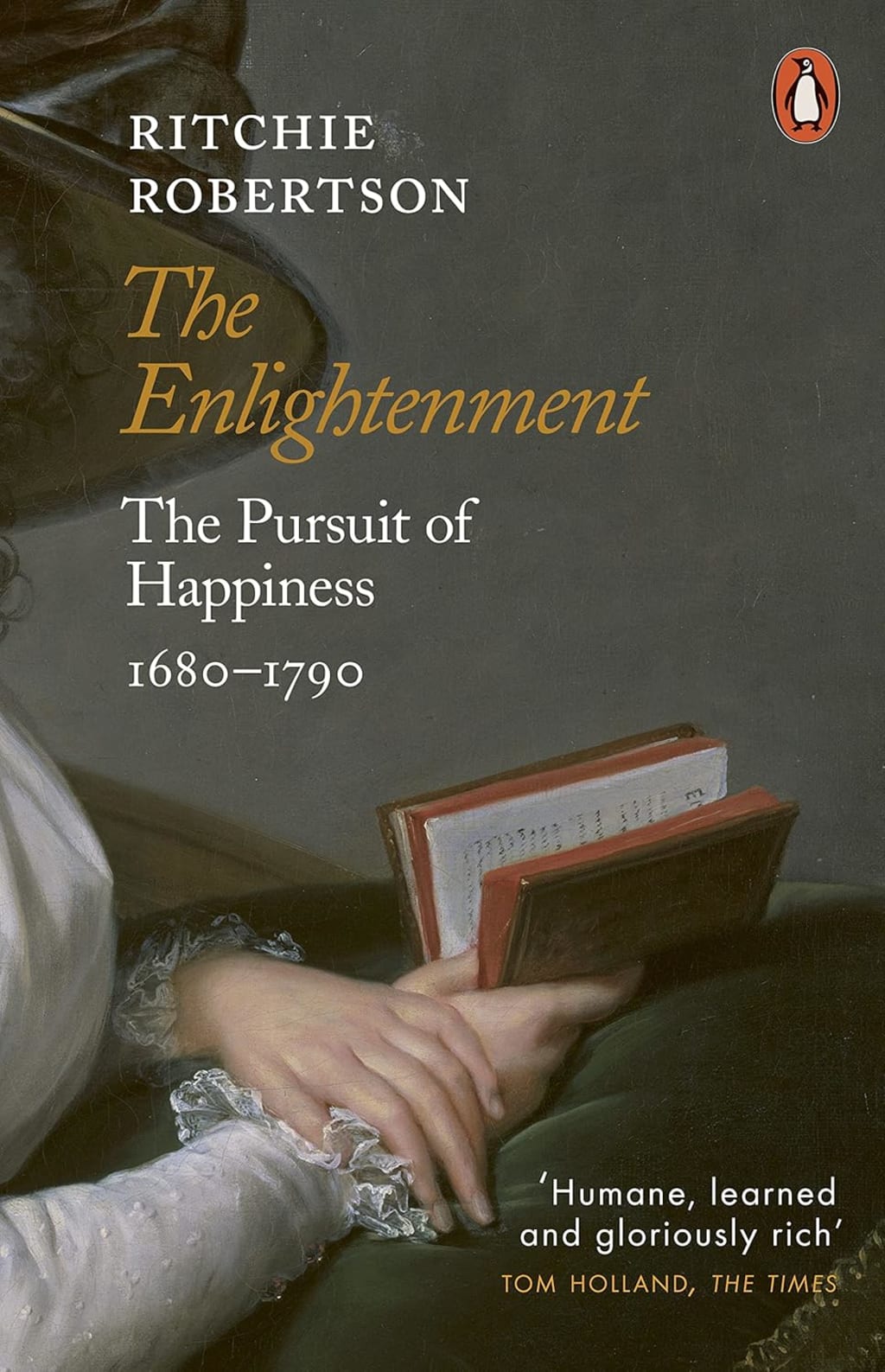
“To them, happiness was not, as it often is in present-day discussions, simply a subjective state, such as might be induced by chemicals; it meant attaining the preconditions for personal happiness, including domestic affection, material sufficiency and a suitable degree of freedom.”
- The Enlightenment by Ritchie Robertson
The reason why I read this book was because of the requirement to read something intellectual to stimulate my brain but also, read something on a topic I would say I know somewhat a little bit about. The book is long, sometimes it is dense but it is still worth the read. There is something about the Enlightenment that creates a certain amount of contradiction - well, that's how I see the era anyway. I was glad to see my point of view taken as one of the perspectives in the book and so, I can say that I enjoyed it. It is a great and marvellous achievement of nonfiction.
Robertson portrays the Enlightenment as a transnational movement, extending beyond the well-known French philosophes like Voltaire, Diderot, and Rousseau. He sheds light on intellectual developments across Britain, Germany, Italy, the Netherlands, and Scandinavia, emphasizing the exchange of ideas between these regions. Robertson’s approach underscores the diverse and interconnected nature of Enlightenment thought, demonstrating how intellectual networks crossed national borders and were fuelled by advances in communication and the rise of a European “Republic of Letters.”
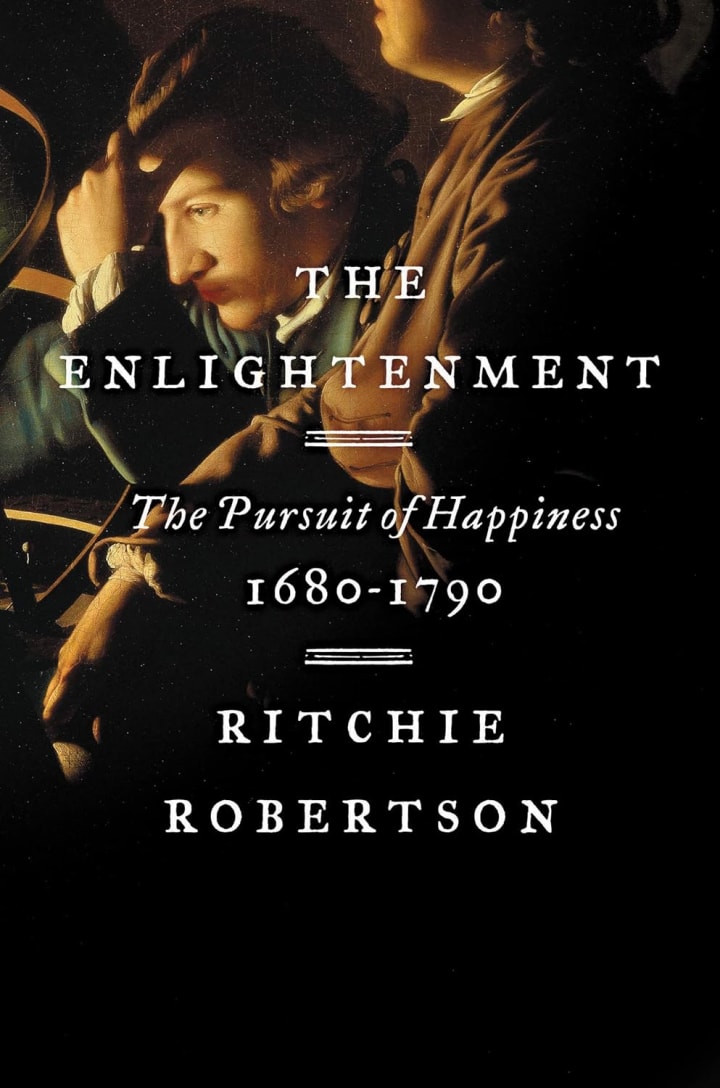
One of Robertson’s most striking arguments is that the Enlightenment was fundamentally a project aimed at enhancing human happiness. This marked a departure from earlier eras that prioritized salvation or moral duty. Robertson connects the Enlightenment to the idea of human flourishing (eudaimonia), tracing how philosophers and political thinkers believed that improving individual and collective happiness could be achieved through reason, science, and progressive social reforms. Thinkers like Bentham, with his principle of utilitarianism ("the greatest happiness for the greatest number"), come to the fore as emblematic of this philosophical shift.
The book provides a thorough examination of the historical backdrop against which Enlightenment ideas emerged, including wars like the Thirty Years’ War and the Seven Years’ War, which caused widespread social disruption and prompted thinkers to reimagine political and social order. Robertson argues that the Enlightenment cannot be separated from its context of economic transformations, urbanisation, and the emergence of a bourgeois public sphere, all of which created fertile ground for new ways of thinking about society, governance, and personal freedom.

Robertson highlights the Enlightenment’s significant shift toward religious tolerance, challenging the rigid religious orthodoxies of the time. He shows how thinkers like John Locke, Pierre Bayle, and later Voltaire championed religious freedom and argued against persecution. The book also covers the complex relationship between religion and Enlightenment thought, noting that while some thinkers sought to reconcile reason and faith, others, such as the deists and atheists, advocated for a complete separation of church and state, laying the groundwork for modern secularism.
The Enlightenment is often synonymous with the rise of science and reason, and Robertson offers a nuanced discussion of how thinkers like Isaac Newton and philosophers like David Hume and Immanuel Kant sought to apply empirical methods to both the natural world and human society. Robertson underscores how rational inquiry challenged established religious and political authorities, encouraging a worldview based on observation, experimentation, and critical thinking. The development of scientific academies and the spread of encyclopaedias were crucial in disseminating Enlightenment ideals to broader publics.

In contrast to traditional Christian ethics based on divine authority, Enlightenment thinkers sought to ground morality in human reason and empathy. Robertson discusses the works of moral philosophers like Adam Smith, whose Theory of Moral Sentiments highlighted the role of sympathy in ethical life, and Kant, who developed a moral philosophy based on the categorical imperative and the autonomy of reason. This new ethical framework focused on human relationships, societal well-being, and the idea that morality should serve human happiness, rather than obey religious commandments.
One of the Enlightenment’s most enduring legacies was its impact on political thought and revolutionary movements. Robertson provides a detailed account of how Enlightenment ideas influenced the American and French Revolutions, particularly through the writings of John Locke, Montesquieu, and Jean-Jacques Rousseau. He emphasises how these thinkers advanced concepts of popular sovereignty, separation of powers, human rights, and civil liberties, all of which directly challenged the absolute monarchies and feudal systems of the time. Robertson argues that the political upheavals of the 18th century were deeply intertwined with Enlightenment aspirations for a more just and equitable society.

Robertson importantly addresses how Enlightenment ideas were not confined to Europe. The movement had global consequences, influencing colonial policies and the spread of European ideals to places like the Americas and India. He also critically examines the darker side of Enlightenment thought, particularly in its relationship to imperialism and slavery. While many Enlightenment thinkers advocated for human rights and equality, some justified colonial exploitation under the guise of “civilising” missions. Robertson’s global perspective adds complexity to the Enlightenment, showing how its ideas were both liberating and, at times, complicit in systems of oppression.
All in all, I think that this book covers all the major points of the Enlightenment, all the things that happened towards it and the things that it led to afterwards. I will have to say though that if you're not already interested in the era, you're going to find this book difficult to give all of your heard and soul to as it truly is a masterly achievement of literature - it is really one of the best books I've read on the subject.
About the Creator
Annie Kapur
I am:
🙋🏽♀️ Annie
📚 Avid Reader
📝 Reviewer and Commentator
🎓 Post-Grad Millennial (M.A)
***
I have:
📖 300K+ reads on Vocal
🫶🏼 Love for reading & research
🦋/X @AnnieWithBooks
***
🏡 UK
Keep reading
More stories from Annie Kapur and writers in Geeks and other communities.
Book Review: "Homer and His Iliad" by Robin Lane Fox
I really wanted to read something literary without going back to just re-reading classics and so, this is where I picked up a book by the great Robin Lane Fox entitled Homer and His Iliad. Even though I may not agree with treating Homer as an actual human being as many scholars now accept that he was probably at least a group of people over a certain amount of time, it is still a pretty good book and explains in some extreme detail the ideas and theories of the book. If you ever want to learn about the Greek Dark Age and the Late Bronze Age then this is probably the best book to start with - readable and entertaining from time to time, Robin Lane Fox gives us a lot to chew on.
By Annie Kapurabout a year ago in Geeks
A System That Isn’t Working Challenge Winners
Systems promise order. They organize behavior, distribute opportunity, and suggest that if everyone follows the rules, things will work. The entries in A System That Isn’t Working look closely at what happens when that promise begins to slip.
By Vocal Curation Team4 days ago in Resources



Comments
There are no comments for this story
Be the first to respond and start the conversation.