
Book Review: "Homer and His Iliad" by Robin Lane Fox
5/5 - Fox delves into the world of Homer's epic, immersing us in the ancient cultures that inspire us still...

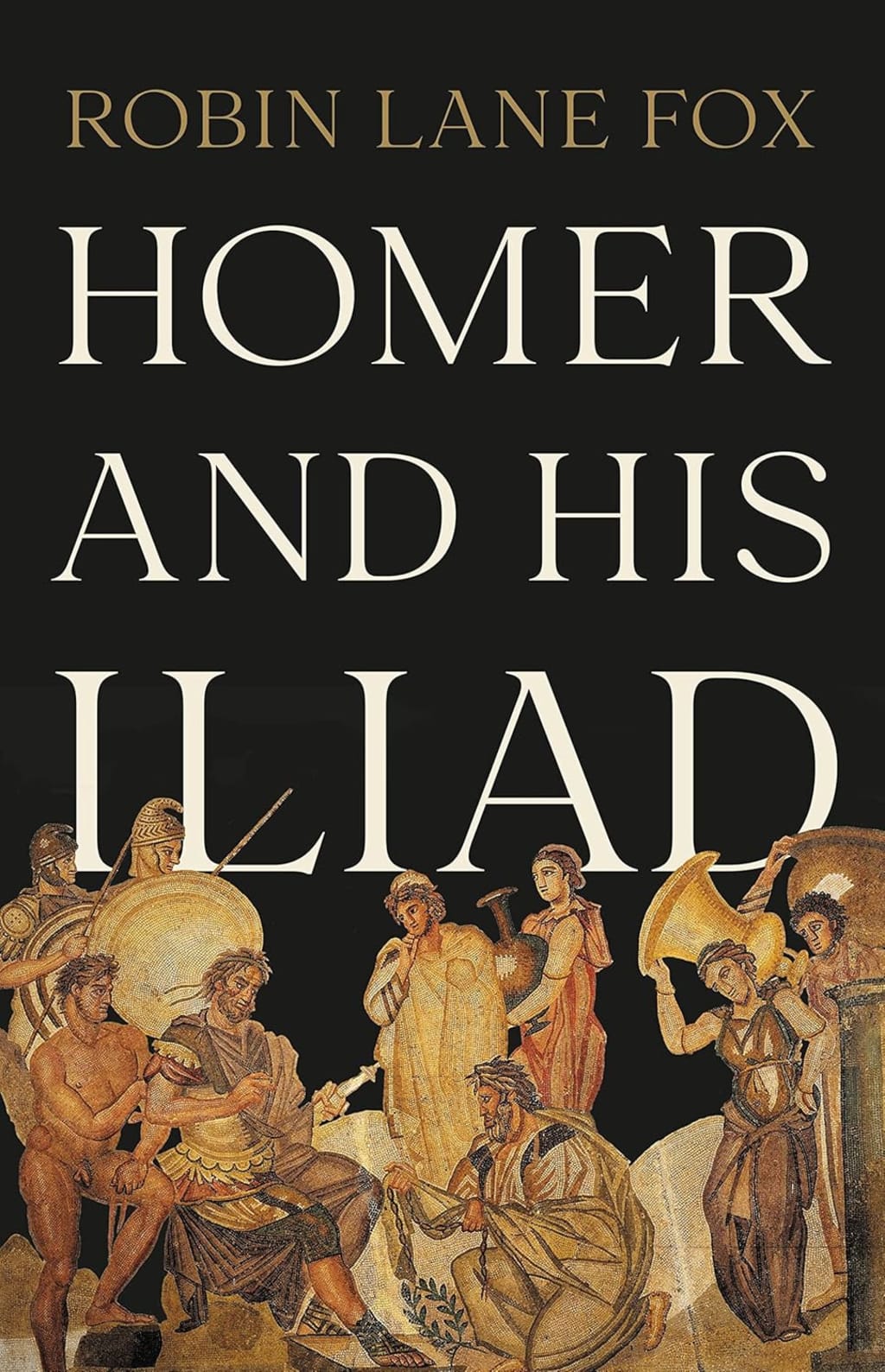
I really wanted to read something literary without going back to just re-reading classics and so, this is where I picked up a book by the great Robin Lane Fox entitled Homer and His Iliad. Even though I may not agree with treating Homer as an actual human being as many scholars now accept that he was probably at least a group of people over a certain amount of time, it is still a pretty good book and explains in some extreme detail the ideas and theories of the book. If you ever want to learn about the Greek Dark Age and the Late Bronze Age then this is probably the best book to start with - readable and entertaining from time to time, Robin Lane Fox gives us a lot to chew on.
Fox explores the historical backdrop of the Iliad, specifically the Late Bronze Age (circa 1200 BCE) and the world of the Mycenaean Greeks. He discusses the archaeological findings at sites like Mycenae, Troy, and other ancient cities, linking them to the descriptions in the Iliad. By doing so, Fox draws attention to the real-world foundations of the epic’s setting, particularly focusing on how elements of Homer’s world—palatial societies, warrior culture, and maritime trade—might have been influenced by historical events, such as the collapse of Bronze Age civilisations. The historical layers of the Iliad are teased out, showing how both oral tradition and subsequent retellings have mythologised what could have been a real conflict, like the Trojan War.
The question of Homer’s authorship is central to the author's discussion, as he navigates through centuries of scholarly debate. Was Homer a single poet, or the Iliad the product of many generations of oral tradition? Fox leans into the theory of an evolving oral tradition, where stories were passed down verbally through generations of bards, known as aoidoi, before being written down. He analyses how this oral tradition influenced the structure of the Iliad, with its repetitive phrases and formulaic expressions. Fox also considers the implications of Milman Parry’s groundbreaking research on oral-formulaic composition, showing how Homer’s language and poetic style are indicative of this oral tradition. The role of performance and the flexibility of the poem’s content in different recitations are also examined.
He gives a detailed account of the social, political, and economic organization depicted in the Iliad. He highlights the warrior aristocracy and the values that shaped Homeric heroes, such as timé (honor) and kleos (glory), explaining how these ideals were central to the self-conception of the Greek elite. The relationships between kings, warriors, and common soldiers are explored in depth, as well as the portrayal of slaves and women in the Homeric world. He connects these elements to the hierarchical structures of the Mycenaean world and later Greek society, showing how the Iliad reflects and reinforces societal norms, including the importance of wealth, lineage, and reputation.
The blending of myth and historical reality in the Iliad is a focal point in Fox’s analysis. He discusses the mythological underpinnings of the Trojan War, such as the involvement of the gods and legendary figures like Achilles and Helen, contrasting these with what we know of Bronze Age warfare and diplomacy. He critically examines how the Iliad blends history with fiction, presenting a larger-than-life conflict that incorporates elements of both myth and real-world warfare. He discusses whether the Trojan War might have been a real historical event and how much of Homer’s depiction aligns with the archaeological evidence at Troy and surrounding regions.
Fox pays significant attention to Homeric heroes, especially Achilles and Hector, analyzing their complex personalities and motivations. Achilles, for example, is shown as embodying the Greek ideals of heroism but also challenging them with his anger, pride, and eventual realisation of the futility of war. Hector, on the other hand, is depicted as a tragic hero who embodies the values of duty and familial loyalty, ultimately doomed by his confrontation with Achilles. He explores how these characters, and others such as: Agamemnon, Patroclus, and Paris, reflect the psychological and moral tensions of Homeric heroism. Then he discusses how the tension between individual glory and communal responsibility runs through the Iliad, shaping the fates of its characters.
Fox delves deeply into Homer’s literary style, analysing how the poet uses recurring phrases, epithets, and formulaic expressions that were characteristic of oral composition. He explains how these techniques helped bards memorise and perform the epic, as well as how they added to the rhythmic and aesthetic qualities of the poem. He also explores the use of similes, metaphors, and detailed imagery in the Iliad, which bring the characters and scenes to life with vividness and power. He emphasises Homer’s mastery of narrative pacing, from the grand scale of battle scenes to the intimate, personal moments of dialogue and reflection, illustrating the diversity and richness of the Iliad’s language.
All in all, I think there is a lot in this book to learn about the endurance of The Iliad and though you may or may not have read it, this is a good place to start if you have or have not. The detailed account of the historicity (or lack thereof) that Fox critiques is not just a testament to the impact of the text and its author upon the international literary cultures, but it is also a testament to how it still today has an impact upon our very souls. We would not bother otherwise.
About the Creator
Annie Kapur
I am:
🙋🏽♀️ Annie
📚 Avid Reader
📝 Reviewer and Commentator
🎓 Post-Grad Millennial (M.A)
***
I have:
📖 300K+ reads on Vocal
🫶🏼 Love for reading & research
🦋/X @AnnieWithBooks
***
🏡 UK
Keep reading
More stories from Annie Kapur and writers in Geeks and other communities.
Book Review: "Sonny Boy" by Al Pacino
I had been waiting for this book since last year and honestly, I don't think anyone is disappointed by this giant narrative about one of Hollywood's most beloved and talented megastars. One of the last true movie stars of his era to still be alive and working, Al Pacino is perhaps one of the most expansive actors with the most range. From the iconic Michael in The Godfather Trilogy to portraying Shylock and doing that incredible speech in The Merchant of Venice. From Dog Day Afternoon to his Oscar-winning performance in Scent of a Woman. When it comes to Al Pacino, nobody could possibly have anything bad to say about him and this book goes on to prove that and solidify his space in movie history as one of the greatest actors to ever live.
By Annie Kapurabout a year ago in Geeks
A Complete Guide to Decentralized Exchange Development for Modern DeFi Platforms
Decentralized finance has reshaped the way digital assets are traded, stored, and managed across blockchain ecosystems. At the center of this transformation are decentralized exchanges, platforms that allow users to trade cryptocurrencies directly from their wallets without relying on centralized intermediaries. As demand for transparent, secure, and user-controlled financial systems grows, businesses and blockchain startups are increasingly investing in Decentralized Exchange Development to build scalable trading ecosystems. These exchanges rely on smart contracts, automated liquidity mechanisms, and distributed governance models to enable secure and efficient transactions. This guide explains the essential components, technologies, and development considerations behind modern decentralized exchanges, offering a clear understanding of how these platforms function and why they have become a critical infrastructure layer within the broader DeFi landscape.
By Henry james4 days ago in Geeks




Comments
There are no comments for this story
Be the first to respond and start the conversation.