
Book Review: "The Collected Dorothy Parker" by Dorothy Parker
4/5 - if we ignore the often cliché poetry, this anthology is actually very good...

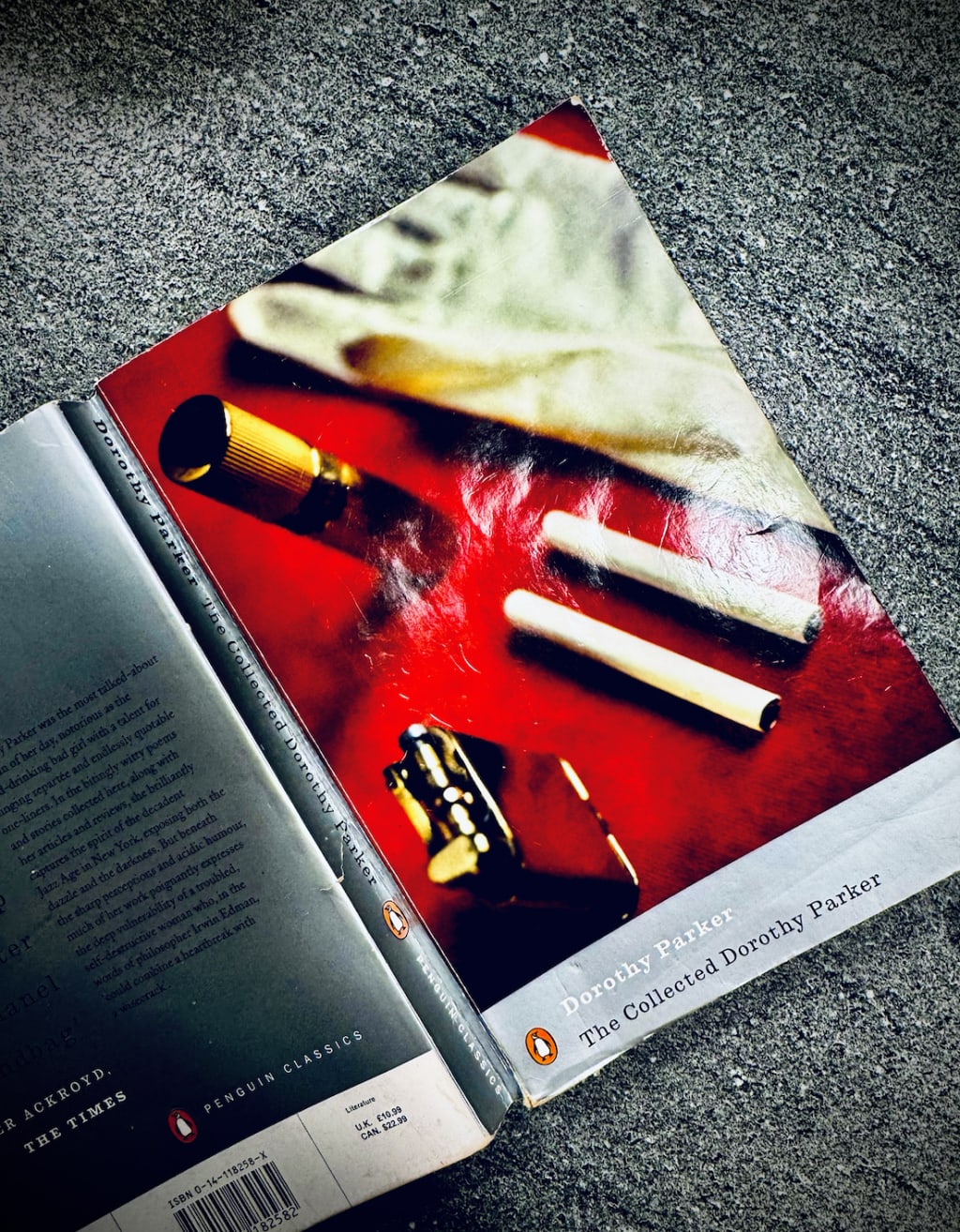
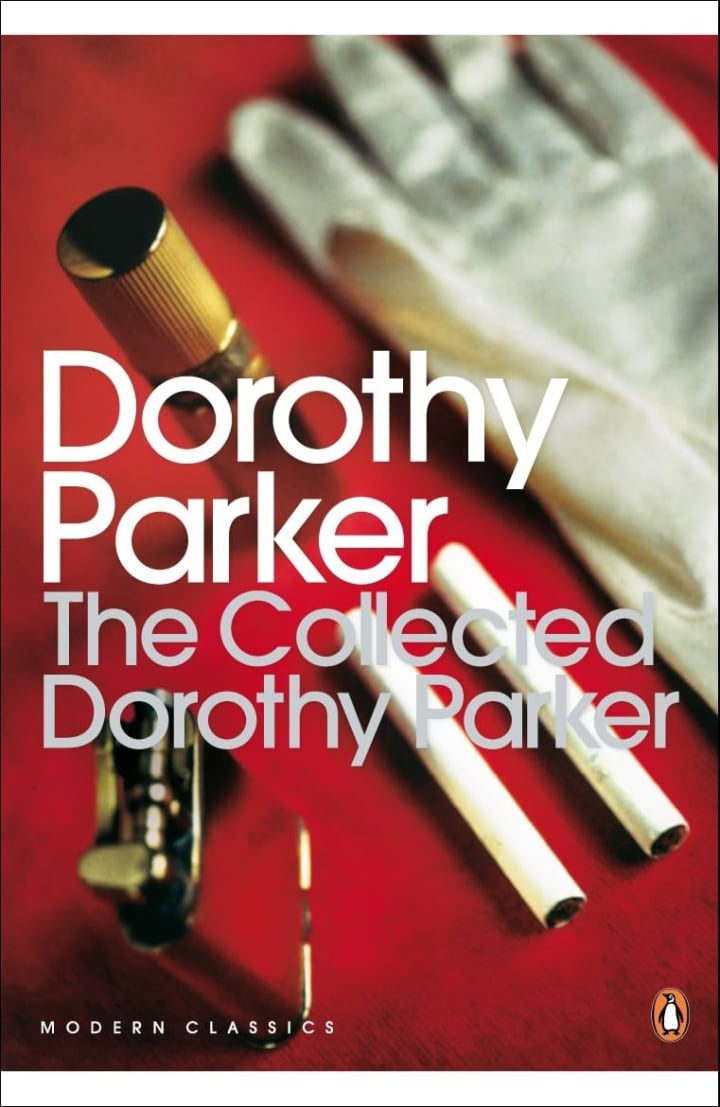
I'm not a big Dorothy Parker reader and have only read a tiny bit in my time. I am by no means a fan. I'm going to be very honest with you here. There was a deal on the online used bookstore and so, I needed a good, cheap book to add to the deal so I could get one of my books for free. I'm looking at doing the same thing but I'm not sure which book I want for free. Anyways, Dorothy Parker's stories have been more entertaining than her poetry (which I'm more on the fence about). So here we go: a review of The Collected Dorothy Parker. And let's keep it to the good stuff, shall we?
The Lovely Leave is a great way to open the anthology because it definitely sets the scene for the neurotic and slightly robotic women that Dorothy Parker is so good at writing. It's about a woman who is waiting to see her man and so she goes about making herself up and decorating the house with flowers and is clearly so excited and yet, agitated to see him. When he gets there, she notices he has not got his bags with him and so, he has to remind her that there is a war going on and so he has to leave again in less than an hour. After she almost cries, they have an argument and eventually he does actually leave. The story ends with an ambiguity relative to the state of the woman.
A Telephone Call is another one that is pretty intriguing mainly because it doesn't actually have a key storyline - instead it gives us the frantic internal monologue of one of these neurotic women wanting to phone a loved one and also wondering why the loved one has not phoned her. Back and forth, we see her thoughts go on whether to call or not until she quite literally starts to pray. In this story, Dorothy Parker uses a lot of repeated dialogue and apart from their being no actual plot to follow, there is also a lack of any other character. We get these momentary flashes of dialogue that has clearly been repeated or remembered from a conversation had, but mostly, it is our regular frantic female protagonist that is losing her mind about whether to make a phone call or not.
Big Blonde is another great story. It's about a woman who was once a model who, eventually approaching the age of 30 years' old, meets a man named Herb and settles down to get married to him. He though, doesn't really think she is a person. To him, she should just be a dizzy and fun blonde. However, eventually as her feelings towards her new situation and Herb's horrid drinking habit start to come out, she begins doing more crying than anything else. When they go out and she isn't any fun, he complains about her and eventually - I believe he gives her a black eye. Eventually he gets up and leaves for a job in Detroit, leaving her behind in New York. She is kind of relieved but then goes about going out every other evening with a number of other men. Now that she is approaching forty, it is more difficult to find a man to settle down with. Instead, she goes about with numerous awful men who all complain when she isn't all perked up.
She herself has developed a drinking habit to sleep things off, wishes she was dead a few times and even goes through the stages of getting some drug from New Jersey to help her rest. It is a horrific yet ironic story that is also set to our time about the way men expect women to be always happy and perky in their presence and that they can never just be themselves because it is never enough. It is a message to women everywhere that men don't want a woman with a personality, they want a fun, dizzy woman who will laugh at their jokes and otherwise, just shut up.
The last 'story' (as it is not really a story) I want to talk about is called The Little Hours which is about a woman who complains about the reading of various French writers, mostly that of Le Rouchefoucald (but also of Verlaine briefly, for about one line). We see the neurotic female character come out again, but this time in weird tangents. From reading Le Rouchefoucald begrudgingly, our protagonist then comments on how women always have to do what someone else wants without giving their own thoughts and opinions and how imaginary sheep should, in fact, be abl to count themselves as she is not their scorekeeper. This is all entrapped in the insomnia the protagonist feels and how she looks like she's been awake since circa.1650. The whole thing is one big metaphor for the way in which women always have to do whatever everyone else wants without consideration for themselves. It really is an insanely good narrative.
There are probably many more I could talk about but this is getting a little bit too long. Dorothy Parker's female narrators are brilliant works of their time. They are the increasingly anxious, the internal monologuing women of a universal time. They are the extended metaphors of what it means to be constantly beat down by the men around you and also reveal men's utter disdain for women. No matter how deep down it is buried, it is nearly always there. I mean, in the 1900s of course. Nowadays, I don't think every man (but there are a lot of them) have that kind of disdain and yet, expectation of women. It is ironic as it sounds stupid. Dorothy Parker reveals it all to us.
About the Creator
Annie Kapur
I am:
🙋🏽♀️ Annie
📚 Avid Reader
📝 Reviewer and Commentator
🎓 Post-Grad Millennial (M.A)
***
I have:
📖 280K+ reads on Vocal
🫶🏼 Love for reading & research
🦋/X @AnnieWithBooks
***
🏡 UK
Keep reading
More stories from Annie Kapur and writers in Geeks and other communities.
Book Review: "The Scent of Dried Roses" by Tim Lott
Used bookshops are all the rage if you've got a little bit of money in your pocket. Some books are as cheap as perhaps a few pounds and of course, therefore much cheaper than Amazon - including sometimes Amazon's digital borrowing service. I recently hankered around some used online bookshops and found a few texts that were sort of random. I'm going to admit I didn't read the backs of them before buying - I just bought ones that were cheap and on sale. This is the first of the books in that realm, about family, mental illness, suicide all set against a backdrop of an ever-changing Southall, London...
By Annie Kapur4 months ago in Geeks
Silver Screen Magic with Mae West
American actress and singer Mae West became a popular film actress during the Great Depression. She started entertaining in vaudeville, then performed on Broadway, and finally went to Hollywood. She signed up with Paramount Pictures and made her debut in the 1932 film “Night After Night.” She also starred in musicals, comedies, and crime dramas. The American Film Institute named her one of the best classic Hollywood actresses.
By Rasma Raisters5 days ago in Geeks
Jeff Bezos’ ex‑wife MacKenzie Scott who sold half of her Amazon stake to donate may have sent millions to organisations under FBI investigation
Amazon founder Jeff Bezos’ ex‑wife MacKenzie Scott recently cut down her stake at the company by nearly 50% to donate to charities. A report claims that the billionaire philanthropist donated millions of dollars to a funding network that supports organisations now facing FBI and congressional investigations over alleged ties to Hamas. In 2025, Scott reportedly donated $5 million, and in 2021, $10 million, to the Solidaire Network through her charity, Yield Giving. The network describes itself as connecting social movements with donors to build systems based on love and justice.
By Dena Falken Esqabout 11 hours ago in Geeks
Rachel Reviews: The Spiral Archive by Pieter Hendrik
It's difficult for me to know where to start with a review of this book as it was, for me, an entirely unique experience and one that I'll probably never have again. I don't want that to be interpreted as unenjoyable but it has left me scratching my head a little and ruminating on its content, its themes and its characters.
By Rachel Deemingabout 23 hours ago in BookClub


Comments (2)
Charmed by this one!
Thanks for this interesting review. I don't think this will go on my ever-growing list that you have given me, but it may convince others to dip in