
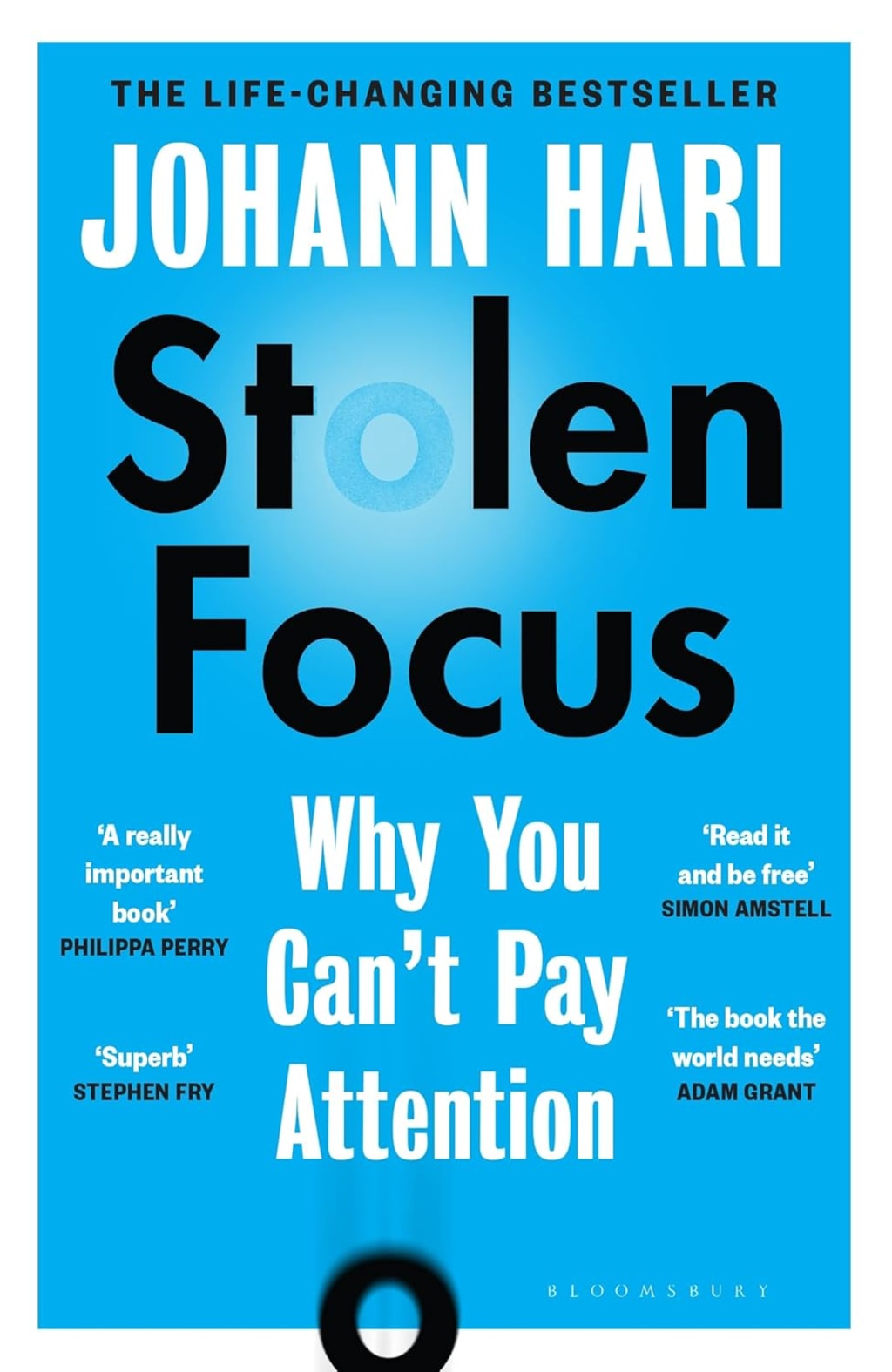
Book Review: "Stolen Focus" by Johann Hari
5/5 - a book that simply makes sense...

“We live in a culture that is constantly amping us up with stress and stimulation.”
- "Stolen Focus" by Johann Hari
Yes I'm reading more by this controversial journalist. I believe that perhaps Johann Hari is trying to make a point and I am aware that he often cherry-picks facts thank you very much Alex Edmans. However, I think we should also be aware that he probably makes some good points even though they are a little bit obvious from time to time. The enjoyability of reading a Johann Hari book is basically that if you have more than half a brain to think about these things - you can basically say to yourself, "yes, I was right all along!" But let's not get ahead of ourselves. Let's take a good look at what he's really talking about here. From the ultra-processed food revolution that plagued the childhoods of millennials like myself to the sinister intentions of 'surveillance capitalism' that is now making its way into our homes, maybe "Don't Be Evil" is not really the tagline big-tech companies want to be taking since they have become a huge slice of the problem.
The book begins with Hari’s realisation of his own inability to concentrate. He shares a personal story about leaving his phone at home during a trip to Provincetown, Massachusetts, a deliberate attempt to reconnect with his own focus. The experiment proves both illuminating and unsettling as Hari begins to uncover the depth of his own attention problems and reflects on how widespread these issues have become in society. This sets the stage for a broader exploration of the causes and consequences of our diminishing focus. Again, I think I have said this before but I don't like the amount of time he spends talking about himself in his books because I will be perfectly honest as a reader - we don't care about him, we care about the argument he is making. He defers the argument by filling it with weird anecdotes that at times don't even sound like they happened because they are too conveniently fitting for the very particular argument he is making at the time.
Hari draws upon a wealth of psychological and neuroscientific research to outline how our attention has been hijacked by forces far beyond our individual control. Central to his argument is the role of technology, particularly social media platforms, in exploiting our cognitive vulnerabilities. He explains how tech companies have designed their platforms to keep users hooked, using algorithms that maximise engagement at the expense of mental clarity. The “attention economy,” as Hari describes it, is an industry predicated on distraction, where the primary goal is to monetise every second of our focus. Analysing the two different sides of this in which one says that this is being overstated and the says it is being understated is something that perhaps is not one of the things we usually encounter in Hari's writing but here we are. It was wonderfully written and incredibly interesting even though yes, it is an argument we are hearing over and over again and yet nobody is doing anything about it.
One of the book’s strengths lies in its exploration of the biological underpinnings of attention. Hari delves into the science of dopamine, a neurotransmitter associated with pleasure and reward, and explains how the constant pings, notifications, and updates we receive online trigger dopamine hits. These intermittent rewards create a cycle of addiction that makes it increasingly difficult to sustain focus on less immediately gratifying tasks, such as reading a book or having a deep conversation. Hari critiques this manipulation of our neurobiology, arguing that it has profound implications for mental health, creativity, and interpersonal relationships. Unfortunately, if you have watched all those weird documentaries by people who once worked at Google, then this is a fairly obvious point as well. Though it was enjoyable reading, I didn't see any difference to what everyone else has been saying since about 2018. I have to say though, the main plus is the link he makes between the sociological and the biological - an argument I don't think I've seen before.

However, Hari does not lay the blame solely on technology. He takes a holistic approach, examining a multitude of societal factors that contribute to the attention crisis. One key issue is the modern workplace, where employees are expected to multitask and remain perpetually available, often at the cost of deep, focused work. Hari interviews productivity experts and workers across industries to illustrate how the cult of busyness has eroded our ability to concentrate, fostering a culture where shallow work is prioritised over meaningful, sustained effort.
Another significant factor is the decline in reading for pleasure. Hari laments the fact that long-form reading—a practice essential for cultivating deep focus—has been replaced by quick skimming and fragmented online browsing. He connects this trend to broader educational and cultural shifts, highlighting how attention spans are shrinking in younger generations who are growing up immersed in digital media. This is the one that hit me the hardest. The decline in reading for pleasure is something that kind of makes me sick to see. I truly wish that as many people as physically possible could enjoy reading but, I also notice that the decline in this activity has been designed to keep us focused on the online fragmented and short-form world. Therefore, as you and I read for pleasure we can definitely say we are committing a revolutionary act.

One of the people he interviews in this book which is very interesting is Aza Raskin - the man who invented 'infinite scroll' who has now basically become Victor Frankenstein in which he recognises that what he has created has been horrifying for humanity. Another person he interviews is Tristan Harris, a former Google Design ethicist. Throughout all these different interviews and anecdotes he adds, the structure of the book becomes more wild with each topic covered. But one thing remains thoroughly true: what has been done has been done absolutely, positively on purpose in order to control an entire population of people during a time when more and more people were becoming more and more liberated.
All in all, I think this book, though it still has some data issues, is an important read for anyone getting started in the genre I like to call 'what the hell happened?' or, here's another one: 'it used to be called dystopia, but here the hell we are...' Pick it up. Give it a go and perhaps, it might change the way you see things.
About the Creator
Annie Kapur
I am:
🙋🏽♀️ Annie
📚 Avid Reader
📝 Reviewer and Commentator
🎓 Post-Grad Millennial (M.A)
***
I have:
📖 280K+ reads on Vocal
🫶🏼 Love for reading & research
🦋/X @AnnieWithBooks
***
🏡 UK
Keep reading
More stories from Annie Kapur and writers in Geeks and other communities.
The Driver's Seat by Muriel Spark
Note: This is not an opinion article, it is analysis. If you would like to read my review then click here. This book was written by the acclaimed Scottish author Muriel Spark and published in 1970. The novella marked a distinctive entry in Spark's impressive literary career, notable for its departure from traditional narrative styles and its exploration of darker themes. The author, known for her sharp wit and keen psychological insights, delved into the psychological thriller genre with this work, creating a story that is both compelling and disturbing.
By Annie Kapur12 months ago in Geeks
The Rachels - 2025
Much to my surprise, I have kept a list of the films I‘ve seen this year. I daresay it isn’t complete. There will be films that snuck in on a late night in front of the TV that I would’ve forgotten to note. Or others, that I went to watch at the cinema, but then had a red wine and promptly forgotten about. But it’s not a bad approximation of the films I’ve seen this year. In total, there are 53 films listed, so an average of one a week and one for good luck.
By Rachel Robbins26 days ago in Geeks
Can you watch Super Bowl in Australia?
Super Bowl, one of the most exciting sporting nights of the year, is now less than a month away and the excitement is already palpable. Scheduled on February 8, 2026 at Levi’s Stadium in Santa Clara, California, this will be the third Super Bowl held in the San Francisco Bay Area.
By David Cooka day ago in Geeks



Comments (1)
Nice work, loved the ending!